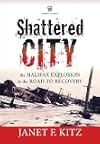
Shattered City: The Halifax Explosion and the Road to Recovery
by Janet F. Kitz
On This Page
Description
This book, the most comprehensive ever written on the Explosion, details the terrific devastation, the aftermath and the restoration. It encompasses dozens of previously unpublished stories, photographs, and documents, along with some thought-provoking coverage of the inquiry into the disaster. A best- selling book from its first printing in 1989, this new edition has an updated cover and is sure to be a must-have for readers.Tags
Recommendations





















Member Reviews
First sentence: My interest in the Halifax Explosion began in 1980, sparked by research for an anthropology paper at Saint Mary's University.
Premise/plot: Shattered City is a nonfiction book for adults about the Halifax explosion (which occurred on December 6, 1917). It starts off by explaining the research process and project. Talking about the ways information for the book was gathered and collected, what resources were examined. It then begins chronicling the event. The section of the book that chronicled the day of the disaster was intense yet intriguing. It was packed with what appear to be firsthand accounts. This section is where there is a human element. It isn't so much that there's a consistent cast of [real life] characters show more to follow, but even spending a few paragraphs with a family is something more personal. The 'aftermath' section which is "the road to recovery," is perhaps less personal, less human-interest, more facts and statistics. (Though not always.) For example, reading about the reconstruction of houses, streets, neighborhoods is less personal and more matter-of-fact. Or reading about the weekly allotment of financial assistance to buy food and how that was determined. But there were also updates on schools for the blind and how adults and children were learning or relearning necessary skills for beginning to live life again. So there were occasional moments of high interest.
My thoughts: This book should NOT be confused with a movie with the same name. That is how I came across this book. It is not the author's fault--nor the book's fault--that the movie about the Halifax explosion shares the same name. The movie chronicles ONE family and a small cast of characters. It builds up to the explosion over several days. You get attached to the characters. There is intensity and suspense. There is heartbreak. It is super-absorbing and compelling. This book....isn't. The first part is definitely more interesting than the second part. But it is also very technical. I'm not expressing it in the right words. Human interest. This one doesn't always stay focused on a 'human interest' perspective. The facts may be of great interest to the right reader. But if you care more about people than supplies of food or lumber...then you might find yourself a bit bored now and then. show less
Premise/plot: Shattered City is a nonfiction book for adults about the Halifax explosion (which occurred on December 6, 1917). It starts off by explaining the research process and project. Talking about the ways information for the book was gathered and collected, what resources were examined. It then begins chronicling the event. The section of the book that chronicled the day of the disaster was intense yet intriguing. It was packed with what appear to be firsthand accounts. This section is where there is a human element. It isn't so much that there's a consistent cast of [real life] characters show more to follow, but even spending a few paragraphs with a family is something more personal. The 'aftermath' section which is "the road to recovery," is perhaps less personal, less human-interest, more facts and statistics. (Though not always.) For example, reading about the reconstruction of houses, streets, neighborhoods is less personal and more matter-of-fact. Or reading about the weekly allotment of financial assistance to buy food and how that was determined. But there were also updates on schools for the blind and how adults and children were learning or relearning necessary skills for beginning to live life again. So there were occasional moments of high interest.
My thoughts: This book should NOT be confused with a movie with the same name. That is how I came across this book. It is not the author's fault--nor the book's fault--that the movie about the Halifax explosion shares the same name. The movie chronicles ONE family and a small cast of characters. It builds up to the explosion over several days. You get attached to the characters. There is intensity and suspense. There is heartbreak. It is super-absorbing and compelling. This book....isn't. The first part is definitely more interesting than the second part. But it is also very technical. I'm not expressing it in the right words. Human interest. This one doesn't always stay focused on a 'human interest' perspective. The facts may be of great interest to the right reader. But if you care more about people than supplies of food or lumber...then you might find yourself a bit bored now and then. show less
An excellent read about one of the largest man-made explosions in history. If you haven't heard of the Halifax Explosion, it was a disaster that occurred on December 6, 1917, in the harbour of Halifax, Nova Scotia, Canada. A Belgian relief vessel, the Imo, collided with the French Mont Blanc, which was carrying an impressive array of explosives. (I can't remember the details, but my highly technical appraisal of the description was "that is a LOT of explosives.") Unfortunately relatively few people knew what exactly was on the Mont Blanc, so when she blew up, a lot of people were severely injured in the blast just because they were so close, standing along the shore to watch the fire, or because they happened to be standing at the show more window and then the window imploded toward them. (That's one of the really horrific things about the aftermath of the explosion: the eye injuries. One girl in hospital encountered a bucket full of human eyes that had been removed from luckless victims.) This book describes in great detail the events leading up to the explosion, the aftermath and its impact on the survivors, and the relief efforts that endeavoured to put Haligonians back on their feet.
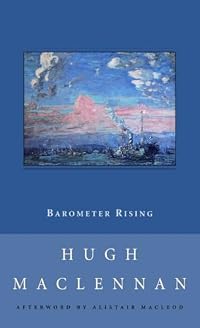
This book is very well researched and obviously has been put together with great care. Because it was written in the 1980s, the author had greater access to actual survivors (i.e. more of them were still alive), and their experiences really bring the story home. Survivors told of standing in one spot just before the ship blew up and a few minutes later woke up to find themselves miles away. A miracle baby survived because she landed up under the stove and was sheltered by the ash pan. A schoolboy survived because his satchel took the brunt of some debris. Some lost eyes, others nearly lost arms, and pretty much every family in Halifax lost a few relatives. And for you CanLit devotees out there, you will note a cameo appearance by none other than Hugh MacLennan, who immortalized the explosion in the very excellent Barometer Rising.
When the book turned to discussions of the relief effort, I was actually quite choked up by the generosity of the people of Massachusetts, and all the efforts that were made to ensure that the kids would still have a decent Christmas. Later chapters on the inquiry into the events leading up to the explosion were interesting from a technical standpoint although they will likely not enthrall every reader.
All in all, this is probably one of the best books out there about the explosion. If you're interested in Canadian history, especially in WW1, or if you've read Barometer Rising and want to know the story behind the story, pick this one up. show less
This book is very well researched and obviously has been put together with great care. Because it was written in the 1980s, the author had greater access to actual survivors (i.e. more of them were still alive), and their experiences really bring the story home. Survivors told of standing in one spot just before the ship blew up and a few minutes later woke up to find themselves miles away. A miracle baby survived because she landed up under the stove and was sheltered by the ash pan. A schoolboy survived because his satchel took the brunt of some debris. Some lost eyes, others nearly lost arms, and pretty much every family in Halifax lost a few relatives. And for you CanLit devotees out there, you will note a cameo appearance by none other than Hugh MacLennan, who immortalized the explosion in the very excellent Barometer Rising.
When the book turned to discussions of the relief effort, I was actually quite choked up by the generosity of the people of Massachusetts, and all the efforts that were made to ensure that the kids would still have a decent Christmas. Later chapters on the inquiry into the events leading up to the explosion were interesting from a technical standpoint although they will likely not enthrall every reader.
All in all, this is probably one of the best books out there about the explosion. If you're interested in Canadian history, especially in WW1, or if you've read Barometer Rising and want to know the story behind the story, pick this one up. show less
A well written account of the Halifax Explosion. The author interviewed survivors of this disaster while they were still alive, and has written a riveting account of that day, and the days that followed. a must read for anyone interested in Canadian history.
There's an interesting story here, but sadly, the book is written as a simple recitation of facts and figures. There are a lot of people here with some fascinating stories to tell, but even when the author tries to get in close for a good look at someone, she seems unable to really empathize with her subjects. While the story is intriguing, the delivery of it is not.
A comprehensive reconstruction of the Halifax Harbour Explosion of 12/6/1917 and all the related events that followed; investigation, aid to persons affected, reconstruction, prosecution, and personal stories. I found this book to be well written and objective. It was a tough story to tell because so many people died and suffered extreme loss of family & property but it also told of the strength of the survivors and the communities that were dedicated to restore their health and lifestyles.
This is a detailed, pieced together telling of the massive explosion in Halifax, Nova Scotia in 1917. It was interesting, for the most part, and covered multiple facets of the disaster, including personal stories, finances, the recovery, the evaluation of the event.
A fascanating account of the Halifax explosion that took place in 1917 when a munitions ship and a hospital ship collided in Halifax Harbour. Around 1600 people died on that day with thousands more injured and a large part of Halifax destroyed. It was the biggest man-made explosion prior to the nuclear age and yet, outside Canada, hardly anyone has heard of it.
Members
- Recently Added By
Lists

Disaster Books
74 works; 19 members
Author Information
5 Works 146 Members
Common Knowledge
- Original publication date
- 1989
- Important places
- Halifax, Nova Scotia, Canada; Nova Scotia, Canada; Canada
- Important events
- Halifax Explosion (1917)
- Dedication
- To the survivors, to those who suffered loss and deprivation, and to those who dropped everything to rush to their aid.
To my husband, Leonard, for his understanding. - First words
- On Saturday, December 1, 1917, at 11:00 p.m., the Mont Blanc, under cover of darkness, slipped out of Gravesend Bay in New York Harbour.
- Last words
- (Click to show. Warning: May contain spoilers.)The tower and its bells are a permanent memorial not only to the Orr family but also to the men, women, and children who were killed, to the identified and unidentified, to those who were never found, to the maimed, the blinded, the orphaned, to the thousands who lost loved ones, homes, and possessions in the Halifax Explosion of December 6, 1917. (Epilogue)
Classifications
Statistics
- Members
- 99
- Popularity
- 324,847
- Reviews
- 7
- Rating
- (3.86)
- Languages
- English
- Media
- Paper, Ebook
- ISBNs
- 6
- ASINs
- 3