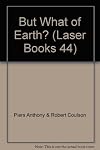
But What of Earth?
by Piers Anthony
On This Page
Description
Science-fiction, autobiography, and a candid, witty send-up of the publishing industry combine in a wild adventure of a novel that winds up in the wrong hands.Tags
Recommendations









Member Reviews
A really long time ago, an evil Editor and a bunch of Moron Copy Editors ruined Piers Anthony's book. He's still super pissed about it, so has re-written the whole thing and included footnotes in which he tells us what these people wrote in the margins of his manuscript and argues back at them. He comes off as insulting and bitter, even though the other people come off as stupid meddlers. The story itself is pretty average, but better than the version that was actually published.
High rating for really everything a reader looks for --experience, grace, escape, reflection, insight. And for that subtle advantage one has over non-readers. Piers Anthony delivers all, in space.
His wonderful first-person idiosyncratic "Introduction", braces us for the two parts of the book: The first is the "story", and the 2d part, presented entirely in Endnotes, is a detailed manual on the publishing world of the 1970's period in which this book and the larger series it engages, was written.
The story, Piers Anthony explains, was worked up from the notion that "the level of civilization in the world may be governed by population". [7] He reminds us of the experiment done with mice--they multiply, and even if you do your best to show more provide ample food and a pleasant environment, their own numbers will result in nasty behaviors. As population increases, so does fighting. Those who survive overcrowding are not sweet and gentle, even when food and resources are provided.[212] But what if Earth was depopulated by an entirely peaceful event? Here, by "instantaneous transmission" of volunteers -- emigration to remote colonies.
Those of us dimly or brightly aware of the rat-paradise experiment and the Malthusian imperatives dictated by breeding, will find the author's topic relevant and his insights valuable. show less
His wonderful first-person idiosyncratic "Introduction", braces us for the two parts of the book: The first is the "story", and the 2d part, presented entirely in Endnotes, is a detailed manual on the publishing world of the 1970's period in which this book and the larger series it engages, was written.
The story, Piers Anthony explains, was worked up from the notion that "the level of civilization in the world may be governed by population". [7] He reminds us of the experiment done with mice--they multiply, and even if you do your best to show more provide ample food and a pleasant environment, their own numbers will result in nasty behaviors. As population increases, so does fighting. Those who survive overcrowding are not sweet and gentle, even when food and resources are provided.[212] But what if Earth was depopulated by an entirely peaceful event? Here, by "instantaneous transmission" of volunteers -- emigration to remote colonies.
Those of us dimly or brightly aware of the rat-paradise experiment and the Malthusian imperatives dictated by breeding, will find the author's topic relevant and his insights valuable. show less
I found this to be an enlightening book, both as a fiction piece and as an example of what can happen if one does not be careful as to what changes they allow an editor to run through on a book or other piece for publication. The story follows the time line of a man during a time when colonization of other planets is released to the public and just what happens to Earth as it flows. The story itself has some interesting spots. The more interesting part for me was the commentary by the author of what happened after he submitted it to the publisher by the six (!!!) Copyeditors. For writers, I recommend reading this for the information. For others, I recommend reading it for the information the story presents as something to think about.
Interesting; includes description of the unpleasant editing process for this book.
Ratings
Members
- Recently Added By
Author Information

Piers Anthony Dillingham Jacob was born in August, 1934, in Oxford, England. He graduated from Goddard College in Vermont in 1956. He became a naturalized U.S. citizen while serving in the United States Army in 1958. He served in the U.S. Army from 1957-1959. In 1977, he received a British Fantasy Award for A Spell for a Chameleon. Anthony's show more family emigrated to the United States from Britain when he was six. Highly popular because of his science fiction and fantasy works, Anthony is also known for the Jason Striker series and martial arts novels co-written with Roberto Fuentes. A highly prolific author, Anthony's other works include Bio of a Space Tyrant, Cluster, and the Omnivore series. Anthony makes his home in Tampa, Florida. He also writes under the pseudonym Robert Piers. (Bowker Author Biography) show less
All Editions
Common Knowledge
- Canonical title
- But What of Earth?
- Original publication date
- 1976 (Collaboration with Robert Coulson) (Collaboration with Robert Coulson); 1989 (Anthony's original republished) (Anthony's original republished)
- Important events
- Colonization of other planets
- Disambiguation notice
- The first printing by Laser Books (ISBN 0-373-72044-0) was a "collaboration" between Piers Anthony and Robert Coulson; the later printings had only the original text of Piers Anthony and a substantial running commentary on th... (show all)e printing process and how his text got abused in the first printing. Please do not combine with the 0812530985 or the 0606111778 ISBNs.
Classifications
Statistics
- Members
- 359
- Popularity
- 87,405
- Reviews
- 4
- Rating
- (3.28)
- Languages
- English
- Media
- Paper
- ISBNs
- 2
- ASINs
- 1