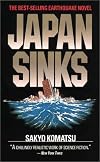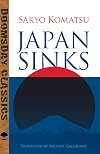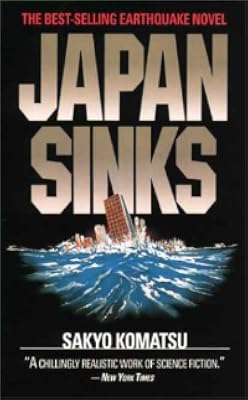
Japan Sinks: A Novel about Earthquakes
by Sakyo Komatsu
On This Page
Description
"A chillingly realistic work of science fiction." ― The New York Times. After dropping anchor for the night near a small island to the south of Japan, a crew of fishermen awaken to find that the island has vanished without a trace. An investigating scientist theorizes that the tiny island has succumbed to the same force that divided the Japanese archipelago from the mainland ― and that the disastrous shifting of a fault in the Japan Trench has placed the entire country in danger of being show more swallowed by the sea. Based on rigorous scientific speculation, Japan Sinks recounts a completely credible series of geological events. The story unfolds from multiple points of view, offering fascinating perspectives on the catastrophe's political, social, and psychological effects. Winner of the Mystery Writers of Japan Award and the Seiun Award, this prescient 1973 science-fiction novel foreshadowed the consequences of the 1995 Osaka-Kobe earthquake and the 2011 Tohoku earthquake and tsunami. show lessTags
Recommendations































Member Reviews
Disaster film in book form. I like how it unfolded but the portrayal of women and sex was very off-putting. On the plus side of the sexism, there were only about three women briefly in the book so the weirdness was rather limited. Yay? Would have gotten more out of the book if I knew more about the geography of Japan - my knowledge is mostly limited to the northern parts. Also, I feel knowledge of kimono patterns and symbolism would have helped. The very Japanese reaction to the disaster did make this an interesting read but the end (with the dragon metaphor, weird nudity request, etc) was a bit eye-rolling to me and dropped this half a star. Reminded me a lot of The Meg, particularly at the beginning, which isn't exactly a ringing show more endorsement. show less
Sakyo Komatsu is considered to be one of Japan's masters of science fiction and is highly regarded as an author. Probably his most well-known and influential work was Japan Sinks, an earthquake disaster novel that he wrote between 1964 and1973. Published in Japan in 1973, Japan Sinks earned Komatsu both a Mystery Writers of Japan Award and a Seiun Award. The novel has since inspired a sequel (which Komatsu coauthored with Kōshū Tani), two live-action films, a television series, and even a manga adaptation by Takao Saito. Michael Gallagher's abridged English translation of the novel was first published by Harper & Row in 1976 and became the basis for translations in eleven more languages. Kodansha International brought the novel back show more into print in 1995 with an additional author's note from Komatsu. Unfortunately, that edition has gone out of print as well and Japan Sinks is now somewhat difficult to find--a shame for such a notable work.
Earthquake and tsunamis are not unusual occurrences in Japan. They are something that the country has faced for centuries and has made preparations to deal with. But an increase in seismic and volcanic activity has many scientists concerned, especially when an entire island off the southern coast of Japan disappears over night. An investigation is subsequently launched into the incredible event. As hard as it is to believe, the island has sunk. What is even more terrifying is the discovery of unprecedented tectonic plate movements that will result in increasingly violent and destructive earthquakes and volcanic eruptions. It is theorized that within a few years the entire Japanese archipelago will be lost. The real question is what can be done about Japan's impending doom. The geological event cannot be stopped, but no one wants to believe that it will actually happen, either.
The narrative in Japan Sinks is a bit disjointed, particularly early on in the novel. I assume this is at least in part due to the abridgement, but I'm not entirely sure how much or even what was cut from the original Japanese edition of Japan Sinks. The beginning of the novel seems like a sequence of scenes that aren't directly related, but most are eventually revealed to be needed for the story as a whole. It's as if the connecting material is missing, though. However, as the novel progresses, the disparate story elements are tied together. By the end of Japan Sinks the only things that seemed tacked on and largely unnecessary were the romantic subplots; I can only imagine that these were more thoroughly developed in the original, but once again I'm not certain. For the most part, the unconnected nature of the storytelling was only a minor annoyance.
Although the narrative is somewhat fragmented, there is one thing that Komatsu excels at in Japan Sinks--he takes into consideration all aspects of the impending crisis in a very realistic way. The story is solidly based in real science, which makes it all the more terrifying. Komatsu explores the political maneuverings, both national and international, that are involved in dealing with the disaster as well as its economic implications. The scope of Japan Sinks is both global and personal, but I found the novel to be most engaging when it focused on the experiences of individuals. Granted, these sections were so effective because they took place within a greater context. Widespread death and destruction takes on more significance when it is known what it means for a single person as well as for a country as a whole. Japan Sinks addresses all of these issues and as a result the novel is a chilling account.
Experiments in Manga show less
Earthquake and tsunamis are not unusual occurrences in Japan. They are something that the country has faced for centuries and has made preparations to deal with. But an increase in seismic and volcanic activity has many scientists concerned, especially when an entire island off the southern coast of Japan disappears over night. An investigation is subsequently launched into the incredible event. As hard as it is to believe, the island has sunk. What is even more terrifying is the discovery of unprecedented tectonic plate movements that will result in increasingly violent and destructive earthquakes and volcanic eruptions. It is theorized that within a few years the entire Japanese archipelago will be lost. The real question is what can be done about Japan's impending doom. The geological event cannot be stopped, but no one wants to believe that it will actually happen, either.
The narrative in Japan Sinks is a bit disjointed, particularly early on in the novel. I assume this is at least in part due to the abridgement, but I'm not entirely sure how much or even what was cut from the original Japanese edition of Japan Sinks. The beginning of the novel seems like a sequence of scenes that aren't directly related, but most are eventually revealed to be needed for the story as a whole. It's as if the connecting material is missing, though. However, as the novel progresses, the disparate story elements are tied together. By the end of Japan Sinks the only things that seemed tacked on and largely unnecessary were the romantic subplots; I can only imagine that these were more thoroughly developed in the original, but once again I'm not certain. For the most part, the unconnected nature of the storytelling was only a minor annoyance.
Although the narrative is somewhat fragmented, there is one thing that Komatsu excels at in Japan Sinks--he takes into consideration all aspects of the impending crisis in a very realistic way. The story is solidly based in real science, which makes it all the more terrifying. Komatsu explores the political maneuverings, both national and international, that are involved in dealing with the disaster as well as its economic implications. The scope of Japan Sinks is both global and personal, but I found the novel to be most engaging when it focused on the experiences of individuals. Granted, these sections were so effective because they took place within a greater context. Widespread death and destruction takes on more significance when it is known what it means for a single person as well as for a country as a whole. Japan Sinks addresses all of these issues and as a result the novel is a chilling account.
Experiments in Manga show less
Japan Sinks is sort of the literary equivalent of the big disaster movie, like The Day After Tomorrow, or 2012. The cause of the catastrophe is a force of nature, and the story focuses primarily on how humanity responds to the destruction, in this case the literal sinking of Japan. In particular, the focus is somewhat on how Japan would respond to a catastrophe like this one, and also how the international community would respond, considering Japan's cultural xenophobia and how spectacularly Japan had managed to PO large portions of the international community in the past.
My complaint with the book is due to its length, it never really spends enough time on any of those points - the personal tragedies, the societal response, or the show more diplomatic response. show less
My complaint with the book is due to its length, it never really spends enough time on any of those points - the personal tragedies, the societal response, or the show more diplomatic response. show less
Story: 6 / 10
Characters: 5
Setting: 10
Prose: 4
Consider skipping this "quintessential" Japanese science-fiction novel. I came across it on a Top 10 Japanese SF list, which also included 2 other books by Komatsu. However, neither the prose nor the story structure are very strong. Only the story concept is interesting. But what good is a concept without the execution?
Certainly don't read this book before going to Japan for the first time...
Characters: 5
Setting: 10
Prose: 4
Consider skipping this "quintessential" Japanese science-fiction novel. I came across it on a Top 10 Japanese SF list, which also included 2 other books by Komatsu. However, neither the prose nor the story structure are very strong. Only the story concept is interesting. But what good is a concept without the execution?
Certainly don't read this book before going to Japan for the first time...
Totally readable! Weirdly dated in ways I'm not quite able to place.
Slightly longer review on Positron:
https://www.positronchicago.com/2020/03/japan-sinks-by-sakyo-komatsu.html
Slightly longer review on Positron:
https://www.positronchicago.com/2020/03/japan-sinks-by-sakyo-komatsu.html
Enjoyably Good
Der Titel verrät ja leider schon worum es geht, aber allein bis feststeht, dass Japan überhaupt sinkt, vergehen leider (gefühlt) viel zu viele Seiten, die man mit einem U-Boot auf dem Meeresgrund verbringt oder bei irgendwelchen Besprechungen. Nachdem ich mich aber durch diese Seiten gekämpft hatte, hat mich auf eine gruselige Art fasziniert, wie detailreich der Autor sich das Sinken Japans vorgestellt hat und das bereits in den 70ern. Es ist, als hätte er die Bilder, die dieses Jahr über die Fernsehbildschirme gingen, in Worte gefasst. Somit ist dieses Buch für mich, obwohl es am Anfang zäh zu lesen war, ein Buch geworden, dass mir doch noch eine Weile im Gedächtnis bleiben wird.
Nov 11, 2011German
Members
- Recently Added By
Lists

Best Post-Apocalyptic Stories
143 works; 88 members

SF & Fantasy in Translation
95 works; 18 members
Best Science Fiction Originally Published in a Language Other Than English
449 works; 34 members

Speculative Fiction from around the World
610 works; 18 members

science fiction
17 works; 1 member

books that have been adapted for film or stage
27 works; 1 member
Author Information

37+ Works 262 Members
Awards and Honors
Awards
Series
Belongs to Publisher Series
Delta Science Fiction (114)
Common Knowledge
- Canonical title*
- Гибель дракона
- Original title
- Nippon Chinbotsu (日本沈没) (日本沈没)
- Original publication date
- 1972
- Related movies
- 日本沈没 Nihon Chinbotsu - Tidal Wave - Submersion of Japan (1973); 日本沈没 Nihon Chinbotsu - Sinking of Japan (2006); 日本以外全部沈没 Nihon Igai Zenbu Chinbotsu - Everything Other than Japan Sinks (2006)
- Dedication
- This translation is for Rosemary and Maureen
-Michael Gallagher (New English Library 1977) - First words
- The area around the rear entrance of Tokyo Station was crowded as always.
- Last words
- (Click to show. Warning: May contain spoilers.)The train sped westward, plunging ever deeper into the chill darkness of an early winter.
- Original language
- Japanese
*Some information comes from Common Knowledge in other languages. Click "Edit" for more information.
Classifications
- Genres
- Fiction and Literature, Science Fiction
- DDC/MDS
- 895.63 — Literature & rhetoric Literatures of other languages Literatures of East and Southeast Asia Japanese Japanese fiction
- LCC
- PL855 .O414 .N5613 — Language and Literature Languages and literatures of Eastern Asia, Africa, Oceania Languages of Eastern Asia, Africa, Oceania Japanese language and literature Japanese literature Individual authors and works
- BISAC
Statistics
- Members
- 158
- Popularity
- 207,120
- Reviews
- 8
- Rating
- (3.16)
- Languages
- 9 — English, French, German, Hungarian, Japanese, Polish, Russian, Spanish, Swedish
- Media
- Paper, Ebook
- ISBNs
- 13
- UPCs
- 1
- ASINs
- 3