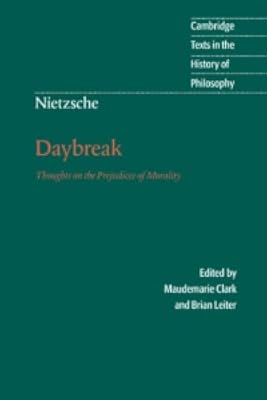
Daybreak: Thoughts on the Prejudices of Morality
by Friedrich Nietzsche 
On This Page
Description
Daybreak marks the arrival of Nietzsche's 'mature' philosophy and is indispensable for an understanding of his critique of morality and 'revaluation of all values'. This volume presents the distinguished translation by R. J. Hollingdale, with a new introduction that argues for a dramatic change in Nietzsche's views from Human, All Too Human to Daybreak, and shows how this change, in turn, presages the main themes of Nietzsche's later and better-known works such as On the Genealogy of show more Morality. The main themes of Daybreak are located in their intellectual and philosophical contexts: in Nietzsche's training as a classical philologist and his fascination with the Sophists and Thucydides; in the moral philosophies of Kant and Schopenhauer, which are the central foci of Nietzsche's critique of morality; and in the German Materialist movement of the 1850s and after, which shaped Nietzsche's conception of persons. The edition is completed by a chronology, notes and a guide to further reading. show lessTags
Recommendations

























Member Reviews
A book such as this is not for reading straight through or reading aloud but for dipping into, especially when out walking or on a journey; you must be able to stick your head into it and out of it again and again and discover nothing familiar around you. —Daybreak, Book V, 454
Daybreak (1881) is prime mid-period Nietzsche, part of the so-called free-spirit trilogy between Human, All Too Human and The Joyous Science. You can feel Nietzsche thinking his way past Dionysus, Schopenhauer, and Wagner, without presuppositions, to whatever was coming next.
There are many kinds of daybreaks.
The 1982 R.J. Hollingdale translation is a fun read, and a great improvement over the stiff and dusty 1911 John McFarland Kennedy translation that I saw show more online. Foregoing ‘system’ for ‘style,’ Nietzsche wrote Daybreak as a set of 575 aphorisms, some a line or two long, some a few pages — cut and polished nuggets from his notebooks, pushing light in all directions. He claims the right to change his mind, maligns ‘the half-and-halfness of all romanticism and fatherland-worship,’ swats at ‘the fog of habits and opinions,’ and derides political and economic affairs as ‘a wasteful use of the spirit.’
The flipside of Nietzsche’s critique of ‘the peoples’ and their preoccupations (‘intoxication means more to them than nourishment’) is his affirmation of solitude.
A: So you intend to return to your desert?
B: I am not quick moving, I have to wait for myself. It is always late before the water comes to light out of the well of myself, and I often have to endure thirst for longer than I have patience. That is why I go into solitude — so as not to drink out of everybody's cistern. When I am among the many I live as the many do, and I do not think as I really think; after a time it always seems as though they want to banish me from myself and rob me of my soul — and I grow angry with everybody and fear everybody. I then require the desert, so as to grow good again.
I know what he means. Even long dead, the man is a goddamned inspiration.
Let us pass by! — Spare him! Leave him in his solitude! Do you want to break him completely to pieces? He has sprung a leak, like a glass into which something too hot has suddenly been poured — and he was such a precious glass! show less
Daybreak (1881) is prime mid-period Nietzsche, part of the so-called free-spirit trilogy between Human, All Too Human and The Joyous Science. You can feel Nietzsche thinking his way past Dionysus, Schopenhauer, and Wagner, without presuppositions, to whatever was coming next.
There are many kinds of daybreaks.
The 1982 R.J. Hollingdale translation is a fun read, and a great improvement over the stiff and dusty 1911 John McFarland Kennedy translation that I saw show more online. Foregoing ‘system’ for ‘style,’ Nietzsche wrote Daybreak as a set of 575 aphorisms, some a line or two long, some a few pages — cut and polished nuggets from his notebooks, pushing light in all directions. He claims the right to change his mind, maligns ‘the half-and-halfness of all romanticism and fatherland-worship,’ swats at ‘the fog of habits and opinions,’ and derides political and economic affairs as ‘a wasteful use of the spirit.’
The flipside of Nietzsche’s critique of ‘the peoples’ and their preoccupations (‘intoxication means more to them than nourishment’) is his affirmation of solitude.
A: So you intend to return to your desert?
B: I am not quick moving, I have to wait for myself. It is always late before the water comes to light out of the well of myself, and I often have to endure thirst for longer than I have patience. That is why I go into solitude — so as not to drink out of everybody's cistern. When I am among the many I live as the many do, and I do not think as I really think; after a time it always seems as though they want to banish me from myself and rob me of my soul — and I grow angry with everybody and fear everybody. I then require the desert, so as to grow good again.
I know what he means. Even long dead, the man is a goddamned inspiration.
Let us pass by! — Spare him! Leave him in his solitude! Do you want to break him completely to pieces? He has sprung a leak, like a glass into which something too hot has suddenly been poured — and he was such a precious glass! show less
Reflexões sobre os preconceitos morais prossegue no estilo aforístico da filosofia de Friedrich Nietzsche, inaugurado com Humano, demasiado humano (1878). Em 575 aforismos, cuja extensão varia de duas linhas a algumas páginas, Nietzsche elabora sua crítica da moral cristã-ocidental e dos conceitos a ela associados, como "alma", "Deus", "pecado", "sujeito" e "livre-arbítrio" e também o "dever", a "compaixão", a "utilidade" e muitos outros. No subtítulo do livro, a palavra "preconceito" é usada no sentido filosófico de concepção formada antes do julgamento (um "pré-juízo").
Ka shumë agime që nuk kanë zbardhur ende shkruan Niçe që në krye fare të kësaj vepre, duke cituar mendimtarin Rig Veda. Kjo bëhet udhëheqje për veprim. Në këtë libër do të gjeni mendime për paragjykimet morale, përcaktim i cili është edhe nëntitull i veprës "Agu i mëngjesit" dhe kjo duket se do të gjeni duke punuar një njeri nëntokësor, një njeri që shpon. Gërmon e gërryen. Do ta shihni atë, duke menduar që keni sy tgë aftë dhe depërtues për të parë këtë punë të thellësive - sesi shkon ngadalë përpara, me kujdes dhe me një papërkulshmëri të butë, pa u shqetësuar shumë për mjerimin që sjell me vete mungesa e gjatë e dritës dhe e ajrit, madje mund të quhet si një gjë e lumtur show more pikërisht kjo punë në errësirë!... show less
Alright as Nietzschean morality goes; not a fan of the misogyny and repetitiveness. Nietzsche hasn't found his big thesis yet, so in comparison to Gay Science, this book stumbles.
Interesting aphorisms, not as well known as some of his other works but insightful.
Nietzsche breekt in Morgenrood (1881) rigoureus met de westerse traditie. Hij doet verslag van zijn immorele onderneming om de fundamenten van de heersende moraal te bevragen en als een mol te ondergraven. Want zijn die fundamenten wel zo onaantastbaar als iedereen denkt? Zijn niet-aflatende `veldtocht tegen de moraal begint in dit boek met briljante dieptepsychologische analyses. Nietzsche probeert de herkomst van de moraal te achterhalen en de verzwegen belangen die eraan ten grondslag liggen. De vraag naar de verhouding tussen denken en moraal leidt vervolgens tot volslagen nieuwe perspectieven op de diepste drijfveren van de mens, de aard van zijn bewustzijn en de bronnen van het kennen. De `filosoof met de hamer profileert zich in show more Morgenrood bewust als verlichtingsdenker show less
Jan 9, 2017Dutch
Members
- Recently Added By
Author Information

1,379+ Works 78,202 Members
The son of a Lutheran pastor, Friedrich Wilhelm Nietzsche was born in 1844 in Roecken, Prussia, and studied classical philology at the Universities of Bonn and Leipzig. While at Leipzig he read the works of Schopenhauer, which greatly impressed him. He also became a disciple of the composer Richard Wagner. At the very early age of 25, Nietzsche show more was appointed professor at the University of Basel in Switzerland. In 1870, during the Franco-Prussian War, Nietzsche served in the medical corps of the Prussian army. While treating soldiers he contracted diphtheria and dysentery; he was never physically healthy afterward. Nietzsche's first book, The Birth of Tragedy Out of the Spirit of Music (1872), was a radical reinterpretation of Greek art and culture from a Schopenhaurian and Wagnerian standpoint. By 1874 Nietzsche had to retire from his university post for reasons of health. He was diagnosed at this time with a serious nervous disorder. He lived the next 15 years on his small university pension, dividing his time between Italy and Switzerland and writing constantly. He is best known for the works he produced after 1880, especially The Gay Science (1882), Thus Spake Zarathustra (1883-85), Beyond Good and Evil (1886), On the Genealogy of Morals (1887), The Antichrist (1888), and Twilight of the Idols (1888). In January 1889, Nietzsche suffered a sudden mental collapse; he lived the last 10 years of his life in a condition of insanity. After his death, his sister published many of his papers under the title The Will to Power. Nietzsche was a radical questioner who often wrote polemically with deliberate obscurity, intending to perplex, shock, and offend his readers. He attacked the entire metaphysical tradition in Western philosophy, especially Christianity and Christian morality, which he thought had reached its final and most decadent form in modern scientific humanism, with its ideals of liberalism and democracy. It has become increasingly clear that his writings are among the deepest and most prescient sources we have for acquiring a philosophical understanding of the roots of 20th-century culture. (Bowker Author Biography) show less
Friedrich Nietzsche has a Legacy Library. Legacy libraries are the personal libraries of famous readers, entered by LibraryThing members from the Legacy Libraries group.
Some Editions
Series
Belongs to Publisher Series
Work Relationships
Common Knowledge
- Canonical title
- Daybreak: Thoughts on the Prejudices of Morality
- Original title
- Morgenröte : Gedanken über die moralischen Vorurteile
- Original publication date
- 1881
- Epigraph
- "There are so many dawns that
have not yet broken."
Rig Veda - First words
- In this book you will discover a 'subterranean man' at work, one who tunnels and mines and undermines. You will see him - presupposing you have eyes capable of seeing this work in the depths - going forward slowly, cautious... (show all)ly, gently inexorable, without betraying very much of the distress which any protracted deprivation of light and air must entail; you might even call him contented, working there in the dark. Does it not seem as though some faith were leading him on, some consolation offering him compensation? As though he perhaps desires this prolonged obscurity, desires to be incomprehensible, concealed, enigmatic, because he knows what he will thereby also acquire: his own morning, his own redemption, his own daybreak?...
In this book you will find a "subterranean" at work, a tunneler, miner, underminer.
Classifications
Statistics
- Members
- 1,069
- Popularity
- 23,995
- Reviews
- 10
- Rating
- (4.18)
- Languages
- 19 — Czech, Danish, Dutch, English, Finnish, French, German, Greek, Hungarian, Italian, Lithuanian, Norwegian (Bokmål), Polish, Russian, Serbian, Spanish, Swedish, Turkish, Portuguese (Portugal)
- Media
- Paper, Audiobook, Ebook
- ISBNs
- 101
- ASINs
- 25