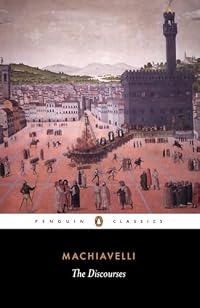
The Discourses
by Niccolò Machiavelli
On This Page
Description
Discourses on Livy is the founding document of modern republicanism, and Harvey C. Mansfield and Nathan Tarcov have provided the definitive English translation of this classic work. Faithful to the original Italian text, properly attentive to Machiavelli's idiom and subtlety of thought, it is eminently readable. With a substantial introduction, extensive explanatory notes, a glossary of key words, and an annotated index, the Discourses reveals Machiavelli's radical vision of a new science of show more politics, a vision of "new modes and orders" that continue to shape the modern ethos. "[Machiavelli] found in Livy the means to inspire scholars for five centuries. Within the Discourses, often hidden and sometimes unintended by their author, lie the seeds of modern political thought. . . . [Mansfield and Tarcov's] translation is careful and idiomatic."-Peter Stothard, The Times "Translated with painstaking accuracy-but also great readability."-Weekly Standard "A model of contemporary scholarship and a brave effort at Machiavelli translation that allows the great Florentine to speak in his own voice."-Choice. show lessTags
Recommendations




































Member Reviews
Considering the social and cultural landscape of the contemporary West, one cannot help but wonder whether we can pull out of our downward slide, and what are the odds of doing so.
An interesting analysis of this issue is provided by Machiavelli, in his "Discourses" (1517). In this deeply insightful book, a commentary on the work of the Roman historian Titus Livius (Livy), Machiavelli examines the ebb and flow of the Roman republic, applying its lessons to the affairs of his own era, and to the life of nations in general. (Note that this is the republican period of Rome, c. 510 - 44 BC, before the advent of the great emperors.)
Let's start with the bad news. Machiavelli is not particularly optimistic about a country's ability to adapt to show more new circumstances:
"There are two reasons why we are unable to change when we need to: In the first place, we cannot help being what nature has made us; in the second, if one style of behavior has worked well for us in the past, we cannot be persuaded we would be better off acting differently. The consequence is that one's fortune changes, for the times change, and one's behavior does not. Another consequence is that cities are destroyed, for the institutions of a republic are never modified to suit changing circumstances...Change comes too late because it is too difficult to accomplish."
If that weren't enough of an obstacle, we are also subject to the whims of fortune; i.e., to circumstances that are beyond our control:
"If you will think sensibly about how people's lives are shaped, you will see that often events and accidents occur against which the heavens were determined we should have no protection. Seeing this sort of thing happened to the Romans, who were so skillful, pious, and well-organized, it is not surprising that it happens much more often to cities or regions who lack these advantages."
Machiavelli goes on to relate Livy's account of Rome's near-demise following an invasion from southern France, which wasn't repelled until the barbarians were threatening the Capitol itself. The Romans, at that time still relatively vulnerable, could not pull together until their very heart was threatened:
"Fortune, in order to make Rome all the greater and build her up to the power she eventually attained, judged it necessary to give her a nasty shock...but did not want, at this point, to destroy her completely...In order to bring [change] about, the whole society must feel endangered; it is not enough for just one individual to change his mind."
It doesn't require much imagination to apply this wisdom to the contemporary West. Consider the mass immigration from the Third World, leading, in some European countries, to a now-foreseeable usurpation of the native population and culture. It is likely that only a shock of great magnitude would be capable of stalling this locomotive. One can only hope that, as was the case with the Roman republic, "fortune" does not intend to destroy us completely.
There are, still, many things that can be done to stave off ruin, says Machiavelli. It is not inevitable. But the task is great, and can only be accomplished by the clarion call of first principles. This is the subject of the chapter entitled "On how, if you want a movement or state to survive for long, you must repeatedly bring it back to its founding principles." Here, we read that
"there is nothing more essential in any form of communal life, whether of a movement, a kingdom, or a republic, than to restore it the reputation it had when it was first founded, and to strive to ensure there are either good institutions or good men who can bring this about, so that one is not dependent on having some external intervention before reform can occur...it is so dangerous there are no circumstances in which one should hope for it."
Machiavelli also emphasizes that to be successful, our behavior must be adapted to the era in which we live. Bold, impetuous action may be perfect at one moment yet disastrous at another. When the Roman army was broken and demoralized, General Fabius avoided defeat against Hannibal by being cautious. Later, when a bold strike was needed, the daring Scipio was appointed to the task. The switch, a fortuitous adaptation, could be accomplished because
"a republic can adapt itself more easily to changing circumstances because it can call on citizens of differing characters. Someone who is used to proceeding in a particular way will never change."
We certainly possess "citizens of differing characters." But will the right ones be called upon at the right time? show less
An interesting analysis of this issue is provided by Machiavelli, in his "Discourses" (1517). In this deeply insightful book, a commentary on the work of the Roman historian Titus Livius (Livy), Machiavelli examines the ebb and flow of the Roman republic, applying its lessons to the affairs of his own era, and to the life of nations in general. (Note that this is the republican period of Rome, c. 510 - 44 BC, before the advent of the great emperors.)
Let's start with the bad news. Machiavelli is not particularly optimistic about a country's ability to adapt to show more new circumstances:
"There are two reasons why we are unable to change when we need to: In the first place, we cannot help being what nature has made us; in the second, if one style of behavior has worked well for us in the past, we cannot be persuaded we would be better off acting differently. The consequence is that one's fortune changes, for the times change, and one's behavior does not. Another consequence is that cities are destroyed, for the institutions of a republic are never modified to suit changing circumstances...Change comes too late because it is too difficult to accomplish."
If that weren't enough of an obstacle, we are also subject to the whims of fortune; i.e., to circumstances that are beyond our control:
"If you will think sensibly about how people's lives are shaped, you will see that often events and accidents occur against which the heavens were determined we should have no protection. Seeing this sort of thing happened to the Romans, who were so skillful, pious, and well-organized, it is not surprising that it happens much more often to cities or regions who lack these advantages."
Machiavelli goes on to relate Livy's account of Rome's near-demise following an invasion from southern France, which wasn't repelled until the barbarians were threatening the Capitol itself. The Romans, at that time still relatively vulnerable, could not pull together until their very heart was threatened:
"Fortune, in order to make Rome all the greater and build her up to the power she eventually attained, judged it necessary to give her a nasty shock...but did not want, at this point, to destroy her completely...In order to bring [change] about, the whole society must feel endangered; it is not enough for just one individual to change his mind."
It doesn't require much imagination to apply this wisdom to the contemporary West. Consider the mass immigration from the Third World, leading, in some European countries, to a now-foreseeable usurpation of the native population and culture. It is likely that only a shock of great magnitude would be capable of stalling this locomotive. One can only hope that, as was the case with the Roman republic, "fortune" does not intend to destroy us completely.
There are, still, many things that can be done to stave off ruin, says Machiavelli. It is not inevitable. But the task is great, and can only be accomplished by the clarion call of first principles. This is the subject of the chapter entitled "On how, if you want a movement or state to survive for long, you must repeatedly bring it back to its founding principles." Here, we read that
"there is nothing more essential in any form of communal life, whether of a movement, a kingdom, or a republic, than to restore it the reputation it had when it was first founded, and to strive to ensure there are either good institutions or good men who can bring this about, so that one is not dependent on having some external intervention before reform can occur...it is so dangerous there are no circumstances in which one should hope for it."
Machiavelli also emphasizes that to be successful, our behavior must be adapted to the era in which we live. Bold, impetuous action may be perfect at one moment yet disastrous at another. When the Roman army was broken and demoralized, General Fabius avoided defeat against Hannibal by being cautious. Later, when a bold strike was needed, the daring Scipio was appointed to the task. The switch, a fortuitous adaptation, could be accomplished because
"a republic can adapt itself more easily to changing circumstances because it can call on citizens of differing characters. Someone who is used to proceeding in a particular way will never change."
We certainly possess "citizens of differing characters." But will the right ones be called upon at the right time? show less
Machiavelli's perusal of Roman history is an entertaining exhibit of political thought from a time when military strategy was still firmly embedded in politics and the glories of Roman antiquity still seemed unsurpassable. He discusses a few topics that still retain theoretical interest today: conspiracies (Book III chapter 6), temporary dictatorship (Book I chapter 34) and the wisdom of the multitude (Book I chapter 58). Others are by now reduced to pure humor, such as "How very wise it is to pretend to be mad at the proper moment" (Book III chapter 2) and "The reasons why the French have been considered less than women in battle" (it's because they rely on fury instead of organization, see Book III chapter 36). Short chapters (about 2 show more pages long on the average) don't lend themselves to deep arguments and Machiavelli jumps arbitrarily from one subject to the next without a structured plan. But even so, the thinking is lucid and the writing pleasant, so readers familiar with Rome and the Renaissance with an interest in political thought will certainly enjoy this unique link between the two eras. show less
A thought-provoking and perceptive read, Discourses on Livy by Niccolò Machiavelli is ideal for those who are passionate about politics, democracy, and the quest for a more just and equitable society. It provides a radical vision of a new science of politics that continues to shape the modern ethos, as well as a foundational exploration of modern republicanism.
Discourses on Livy, the seminal work that laid the foundation for modern republicanism, has been definitively translated into English by Harvey C. Mansfield and Nathan Tarcov. It is extremely readable, staying true to the original Italian text while paying appropriate attention to Machiavelli's idiom and subtlety of thought. Machiavelli's radical vision of a new science of show more politics—a vision of new modes and orders that continue to shape the modern ethos—is revealed in The Discourses, which includes a comprehensive introduction, extensive explanatory notes, a glossary of key terms, and an annotated index.
Livy provided Machiavelli with the inspiration scholars needed for five centuries. The discourses contain the germs of contemporary political philosophy, which are frequently concealed and occasionally unintentional by the writers. Mansfield and Tarcov's translation is careful and idiomatic. show less
Discourses on Livy, the seminal work that laid the foundation for modern republicanism, has been definitively translated into English by Harvey C. Mansfield and Nathan Tarcov. It is extremely readable, staying true to the original Italian text while paying appropriate attention to Machiavelli's idiom and subtlety of thought. Machiavelli's radical vision of a new science of show more politics—a vision of new modes and orders that continue to shape the modern ethos—is revealed in The Discourses, which includes a comprehensive introduction, extensive explanatory notes, a glossary of key terms, and an annotated index.
Livy provided Machiavelli with the inspiration scholars needed for five centuries. The discourses contain the germs of contemporary political philosophy, which are frequently concealed and occasionally unintentional by the writers. Mansfield and Tarcov's translation is careful and idiomatic. show less
Titus Livius or Livy {59 BC- AD 17) was the author of A History of Republican Rome originally stretching to 142 books of which only 35 have survived. Machiavelli set out to write a commentary on these gems from antiquity; that were understood by men of the Italian Renaissance to be significant examples of the legacy of classical culture. The myth of classical culture was all pervasive in Florentine intellectual circles of which Machiavelli was an important figure. His aim was to prove that renaissance Florence particularly its republican element could do no better than learn from the lessons contained in Livy’s histories He was preaching to the converted as the humanist movement was based almost entirely on these precepts.
Machiavelli show more suffered following the overthrow of the Florentine republic and the re-introduction of the Medici family to the positions of power. He was forcibly retired from politics and sought refuge down on his farm. Not being able to finds favour with the new ruling class he sat down to write about his beloved antiquity and said:
“When evening comes, I return home, and I go into my study; and on the threshold, I take off my everyday clothes, which are covered with muck and mire, and I put on regal and curial robes; and dressed in a more appropriate manner I enter into the ancient courts of ancient men and am welcomed by them kindly, and there I taste the food that alone is mine, and for which I was born; and there I am not ashamed to speak to them, to ask them the reasons for their actions; and they, in their humanity, answer me; and for four hours I feel no boredom, I dismiss every affliction, I no longer fear poverty nor do I tremble at the thought of death; I become completely part of them.”
What may have started out as a commentary on Livy’s histories, soon developed into a comparison between the events in classical republican Rome and more recent events in Florence and from this a treatise on the best way to govern a republican state. There are three books containing 142 fairly short chapters with each chapter heading serving as a discussion point for the following text. The chapter headings themselves give the modern reader an idea of some of the tortuous logic that Machiavelli can employ to make his points for example
“Conquests made by republics which are not well organised, and which do not proceed according to Roman standards of excellence bring about their ruin rather than their glorification”
“Whether the guardianship of liberty may be more securely lodged in the people or the upper classes; and who has more reason to create an uprising, he who wishes to acquire or he who wishes to maintain.”
Many of the chapter headings are a lot less complicated but the above examples give an idea of the general direction of the Discourses. One thing remains constant; the examples of classical antiquity should serve as guidelines for all people that wish to be successful leaders in politics and in war.
Familiar themes expounded in The Prince are explored here in more detail; Machiavelli’s deep mistrust of human nature, his ideas that Politics are conflict and conflict is beneficial to the body politic, the way that religion should be used to pacify and encourage the masses and how a ruler or leader in war should not hesitate to be ruthless when necessary. What emerges more particularly from the Discourses is Machiavelli’s belief that republicanism is the best form of government and as such is a tract for how it can work in practice. Machiavelli with his experience in public life became very knowledgeable and cynical about human nature, which is probably an essential requirement for a politician , he says
“…..because men in general live as much by appearances as by realities; indeed, they are often moved more by things as they appear than by things as they really are…….”
Machiavelli also writes about his contemporaries in Florence. He takes quite a sympathetic view towards Savonarola, but can be damming about his own boss Piero Soderini, whom he accuses of being too soft, too soft to deal with the envious men around him. Machiavelli’s dictum was always that if you can rule by love or by fear, it is safer to choose fear.
In a book of this length there is much of interest and much to enjoy, but there is also some pretty turgid stuff. Machiavelli often repeats himself and the continuous use of the same examples from Livy’s histories can get a bit wearing. If you have previously read Machiavelli’s The Prince then the Discourses are on very similar lines and so unless you have an interest in the period, political history, or in Machiavelli then it is probably not necessary to slog through it. The Oxford World Classics edition translated by Julia and Peter Bondanella reads well and gives a flavour of Machiavelli’s syntax. There is a good introduction and some excellent explanatory notes show less
Machiavelli show more suffered following the overthrow of the Florentine republic and the re-introduction of the Medici family to the positions of power. He was forcibly retired from politics and sought refuge down on his farm. Not being able to finds favour with the new ruling class he sat down to write about his beloved antiquity and said:
“When evening comes, I return home, and I go into my study; and on the threshold, I take off my everyday clothes, which are covered with muck and mire, and I put on regal and curial robes; and dressed in a more appropriate manner I enter into the ancient courts of ancient men and am welcomed by them kindly, and there I taste the food that alone is mine, and for which I was born; and there I am not ashamed to speak to them, to ask them the reasons for their actions; and they, in their humanity, answer me; and for four hours I feel no boredom, I dismiss every affliction, I no longer fear poverty nor do I tremble at the thought of death; I become completely part of them.”
What may have started out as a commentary on Livy’s histories, soon developed into a comparison between the events in classical republican Rome and more recent events in Florence and from this a treatise on the best way to govern a republican state. There are three books containing 142 fairly short chapters with each chapter heading serving as a discussion point for the following text. The chapter headings themselves give the modern reader an idea of some of the tortuous logic that Machiavelli can employ to make his points for example
“Conquests made by republics which are not well organised, and which do not proceed according to Roman standards of excellence bring about their ruin rather than their glorification”
“Whether the guardianship of liberty may be more securely lodged in the people or the upper classes; and who has more reason to create an uprising, he who wishes to acquire or he who wishes to maintain.”
Many of the chapter headings are a lot less complicated but the above examples give an idea of the general direction of the Discourses. One thing remains constant; the examples of classical antiquity should serve as guidelines for all people that wish to be successful leaders in politics and in war.
Familiar themes expounded in The Prince are explored here in more detail; Machiavelli’s deep mistrust of human nature, his ideas that Politics are conflict and conflict is beneficial to the body politic, the way that religion should be used to pacify and encourage the masses and how a ruler or leader in war should not hesitate to be ruthless when necessary. What emerges more particularly from the Discourses is Machiavelli’s belief that republicanism is the best form of government and as such is a tract for how it can work in practice. Machiavelli with his experience in public life became very knowledgeable and cynical about human nature, which is probably an essential requirement for a politician , he says
“…..because men in general live as much by appearances as by realities; indeed, they are often moved more by things as they appear than by things as they really are…….”
Machiavelli also writes about his contemporaries in Florence. He takes quite a sympathetic view towards Savonarola, but can be damming about his own boss Piero Soderini, whom he accuses of being too soft, too soft to deal with the envious men around him. Machiavelli’s dictum was always that if you can rule by love or by fear, it is safer to choose fear.
In a book of this length there is much of interest and much to enjoy, but there is also some pretty turgid stuff. Machiavelli often repeats himself and the continuous use of the same examples from Livy’s histories can get a bit wearing. If you have previously read Machiavelli’s The Prince then the Discourses are on very similar lines and so unless you have an interest in the period, political history, or in Machiavelli then it is probably not necessary to slog through it. The Oxford World Classics edition translated by Julia and Peter Bondanella reads well and gives a flavour of Machiavelli’s syntax. There is a good introduction and some excellent explanatory notes show less
There is far more depth in this book than in The Prince, and it should be considered by any individual interested in understanding how Republics do and do not function. Though there is some faulty reasoning (usually based on accepting premises that are inaccurate), most of the book is very logical and empirically-oriented, and the way Machiavelli makes use of the ancients is outstanding.
The work is easy to read and a instructive about power and civics. He discusses the effect of the type of government, religion, and corruptness of the citizenry on the success of a nation, complete with many simple examples involving historical figures.
A fine translation with a good deal of backcround information. Mansfield is a first rate Machiavelli scholar.
Members
- Recently Added By
Lists

Neustadt & May's List
21 works; 1 member

Política - Clásicos
164 works; 2 members

Italian Literature
556 works; 41 members

A Reading List
100 works; 3 members

How to Read a Book's Recommended Reading List
309 works; 10 members

Philosophy, Politics, and Ethics from Oxford World Classics
11 works; 1 member
Works Cited in The Life and Death of Democracy by John Keane
278 works; 1 member
Author Information

442+ Works 42,860 Members
Niccolo Machiavelli was born on May 3, 1469 in Florence, Italy. He was a political philosopher, statesman, and court advisor. Starting out as a clerk, he quickly rose in the ranks because he understood balance of power issues involved in many of his diplomatic missions. His political pursuits quickly ended after he was imprisoned by the Medici show more family. He is best known for The Prince, his guide to power attainment and cutthroat leadership. He also wrote poetry and plays, including a comedy named Mandragola. He died on June 21, 1527 at the age of 58. (Bowker Author Biography) show less
Some Editions
Series
Belongs to Publisher Series
Work Relationships
Is contained in
Reference guide/companion to
Has as a commentary on the text
Has as a student's study guide
Common Knowledge
- Canonical title
- The Discourses
- Original publication date
- 1517
Classifications
- Genres
- Philosophy, Nonfiction, Politics and Government, History, General Nonfiction
- DDC/MDS
- 937 — History & geography History of ancient world (to ca. 499) Italian Peninsula to 476 and adjacent territories to 476
- LCC
- JC143 .M163 — Political Science Political theory Political theory. The state. Theories of the state Modern state
- BISAC
Statistics
- Members
- 2,269
- Popularity
- 8,749
- Reviews
- 13
- Rating
- (4.02)
- Languages
- 15 — Danish, Dutch, English, Finnish, French, German, Hebrew, Italian, Latin, Farsi/Persian, Polish, Portuguese, Spanish, Swedish, Turkish
- Media
- Paper, Audiobook, Ebook
- ISBNs
- 86
- ASINs
- 24