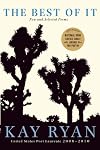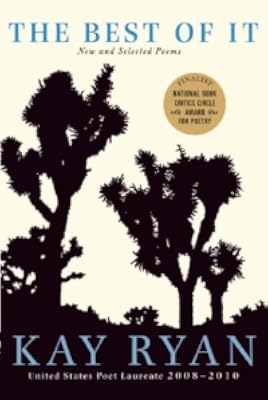
The Best of It: New and Selected Poems
by Kay Ryan
On This Page
Description
Kay Ryan is the sixteenth Poet Laureate of the United States. Here is the poet's own selection of more than two hundred poems, offering both longtime followers and new readers a stunning retrospective of her earlier work as well as a generous selection of powerful new poems.Tags
Recommendations



Member Reviews
One of our recent Poets Laureate, Kay Ryan is a bit of an Emily Dickinson for the 21st century. Her glance is slant, her poems are short and skinny and terse. She eschews end-rhyme and stanza form but has a fondness for internal rhyme, which she evocatively called "recombinant rhyme." I enjoy the way she uses it -- you never know when the lines are going to chime, but you know they will, and the uncertainty only adds to the pleasure. These poems are like glimpses of the horizon seen through a raindrop: tiny, but clear and evocative. On occasion the trick doesn't work and you reach the end of the poem and say "What?" But usually she delivers. This is poetry designed to make you slow down and pay attention.
The poems in Kay Ryan's astonishing collection "The Best of It: New and Selected Poems" are so crisp and immediate that they seem effortless. It is only upon closer inspection that these little miracles of compression begin to give up their secrets, their engaging surfaces gradually yielding ever more layers of nuance.
Ryan's verse reminds one not so much of conventional narrative poems as of some cunningly made artifacts, like those tiny Russian nesting dolls, or an exquisite enameled box that, unsprung, yields an interior vista of startling clarity.
"The Best of It" collects four previous volumes, going back to 1994, and adds 24 new poems. The trajectory of a poet's career in this country, today, does not usually conform to a smooth, show more triumphalist incline, so it is satisfying to know that Kay Ryan is serving as the U.S. Poet Laureate -- a kind of ambassador for the art.
Taken as a whole, "The Best of It" displays an astounding consistency of tone and quality, with the later work and the new poems perhaps shading a bit toward an elegant midcareer austerity.
One of the many charms here is accessibility: the poems tend toward the bite-size (only a few spill over onto a second page), and their initial effect is of a pleasing briskness, free of the dense opacity and deliberate "difficulty" that makes so much contemporary poetry into the readerly equivalent of a trip to the dentist.
Ryan crafts startling rhymes ("hibiscus / to kiss," and "cracked / exact") and jittery rhythms that often stop short or feature a stress falling on an unexpected syllable, with a sideways hop. They are little exploders of cliche: "A bitter pill doesn't need to be swallowed to work," begins one, while waiting for "The Other Shoe" to drop wouldn't be so bad "if the undropped / didn't congregate / with the undropped . . . acquiring density / and weight."
This is not to say that Ryan's poems are glib or facile; on the contrary, they often address abstractions and proclaim paradoxes with vigor, as in "Forgetting":"Forgetting takes space. Forgotten matters displace / as much anything else as / anything else." For all their colloquial style and down-home wit, Ryan's poems tend to circle deeply philosophical issues."Whatever is done," states one, "leaves a hole in the / possible." Ryan's words mirror her mind, in the sense that both are quick and idiosyncratic, likely to land on the unlikely but inspired thought.
These gifts call to mind some illustrious predecessors, including Emily Dickinson, Wallace Stevens, Marianne Moore and Robert Frost. Despite the echoes, though, Ryan is so arresting and genuinely original that her book stays in the mind in a way unlike much contemporary poetry, so often impenetrable and self-absorbed. In today's world of exploding self-expression and relentless ephemera, Kay Ryan sticks.
FROM THE CLEVELAND PLAIN DEALER, April 13, 2010. show less
Ryan's verse reminds one not so much of conventional narrative poems as of some cunningly made artifacts, like those tiny Russian nesting dolls, or an exquisite enameled box that, unsprung, yields an interior vista of startling clarity.
"The Best of It" collects four previous volumes, going back to 1994, and adds 24 new poems. The trajectory of a poet's career in this country, today, does not usually conform to a smooth, show more triumphalist incline, so it is satisfying to know that Kay Ryan is serving as the U.S. Poet Laureate -- a kind of ambassador for the art.
Taken as a whole, "The Best of It" displays an astounding consistency of tone and quality, with the later work and the new poems perhaps shading a bit toward an elegant midcareer austerity.
One of the many charms here is accessibility: the poems tend toward the bite-size (only a few spill over onto a second page), and their initial effect is of a pleasing briskness, free of the dense opacity and deliberate "difficulty" that makes so much contemporary poetry into the readerly equivalent of a trip to the dentist.
Ryan crafts startling rhymes ("hibiscus / to kiss," and "cracked / exact") and jittery rhythms that often stop short or feature a stress falling on an unexpected syllable, with a sideways hop. They are little exploders of cliche: "A bitter pill doesn't need to be swallowed to work," begins one, while waiting for "The Other Shoe" to drop wouldn't be so bad "if the undropped / didn't congregate / with the undropped . . . acquiring density / and weight."
This is not to say that Ryan's poems are glib or facile; on the contrary, they often address abstractions and proclaim paradoxes with vigor, as in "Forgetting":"Forgetting takes space. Forgotten matters displace / as much anything else as / anything else." For all their colloquial style and down-home wit, Ryan's poems tend to circle deeply philosophical issues."Whatever is done," states one, "leaves a hole in the / possible." Ryan's words mirror her mind, in the sense that both are quick and idiosyncratic, likely to land on the unlikely but inspired thought.
These gifts call to mind some illustrious predecessors, including Emily Dickinson, Wallace Stevens, Marianne Moore and Robert Frost. Despite the echoes, though, Ryan is so arresting and genuinely original that her book stays in the mind in a way unlike much contemporary poetry, so often impenetrable and self-absorbed. In today's world of exploding self-expression and relentless ephemera, Kay Ryan sticks.
FROM THE CLEVELAND PLAIN DEALER, April 13, 2010. show less
t their best, Ryan's poems are gem-like, with astounding observations that give a brilliant little flash as you examine them: Oh! At worst, they are doggerel, sing-songly little nothings with no point beyond description (in the manner of giraffe...carafe, though that isn't actually one of her rhymes). This collection includes both and allows a longitudinal look at how Ryan has streamlined and improved her work over time. Her rhymes are less clangy; her abstractions less pronouncements than observations; her descriptions more emblematic or symbolic. This is a very good volume for seeing both ends of her capacity as a poet.
I read this for the 2015 Book Riot Read Harder challenge, and I didn't love it. Poetry is not usually my thing. I am a plot-driven reader and poetry is often short on plot. Beautiful writing alone is rarely enough to engage me. Ryan is definitely a skillful poet, but her poems seem oddly impersonal. They were mostly descriptions of objects - paintings, animals, trees, etc. The few poems that I really enjoyed came at the very end of the book and were about aging. Those, for me, went beyond pretty words on a page to something that resonated.
A thorough collection of stripped down lyric poems. I have the pleasant sense that I am not quite able to read these fully.
Reading her poems, one is struck by their sparseness. The lines are short, sometimes only two or three syllables. Her poems’ lengths are similarly slight rarely going over a page. She manages to contain much thought in this meager space so the reader is required to study the intricacies of her words in order to obtain in full the richness they contain.
Kay Ryan, named the Pulitzer Prize Winner for Poetry 2010, is just the latest in an amazing array of accolades for this wonderfully accessible, widely loved poet. She was appointed the Library of Congress’s sixteenth poet laureate from 2008 to 2010. Salon has compared her poems to Fabergé eggs, tiny, ingenious devices that inevitably conceal some hidden wonder.” The two hundred poems in Ryan’s The Best of It offer a stunning retrospective of her work, as well as a swath of never-before-published poems of which are sure to appeal equally to longtime fans and general readers.
Members
- Recently Added By
Lists

Favorite Recent Poetry: 1980-2022
178 works; 69 members
Author Information

19+ Works 1,007 Members
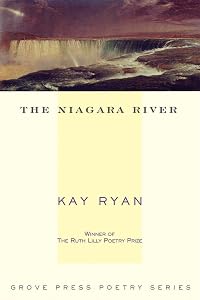
Kay Ryan is a poet and educator. Born in San Jose, California, she received bachelors and masters degrees from the University of California, Los Angeles. Her first collection, Dragon Acts to Dragon Ends, was privately published in 1983. Ryan found a commercial publisher for her second collection, Strangely Marked Metal, but her work went nearly show more unrecognized until the mid 1990s, when some of her poems were anthologized and the first reviews appeared in national journals. She received the Ruth Lilly Poetry Prize in 2004, and published her sixth collection of poetry, The Niagara River. Ryan's other awards include the 2001 Maurice English Poetry Award, a fellowship in 2001 from the National Endowment for the Arts, and a 2004 Guggenheim Fellowship. Her poems have been included in three Pushcart Prize anthologies and have been selected four times for The Best American Poetry. Ryan's collection The Best of It: New and Selected Poems, was a finalist for the 2011 National Book Critics Circle Award. She was awarded Pulitzer Prize for Poetry for this collection. Ryan was named the 16th Library of Congress Poet Laureate Consultant in Poetry and served 2 terms from 2008 to 2010. She currently serves as one of Chancellors of The Academy of American Poets. (Bowker Author Biography) show less
Awards and Honors
Awards
Distinctions
Common Knowledge
- Original title
- The best of it: new and selected poems
- Original publication date
- 2010
- Blurbers
- Dillard, Annie; Wilbur, Richard
Classifications
Statistics
- Members
- 366
- Popularity
- 86,299
- Reviews
- 11
- Rating
- (4.06)
- Languages
- English
- Media
- Paper, Ebook
- ISBNs
- 3
- ASINs
- 6