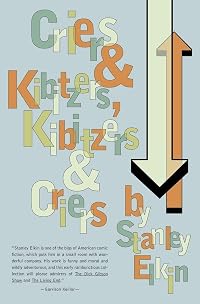
Criers & Kibitzers, Kibitzers & Criers
by Stanley Elkin
On This Page
Description
"This imagination of Elkin's sneaks up, tickles, surprises, shocks, and kills. It makes stories that are deadly funny." --The New York Times Each of the nine short stories collected here feature two types of people--the troubled and the troublemakers. In "The Guest," a homeless man gleefully takes credit for a robbery he did not commit. "In the Alley" tells the story of a terminally ill man who begrudgingly outlives his initial prognosis. And the satiric "I Look Out for Ed Wolfe" features a show more charismatic salesman auctioning off his life's possessions in order to determine his value in the world. Laced with wit, Criers & Kibitzers, Kibitzers & Criers is a keenly observed collection that puts Elkin's comic artistry on full display. This ebook features rare photos and never-before-seen documents from the author's estate and from the Stanley Elkin archives at Washington University in St. Louis. show lessTags
Recommendations























Member Reviews
Sometimes an author who is very obviously right up your alley inexplicably manages to slip underneath your radar, and when you discover him years later you find yourself faced with a huge backlist and gnashing your teeth that you did not come across this astonishing body of work earlier. Stanley Elkin is just such a case for me; by all rights, I should have stumbled over him in the early to mid eighties when I was discovering contemporary American literature for myself and started reading the likes of Thomas Pynchon, John Barth and Robert Coover. Instead, I first enountered him as late as 2011 through a series of posts on one of the blogs I follow.
I read Boswell, Stanley Elkin’s first novel, a few months back, and while I liked it, I show more had some difficulties seeing why everyone kept saying that it was so funny. No such problem with Criers & Kibitzers, Kibitzers & Criers, Elkin’s first collection of stories (some of which predate Boswell) which had me laughing out loud a lot, even – or, coming to think about it, in particular – in places where the subject matter of the story did not appear to lend itself to humour at all.
This starts off with the title story, about a store owner who returns to work after the death of his son – the story manages to be at the same time very funny, when the protagonist’s paranoia runs rampant, suspecting everyone and their grandmother of robbing him blind, and heartbreakingly sad, the portrait of a man whose implicit trust in the benevolence of life has been shattered and who tries to carry on in the face of despair.
“Criers & Kibitzers, Kibitzers & Criers” is, like most of the nine stories in this collection and as Stanley Elkin himself remarks upon in his Preface to the 1990 edition, “right bang smack dab in the middle of realism,” something he’d outgrow later, and which is already apparent in some of the stories here, and it is certainly no coincidence that those tend to be the best of the lot. The volume’s stories also establishes the mood for what is to come, it’s distinctive interweaving of farce and tragedy can be found – to a varying degree and played out in different ways – in all of the following stories.
My personal favourite is “Poetics for Bullies,” a story whose driving, insistent rhythm grabs you at your jacket lapels right from the start and then pushes and pummels you relentlessly for the entire duration of its 20 pages. There is something very Rabelaisian about it (and, I suspect, about Elkin’s writing in general), in the larger-than-life characters, the exuberance of the writing and the way even the apparently most stable conventions and preconceptions are tumbling and turned topsy-turvy. In the case of this particular story we end up thoroughly disliking the character who is a shining example of pretty much every virtue imaginable and rooting for his antagonist, a low-life bully named Push, even wondering if bullies might not indeed be fulfulling a very useful social function… “Poetics for Bullies” is brilliant on every level and alone worth getting this collection. And while none of the other stories is quite as good, there is no really weak story here either, I’m really looking forward to reading more from Stanley Elkin. show less
I read Boswell, Stanley Elkin’s first novel, a few months back, and while I liked it, I show more had some difficulties seeing why everyone kept saying that it was so funny. No such problem with Criers & Kibitzers, Kibitzers & Criers, Elkin’s first collection of stories (some of which predate Boswell) which had me laughing out loud a lot, even – or, coming to think about it, in particular – in places where the subject matter of the story did not appear to lend itself to humour at all.
This starts off with the title story, about a store owner who returns to work after the death of his son – the story manages to be at the same time very funny, when the protagonist’s paranoia runs rampant, suspecting everyone and their grandmother of robbing him blind, and heartbreakingly sad, the portrait of a man whose implicit trust in the benevolence of life has been shattered and who tries to carry on in the face of despair.
“Criers & Kibitzers, Kibitzers & Criers” is, like most of the nine stories in this collection and as Stanley Elkin himself remarks upon in his Preface to the 1990 edition, “right bang smack dab in the middle of realism,” something he’d outgrow later, and which is already apparent in some of the stories here, and it is certainly no coincidence that those tend to be the best of the lot. The volume’s stories also establishes the mood for what is to come, it’s distinctive interweaving of farce and tragedy can be found – to a varying degree and played out in different ways – in all of the following stories.
My personal favourite is “Poetics for Bullies,” a story whose driving, insistent rhythm grabs you at your jacket lapels right from the start and then pushes and pummels you relentlessly for the entire duration of its 20 pages. There is something very Rabelaisian about it (and, I suspect, about Elkin’s writing in general), in the larger-than-life characters, the exuberance of the writing and the way even the apparently most stable conventions and preconceptions are tumbling and turned topsy-turvy. In the case of this particular story we end up thoroughly disliking the character who is a shining example of pretty much every virtue imaginable and rooting for his antagonist, a low-life bully named Push, even wondering if bullies might not indeed be fulfulling a very useful social function… “Poetics for Bullies” is brilliant on every level and alone worth getting this collection. And while none of the other stories is quite as good, there is no really weak story here either, I’m really looking forward to reading more from Stanley Elkin. show less
For the most part, I did not enjoy reading this book. There were some parts that I found more tolerable than others, but I forced myself to look over the text each time I opened the book. It's a book of short stories that are fairly weird. Fortunately, there are some funny parts, but very few and far between. Most of the stories are not very short, and they drag because the characters are unpleasant. I found it a dull read.
i liked when it got weird.
Ratings
Members
- Recently Added By
Author Information

34+ Works 2,660 Members
Stanley Elkin was an American Jewish novelist, short story writer, and essayist. He was born on May 11, 1930. Elkin steadily and quietly worked his way into the higher ranks of contemporary American novelists. He was born in Brooklyn, New York, but grew up in Chicago and has spent most of his life since in the Midwest, receiving his Ph.D. in show more English from the University of Illinois with a dissertation on William Faulkner. He was a member of the English faculty at Washington University in St. Louis from 1960 until his death, and battled multiple sclerosis for most of his adult life. Reviewers found Elkin's first novel, Boswell: A Modern Comedy (1964), the story of an uninhibited modern-day counterpart of the eighteenth-century biographer, hilarious and promising, while the stories in Criers and Kibitzers, Kibitzers and Criers (1966) established Elkin as a writer capable of writing short stories of textbook-anthology quality. The ironically entitled A Bad Man (1967) is about a Jewish department store magnate who deliberately arranges to have himself convicted of several misdeeds so that he can experience the real world of a prison and carry on his own war with the warden in what takes on the dimensions of a burlesque existential allegory. The Dick Gibson Show (1971) uses the host of a radio talk show as a way of showing fancifully what it means to live "at sound barrier," and both Searchers and Seizures (1973) and The Living End (1979) are triptychs of related stories verging on surrealism. The Franchiser (1976), generally considered Elkin's best novel before George Mills, uses the story of a traveling salesman of franchises to show the flattening homogenization of American life. But as usual, what happens in this Elkin novel is less important than the way in which the story is told. Elkin won the National Book Critics Circle Award on two occasions: for George Mills in 1982 and for Mrs. Ted Bliss, his last novel, in 1995. The MacGuffin was a finalist for the 1991 National Book Award for Fiction. Although he enjoyed high critical praise, his books never enjoyed popular success. Elkin died May 31, 1995 of a heart attack. His manuscripts and correspondence are archived in Olin Library at Washington University in St. Louis. (Bowker Author Biography) show less
Series
Belongs to Publisher Series
Work Relationships
Is contained in
Classifications
Statistics
- Members
- 133
- Popularity
- 246,698
- Reviews
- 3
- Rating
- (3.36)
- Languages
- English
- Media
- Paper, Ebook
- ISBNs
- 6
- ASINs
- 3