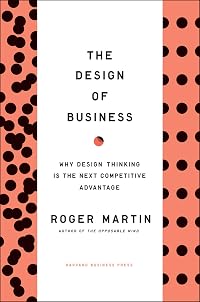
The Design of Business: Why Design Thinking is the Next Competitive Advantage
by Roger L. Martin
On This Page
Description
Most companies today have innovation envy. Many make genuine efforts to be innovative: they spend on R & D, bring in creative designers, hire innovation consultants; but they still get disappointing results. Roger Martin argues that to innovate and win, companies need 'design thinking'.Tags
Recommendations







Member Reviews
I got this from the library after reading a sample of [b:Fixing the Game: Bubbles, Crashes, and What Capitalism Can Learn from the NFL|10898755|Fixing the Game Bubbles, Crashes, and What Capitalism Can Learn from the NFL|Roger L. Martin|http://photo.goodreads.com/books/1328765463s/10898755.jpg|15814691], which looked promising. But my library didn't have that one, so I read this one instead.
It's godawfully written—clunky, repetitive, confusing—and it doesn't really have much to say. But what it does have to say is pretty good, and better than I expected for a "business book."
Martin has two main ideas:
1) Businesses ideas get funneled/simplified from the initial creative stage of exploration ("Mystery"), through an intermediate stage show more of professional practice ("Heuristic"), and finally to an automated stage of maximal exploitation ("Algorithm").
2) The typical economic structure of businesses tends to favor exploitation and the value of reliability (repeatable results) over exploration and the value of validity (new knowledge); "design thinkers" work to balance the two tendencies.
This produces hideous sentences, such as (picking at random from p. 17, i.e. quite early in the book) "What is the value to a business of driving through the knowledge funnel from mystery to heuristic to algorithm?" What, indeed?
But I kept up with it for two reasons. One, since my long ago start at an MA in Whole Systems Design (WSD), I've learned that to much of the world, the idea of design as anything more than artsy doodles, let alone a broad approach to creative problem-solving, is completely foreign. So it was nice to see someone trying to give design a good name in that deeper sense.
Two was the wild one, though. Martin associates exploration/validity-valuing thought with C.S. Peirce's notion of abductive reasoning—or "inference to the best explanation"—as opposed to induction and deduction, lumped together as analytical reasoning, the tools of exploitation/reliability. Now, that in itself wasn't a big shock, since that split has been familiar to me since I learned about abduction via Carlo Ginsburg and Umberto Eco's essays in the fantastic anthology [b:The Sign of Three: Dupin, Holmes, Peirce|328885|The Sign of Three Dupin, Holmes, Peirce|Umberto Eco|http://photo.goodreads.com/books/1266525729s/328885.jpg|1913081]. But there it had been in the context of semiotics, extended to historical and literary thinking. Later I made some faint attempts of my own to link abduction up with cognitive science and its notions of creative problem-solving, and in the back of my mind I knew it was exactly what WSD's "design thinking" was about—but I'd never articulated that to anyone, nor seen any trace of it in others' writing. And here Martin plunks it into the center of his book!
He by no means has the last word on abduction, though; often he uses it as just a fancy synonym for "creativity." There's really not much more to this book than the two points above, supported by lots of examples. There's very little in the way of imagining new forms of management or business structure which might complement and support design thinking. For the full story at that level, I suspect WSD's old heroine Mary Parker Follett ([b:Mary Parker Follett: Prophet of Management : A Celebration of Writings from the 1920s|2260358|Mary Parker Follett Prophet of Management A Celebration of Writings from the 1920s|Pauline Graham|http://photo.goodreads.com/books/1266679428s/2260358.jpg|2266311]) had it all straight 90 years ago. show less
It's godawfully written—clunky, repetitive, confusing—and it doesn't really have much to say. But what it does have to say is pretty good, and better than I expected for a "business book."
Martin has two main ideas:
1) Businesses ideas get funneled/simplified from the initial creative stage of exploration ("Mystery"), through an intermediate stage show more of professional practice ("Heuristic"), and finally to an automated stage of maximal exploitation ("Algorithm").
2) The typical economic structure of businesses tends to favor exploitation and the value of reliability (repeatable results) over exploration and the value of validity (new knowledge); "design thinkers" work to balance the two tendencies.
This produces hideous sentences, such as (picking at random from p. 17, i.e. quite early in the book) "What is the value to a business of driving through the knowledge funnel from mystery to heuristic to algorithm?" What, indeed?
But I kept up with it for two reasons. One, since my long ago start at an MA in Whole Systems Design (WSD), I've learned that to much of the world, the idea of design as anything more than artsy doodles, let alone a broad approach to creative problem-solving, is completely foreign. So it was nice to see someone trying to give design a good name in that deeper sense.
Two was the wild one, though. Martin associates exploration/validity-valuing thought with C.S. Peirce's notion of abductive reasoning—or "inference to the best explanation"—as opposed to induction and deduction, lumped together as analytical reasoning, the tools of exploitation/reliability. Now, that in itself wasn't a big shock, since that split has been familiar to me since I learned about abduction via Carlo Ginsburg and Umberto Eco's essays in the fantastic anthology [b:The Sign of Three: Dupin, Holmes, Peirce|328885|The Sign of Three Dupin, Holmes, Peirce|Umberto Eco|http://photo.goodreads.com/books/1266525729s/328885.jpg|1913081]. But there it had been in the context of semiotics, extended to historical and literary thinking. Later I made some faint attempts of my own to link abduction up with cognitive science and its notions of creative problem-solving, and in the back of my mind I knew it was exactly what WSD's "design thinking" was about—but I'd never articulated that to anyone, nor seen any trace of it in others' writing. And here Martin plunks it into the center of his book!
He by no means has the last word on abduction, though; often he uses it as just a fancy synonym for "creativity." There's really not much more to this book than the two points above, supported by lots of examples. There's very little in the way of imagining new forms of management or business structure which might complement and support design thinking. For the full story at that level, I suspect WSD's old heroine Mary Parker Follett ([b:Mary Parker Follett: Prophet of Management : A Celebration of Writings from the 1920s|2260358|Mary Parker Follett Prophet of Management A Celebration of Writings from the 1920s|Pauline Graham|http://photo.goodreads.com/books/1266679428s/2260358.jpg|2266311]) had it all straight 90 years ago. show less
Ratings
Members
- Recently Added By
Author Information
15 Works 1,276 Members
Roger Martin is dean at the Rotman School of Management at the University of Toronto. He is a columnist at Business Week Online and a regular contributor to Harvard Business Review and the Financial Times.
Common Knowledge
- Original title
- The Design of Business: Why Design Thinking is the Next Competitive Advantage
- Original publication date
- 2009
Classifications
- Genres
- Business, Nonfiction, Art & Design, General Nonfiction
- DDC/MDS
- 658.4063 — Applied science & technology Management & public relations General management Executive Managing Change Innovation
- LCC
- HD53 .M3644 — Social sciences Industries. Land use. Labor Industries. Land use. Labor Management. Industrial management
- BISAC
Statistics
- Members
- 222
- Popularity
- 147,772
- Reviews
- 2
- Rating
- (3.57)
- Languages
- English
- Media
- Paper, Ebook
- ISBNs
- 1