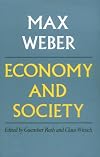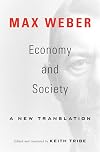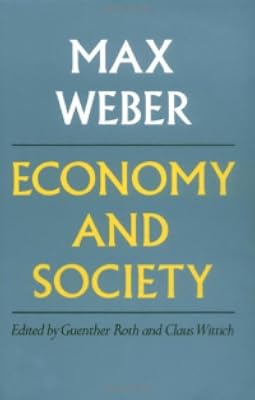
Economy and Society [complete]
by Max Weber
On This Page
Description
Max Weber was the foremost social theorist of the twentieth century; Economy and Society is Weber's most famous work after The Protestant Ethic and the Spirit of Capitalism. It consists of diverse essays that Weber was working on at the time of his death in 1920, ranging over subjects in economics, politics, religion, public administration, and sociology. The book was first published in German in two parts in the early 1920s, then in a more authoritative edition in the late 1950s. Economy show more and Society is a classic work of social theory, and is considered the founding text for modern social debates about action, rationality, bureaucracy and charisma, formal and material justice, religious beliefs, and economic conduct. In this new translation of Part I, Keith Tribe, one of the English-speaking world's leading experts on Weber, aims to present the clearest and most faithful translation yet. Tribe's translation is accompanied by commentary and notes that reflect the decades of scholarship that have passed since Guenther Roth and Claus Wittich published their English translation in 1968.-- show lessTags
Recommendations



























Member Reviews
I like categorization as much as the next person, but this Kategorienlehre was too much for me. I believe the work was unfinished when the author died, and this seems evident from the text. It is a collection of notes and ideas, sensible in its overall structure but clearly in need of more editing and summarizing to improve readability. It still had a great influence on 20th century sociology, but in this case I would recommend derivative works before the original source.
I will never stop reading this book.
Real talk - the hype is deserved. While its difficult to follow the "neo-Kantian realism" end of Weber's methodology, an entire idiosyncratic and systematic social imaginary gradually comes into focus as one flips through chapters. There is a huge amount of insight to be gained, but ironically not too much directly in dialogue with Marx.
Reading Simmel's Philosophy of Money gives some additional insight.
Real talk - the hype is deserved. While its difficult to follow the "neo-Kantian realism" end of Weber's methodology, an entire idiosyncratic and systematic social imaginary gradually comes into focus as one flips through chapters. There is a huge amount of insight to be gained, but ironically not too much directly in dialogue with Marx.
Reading Simmel's Philosophy of Money gives some additional insight.
This book is An Outline of Interpretive Sociology and its economy.
, (2), 840 pp.contemporary blue cloth. 27cm. Few pencil marks.First edition of one of the greatest and most influential works of modern sociology in which Weber attempts to provide a more secure foundation of sociology and the science of history. It was published as part III of the series " Grundriß der Sozialökonomik" ZiegenfuÃ: II.841. A near fine copy.
See also Peter E. Gordon's review of "Charisma and Disenchangment: The Vocation Lectures" in NYRB June 11,2020
Ratings
Members
- Recently Added By
Lists

KIB Non-Fiction Book Cloud
41 works; 1 member

Shaykh Hamza's Book Recommendations
439 works; 3 members

Books Cited in Blueprint by Nicholas Christakis
261 works; 1 member
Author Information

342+ Works 11,402 Members
Max Weber, a German political economist, legal historian, and sociologist, had an impact on the social sciences that is difficult to overestimate. According to a widely held view, he was the founder of the modern way of conceptualizing society and thus the modern social sciences. His major interest was the process of rationalization, which show more characterizes Western civilization---what he called the "demystification of the world." This interest led him to examine the three types of domination or authority that characterize hierarchical relationships: charismatic, traditional, and legal. It also led him to the study of bureaucracy; all of the world's major religions; and capitalism, which he viewed as a productof the Protestant ethic. With his contemporary, the French sociologist Emile Durkheim---they seem not to have known each other's work---he created modern sociology. (Bowker Author Biography) show less
Some Editions
Awards and Honors
Awards
Notable Lists
Common Knowledge
Classifications
Statistics
- Members
- 664
- Popularity
- 43,377
- Reviews
- 5
- Rating
- (4.33)
- Languages
- 7 — English, French, German, Italian, Portuguese, Russian, Spanish
- Media
- Paper, Ebook
- ISBNs
- 22
- ASINs
- 8