
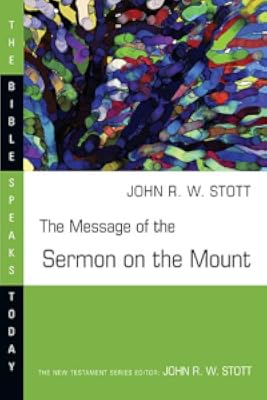
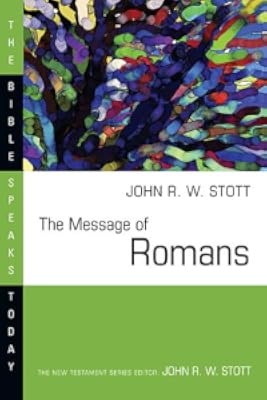
The Message of the Sermon on the Mount (Matthew 5-7 : Christian Counter-Culture)
by John R. W. Stott
Bible Speaks Today
On This Page
Description
The followers of Jesus are to be different, ' writes John Stott, 'different from both the nominal church and the secular world, different from both the religious and the irreligious. The Sermon on the Mount is the most complete delineation anywhere in the New Testament of the Christian counter-culture. Here is a Christian value-system, ethical, standard, religious devotion, attitude to money, ambition, lifestyle and network of relationships - all of which are totally at variance with show more those in the non-Christian world. And this Christian counter-culture is the life of the Kingdom of God, a fully human life indeed but lived out under the divine rule.'In his careful exposition of the Sermon on the Mount, John Stott accurately expounds the biblical text and relates it to life today. Above all, the author says, he wants to let Christ speak this sermon again, this time to the modern world. show lessTags
Recommendations







Member Reviews
In 1978 John Stott published a commentary on the Sermon on the Mount entitled Christian Counter-Culture. It's a testimony to the insight of Stott's exegesis and, more importantly, to the power of Matthew 5-7 that thirty-seven years later, this is still a counter-cultural document.
Stott had a gift for making complicated things simple. Here he takes not only the Sermon itself, but also a multitude of various interpretative traditions and distills them into neatly numbered lists.
There are elements of his interpretation that I would disagree with. For example, on Matthew 6:5-6 Jesus exhorts his followers to pray in private, not like the hypocrites who love to be seen in public. Stott notes that there was nothing inherently wrong with show more praying on street corners and synagogues "if their motive was to break down segregated religion and bring their recognition of God out of the holy places into the secular life of every day" (133). In the first place, isn't the Synagogue a holy place? More importantly, this statement presumes (anachronistically) that first century Jewish people divided their life into religious and secular spheres—a trademark problem of the Enlightenment.
Yet for every passage that makes me shake my head, there are twenty more that reveal the sort of understanding only a committed follower of Jesus can demonstrate.
In the introduction, Stott wrote:
"Of course commentaries by the hundred have been written on the Sermon on the Mount. I have been able to study about twenty-five of them, and my debt to the commentators will be apparent to the reader. Indeed my text is sprinkled with quotations from them, for I think we should value tradition more highly than we often do, and sit more humbly at the feet of the masters" (9).
John R. W. Stott is now one of the masters he wrote about in 1978. I always benefit from sitting humbly at his feet. show less
Stott had a gift for making complicated things simple. Here he takes not only the Sermon itself, but also a multitude of various interpretative traditions and distills them into neatly numbered lists.
There are elements of his interpretation that I would disagree with. For example, on Matthew 6:5-6 Jesus exhorts his followers to pray in private, not like the hypocrites who love to be seen in public. Stott notes that there was nothing inherently wrong with show more praying on street corners and synagogues "if their motive was to break down segregated religion and bring their recognition of God out of the holy places into the secular life of every day" (133). In the first place, isn't the Synagogue a holy place? More importantly, this statement presumes (anachronistically) that first century Jewish people divided their life into religious and secular spheres—a trademark problem of the Enlightenment.
Yet for every passage that makes me shake my head, there are twenty more that reveal the sort of understanding only a committed follower of Jesus can demonstrate.
In the introduction, Stott wrote:
"Of course commentaries by the hundred have been written on the Sermon on the Mount. I have been able to study about twenty-five of them, and my debt to the commentators will be apparent to the reader. Indeed my text is sprinkled with quotations from them, for I think we should value tradition more highly than we often do, and sit more humbly at the feet of the masters" (9).
John R. W. Stott is now one of the masters he wrote about in 1978. I always benefit from sitting humbly at his feet. show less
This is a Biblical commentary on the Sermon of the Mount. The (renowned!) author is very thoughtful and provided discussions on various topics that are on a tangent to the text. He presented a very structured, organized purview of the Sermon of the Mount. If you like reading Bible commentaries, this is perhaps one of the best out there. The setback of reading Bible commentaries for pleasure is that there is few personal illustrations, analogies or human interest vignettes.
DISCO D: BACKUP / TEOLOGIA
VIDA CRISTIANA / GENERAL
VIDA CRISTIANA / GENERAL
Logos Library
Acima de tudo, quis deixar o próprio Sermão falar, ou melhor, deixar Cristo proferi-lo novamente, desta vez ao mundo contemporâneo.
Assim procurei encarar com integridade os dilemas que o Sermão levanta para os cristãos de hoje, e não esquivar-me deles, já que Cristo não nos deu um tratado acadêmico, calculado simplesmente para estimular a mente.
Eu creio que ele desejava que o seu Sermão do Monte fosse obedecido. De fato, se a igreja tivesse aceitado realisticamente os seus padrões e valores, como aqui demonstrados, e tivesse vivido por eles, ela teria sido a sociedade alternativa que sempre tencionou ser, e poderia oferecer ao mundo uma autêntica contracultura cristã.
Assim procurei encarar com integridade os dilemas que o Sermão levanta para os cristãos de hoje, e não esquivar-me deles, já que Cristo não nos deu um tratado acadêmico, calculado simplesmente para estimular a mente.
Eu creio que ele desejava que o seu Sermão do Monte fosse obedecido. De fato, se a igreja tivesse aceitado realisticamente os seus padrões e valores, como aqui demonstrados, e tivesse vivido por eles, ela teria sido a sociedade alternativa que sempre tencionou ser, e poderia oferecer ao mundo uma autêntica contracultura cristã.
Jun 6, 2020Spanish
"The followers of Jesus are to different," writes John Stott, "different from both the nominal church and the secular world, different from both the religious and the irreligious. The Sermon on the Mount is the most complete delineation anywhere in the New Testament of the Christian counter-culture. Here is a Christian value-system, ethical standard, religious devotion, attitude to money, ambition, lifestyle and network of relationships--all of which are totally at variance with those in the non-Christian world. And this Christian counter-culture is the life of the kingdom of God, a fully human life indeed but lived out under the divine rule." In this careful exposition of Jesus' Sermon on the Mount, John R. W. Stott accurately expounds show more the biblical text and relates it to life today. Above all, the author says, he wants to let Christ speak this sermon again, this time to the modern world. show less
Apr 24, 2021Portuguese (Portugal)
Members
- Recently Added By
Lists

Develop Your Personal Christian Library
101 works; 15 members
Author Information

369+ Works 46,324 Members
John R. W. Stott (1921-2011) has been known worldwide as a preacher, evangelist, and communicator of Scripture. For many years he served as rector of All Souls Church in London, where he carried out an effective urban pastoral ministry. A leader among evangelicals in Britain, the United States, and around the world, Stott was a principal framer of show more the landmark Lausanne Covenant (1974). Stott's many books, including Basic Christianity and The Cross of Christ, have sold millions of copies. In the Bible Speaks Today series, for which he served as New Testament editor, he wrote eight volumes, including The Message of Acts and The Message of Ephesians. show less
Series

Common Knowledge
- Original title
- Christian Counter-Culture; Christian Counter-Culture: The Message of the Sermon on the Mount
- Alternate titles
- Christian counter-culture : the message of the Sermon on the Mount; 登山寶訓精研; 基督教文化的挑戰 : 登山寶訓精研. English; The Message of the Sermon on the Mount [Matthew 5-7]: Christian Counter-Culture
- Original publication date
- 1978
- People/Characters
- Jesus Christ
- Original language*
- Englisch
*Some information comes from Common Knowledge in other languages. Click "Edit" for more information.
Classifications
Statistics
- Members
- 2,263
- Popularity
- 8,828
- Reviews
- 7
- Rating
- (4.14)
- Languages
- 8 — Chinese, Dutch, English, Finnish, French, German, Spanish, Portuguese (Portugal)
- Media
- Paper, Ebook
- ISBNs
- 22
- ASINs
- 16