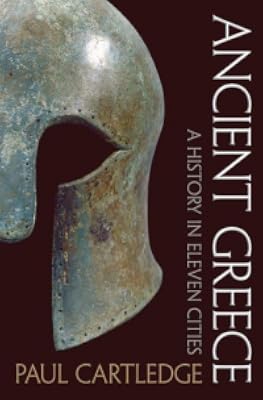
Ancient Greece: A History in Eleven Cities
by Paul Cartledge
On This Page
Description
Paul Cartledge uses the history of eleven major Greek cities to illuminate the most important and informative themes in Ancient Greek history, from the first documented use of the Greek language around 1400 BCE, through the glories of the Classical and Hellenistic periods, to the foundation of the Byzantine empire in around CE 330.Tags
Recommendations
















Member Reviews
I'm naturally dubious when it comes to book that claim to cover topics like, say, the whole of Ancient Greece, for it seems unlikely that any single volume could describe something so wide-ranging with any amount of accuracy. Even to focus on a single city would result in a slew of broad generalizations, surely. I should have been all the more skeptical when I saw this little book, which amounts to a just a little over 200 pages, and that's with the help of large text and huge margins. So why did I read it? Well, I don't really know! The cover attracted me, perhaps.
Paul Cartledge tries to define ancient Greece by examining 11 of its cities; Knosses, Mycenae, Argos, Miletus, Massalia, Sparta, Athens, Syracuse, Thebes, Alexandrea, and show more Byzantion. Though I thought it a foolish endeavor to try to quantify a vast empire that spanned so many years in so few pages, I thought perhaps the cities could be examined on an individual basis to display how versatile Greece could be. Whereas popular media tends to simplify ancient Greece (and most European history, for that matter), I thought this would show its complexity. Unfortunately, each city has scarcely more than a dozen pages dedicated to it, and the information is so bland and unpleasant to read that everything started blending together. That is to say, when I could care enough to pay attention to what I was reading in the first place.
I find ancient history to be incredibly fascinating a lot of the time. The same cannot be said for this book. show less
Paul Cartledge tries to define ancient Greece by examining 11 of its cities; Knosses, Mycenae, Argos, Miletus, Massalia, Sparta, Athens, Syracuse, Thebes, Alexandrea, and show more Byzantion. Though I thought it a foolish endeavor to try to quantify a vast empire that spanned so many years in so few pages, I thought perhaps the cities could be examined on an individual basis to display how versatile Greece could be. Whereas popular media tends to simplify ancient Greece (and most European history, for that matter), I thought this would show its complexity. Unfortunately, each city has scarcely more than a dozen pages dedicated to it, and the information is so bland and unpleasant to read that everything started blending together. That is to say, when I could care enough to pay attention to what I was reading in the first place.
I find ancient history to be incredibly fascinating a lot of the time. The same cannot be said for this book. show less
Not exactly simplistic but simple [intended to be easy to read]. A history of eleven Greek cities from the prehistoric: [Cnidos and Mycenae] to 324 AD: Constantinople, the former Byzantion [700s BC] . So this brief history has come full circle. Each city is chosen by the author to represent a certain geographical area in Greece, both mainland and island. Interesting, learnt some facts from an expert in his field, but oh, those torturous, labyrinthine sentences! The work could use much more editing; I'm getting the feeling the author just tossed this one off casually. The style, not the information, pulled the rating down for me.
Ratings
Members
- Recently Added By
Lists

r/AskHistorians' Recommended Books
1,068 works; 19 members

Books Read in 2013
1,630 works; 51 members
Author Information

43+ Works 4,195 Members
Paul Cartledge is A. G. Leventis Professor of Greek Culture Emeritus at the University of Cambridge. He is an honorary citizen of modern Sparta and holds the Gold Cross of the Order of Honor awarded by the President of Greece. His previous books include The Cambridge Illustrated History of Ancient Greece, The Spartans, Alexander the Great, show more Thermopylae, Ancient Greece, and After Thermopylae: The Oath of Plataea and the End of the Graeco-Persian Wars. show less
Common Knowledge
- Important places
- Knossos, Crete, Greece; Mycenae, Argolis, Greece; Argos, Greece; Miletus, Asia Minor; Massilia, Gaul; Sparta, Greece (show all 11); Athens, Greece; Syracuse, Sicily, Italy; Thebes, Greece; Alexandria, Egypt; Byzantium (Byzantion, Thrace)
- Dedication
- To the Trustees of the A. G. Leventis Foundation
Classifications
Statistics
- Members
- 161
- Popularity
- 204,145
- Reviews
- 2
- Rating
- (3.05)
- Languages
- English
- Media
- Paper, Ebook
- ISBNs
- 1
- ASINs
- 3