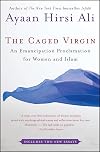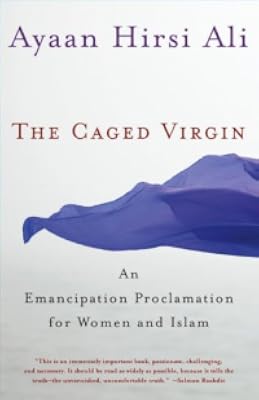
The Caged Virgin
by Ayaan Hirsi Ali
On This Page
Description
Muslims who explore sources of morality other than Islam are threatened with death, and Muslim women who escape the virgins' cage are branded whores. So asserts Hirsi Ali's meditation on Islam and the role of women, the rights of the individual, the roots of fanaticism, and Western policies toward Islamic countries and immigrant communities. This controversial book is a call to arms for the emancipation of women from religious and cultural oppression and from an outdated cult of virginity. show more It is a defiant call for clear thinking and for an Islamic Enlightenment. But it is also the courageous story of how Hirsi Ali herself fought back against everyone who tried to force her to submit to a traditional Muslim woman's life and how she became a voice of reform. She relates her experiences as a Muslim woman so that oppressed Muslim women can take heart and seek their own liberation.--From publisher description. show lessTags
Recommendations



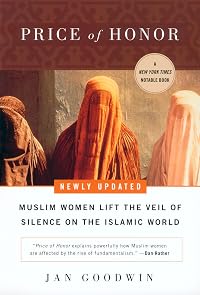
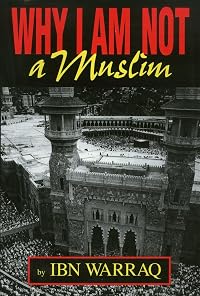
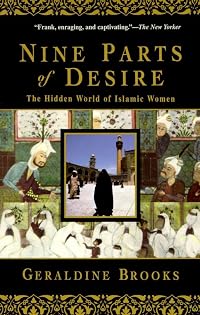
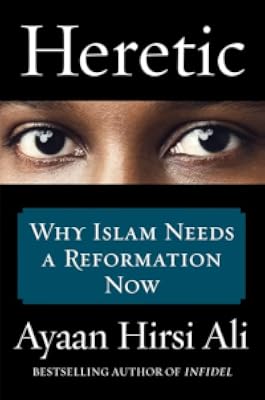







Member Recommendations
Member Reviews
This is a collection of essays that Ayaan Hirsi Ali wrote while she was still a Dutch politician. I have long admired her for her courage to speak out for women's and children's rights and also her intelligence. Reading this book I realize that I also admired her communication skills--she clearly presents her argument, gives examples and reasons why she holds her view, logically reasons through the argument, answers counter-arguments and presents a thoughtful conclusion and call to action. Some of these essays would be excellent material to use in a university-level writing class.
Because this is a collection of essays written at different times and perhaps for different audiences, there is some overlap. However, this didn't bother me show more and just showed me how she is unwavering in her mission and beliefs. Basically her argument is that the moderate Muslims living in the west must speak and act to reform the religion and halt its hijacking by fundamentalists. She sees Islam as a static belief system where questioning and discussion are strictly banned, and therefore is forcing people today to try to emulate a lifestyle of 7th century nomadic Arabs. She has absolute disdain for cultural relativists (who say that all cultures are equal and one group cannot critique another). Her paramount belief is that human rights far outweigh the rights of any culture. She tackles all of these issues from different angles, which I think are quite clear from her essay titles:
1. Stand Up for Your Rights! Women in Islam
2. Why Can't We Take a Critical Look at Ourselves
3. The Virgin's Cage
4. Let Us Have a Voltaire
5. What Went Wrong? a Modern Clash of Cultures (where she heavily references [What Went Wrong] by Bernard Lewis)
6. A Brief Personal History of My Emancipation
7. Being a Politician is Not My Ideal
8. Bin Laden's Nightmare: Interview with Irshad Manji
9. Freedom Requires Constant Vigilance
10. Four Women's Lives
11. How to Deal with Domestic Violence More Effectively
12. Genital Mutilation Must Not Be Tolerated
13. Ten Tips for Muslim Women Who Want to Leave (a very important, and somewhat chilling chapter!)
14. Submission: Part 1 (the script for her film, which is available on YouTube)
15. The Need for Self-Reflection within Islam
16. Portrait of a Heroine as a Young Woman
17. A Call for Clear Thinking
There are reference notes and an index. I might add that my copy is heavily underlined!
Recommended for: anyone interested in human rights, anyone who is interesting in living in a world where those of different faiths can co-exist, or --gasp--, even co-operate. show less
Because this is a collection of essays written at different times and perhaps for different audiences, there is some overlap. However, this didn't bother me show more and just showed me how she is unwavering in her mission and beliefs. Basically her argument is that the moderate Muslims living in the west must speak and act to reform the religion and halt its hijacking by fundamentalists. She sees Islam as a static belief system where questioning and discussion are strictly banned, and therefore is forcing people today to try to emulate a lifestyle of 7th century nomadic Arabs. She has absolute disdain for cultural relativists (who say that all cultures are equal and one group cannot critique another). Her paramount belief is that human rights far outweigh the rights of any culture. She tackles all of these issues from different angles, which I think are quite clear from her essay titles:
1. Stand Up for Your Rights! Women in Islam
2. Why Can't We Take a Critical Look at Ourselves
3. The Virgin's Cage
4. Let Us Have a Voltaire
5. What Went Wrong? a Modern Clash of Cultures (where she heavily references [What Went Wrong] by Bernard Lewis)
6. A Brief Personal History of My Emancipation
7. Being a Politician is Not My Ideal
8. Bin Laden's Nightmare: Interview with Irshad Manji
9. Freedom Requires Constant Vigilance
10. Four Women's Lives
11. How to Deal with Domestic Violence More Effectively
12. Genital Mutilation Must Not Be Tolerated
13. Ten Tips for Muslim Women Who Want to Leave (a very important, and somewhat chilling chapter!)
14. Submission: Part 1 (the script for her film, which is available on YouTube)
15. The Need for Self-Reflection within Islam
16. Portrait of a Heroine as a Young Woman
17. A Call for Clear Thinking
There are reference notes and an index. I might add that my copy is heavily underlined!
Recommended for: anyone interested in human rights, anyone who is interesting in living in a world where those of different faiths can co-exist, or --gasp--, even co-operate. show less
Despite its author usually being portrayed as some provocative, neo-conservative agitator, I found The Caged Virgin to be well-balanced and thoroughly reasonable in its views. To be sure, Ayaan Hirsi Ali is assertive and unafraid in her condemnation and criticism, but when faced with the sickening plight of many Muslim women in both the West and in societies with Islamic majorities, who could blame her? This is an awkward topic for many people, dealing as it does with taboo subjects like religion, race, immigration and sexual morality. But Hirsi Ali is defiant; her arguments will discomfort many people, and rightly so.
Because of this awkwardness, many will close off their minds to Hirsi Ali's book. But it is badly needed for people of show more all creeds, and both genders, to read and engage with and confront this sort of thing. The author attacks the Western doctrine of multiculturalism for its complicity and double standards which, however unintentionally, contribute to the problem (e.g. The present-day attitude of Western cultural relativists, who flinch from criticising Muhammad for fear of offending Muslims, allow Western Muslims to hide from reviewing their own moral values." (pg. 176); "Because multiculturalists will not classify cultural phenomena as 'better' or 'worse' but only neutral or disparate, they actually encourage segregation and unintentionally perpetuate, for instance, the unsatisfactory position of Muslim women." (pg. 63)). However, the failings of multiculturalism, though important, are not the main thrust of Hirsi Ali's argument.
The main thrust of The Caged Virgin is to try to get Muslims (both male and female) to confront the limitations of their own religious practices. As the author explains on page 155, "I force Muslims to face a shortcoming in their faith and to discover the meaning and importance of secular morality, which will enable them to adapt their faith to the real world." She disparages the Muslim sense of victimhood, contending that Western Muslims are not cornered or embattled or beaten-down (pp156-7), and notes their double standards in this attitude to the West ("I am amazed that Muslims are not more offended by the invocation of Allah and 'God is great' for murder [by Islamic fundamentalists] than by [the Danish] cartoons. Why do Muslims not fly into flights of rage when people who go to help Iraqis are kidnapped, tortured, and beheaded in the name of Islam?" (pg. xv); "… at present, reading works by Western [liberal] thinkers is regarded as disrespectful to the Prophet and Allah's message. This is a serious misconception… After all, the fact that the Wright brothers were not Islamic has not stopped Muslims from travelling by air." (pp xii-xiii)). Hirsi Ali contends that only when courageous and free-thinking Muslims confront and reform their religion can Islam progress and mature and cease to cause so much harm both to individual people's lives and in the international political arena.
By far the most heart-breaking assertion in the book is given very early on, and reinforced and evidenced throughout: the sad truth that, often, Muslim women maintain their own repression (pp3-4). Reading the various horror stories provided by Hirsi Ali (including, most sickeningly, the graphic accounts of female genital mutilation and the health problems that result), one would assume that many Muslim women seek to be free of their cage. As the author shows, this is often not the case. One can understand why immigrant women, often illiterate, uneducated and brought up to be obedient and subservient, and in a new and frightening country where they don't speak the language, can meekly conform, but it is more troubling that, as Hirsi Ali contends, "even educated women often have difficulty relinquishing [these] ideas" (pg. 4). On page 31, she hints at a possible explanation:
"Every Muslim is expected to submit to the will of Allah, but the girls and women have to submit most of all. This upbringing can have so great an influence that women never succeed in escaping from the cage. Because they have internalized their subordination, they no longer experience it as an oppression by an external force but as a strong internal shield… They are like prisoners suffering from Stockholm syndrome, in which hostages fall in love with the hostage takers and establish a deep, intimate contact with them. But it is an unhealthy intimacy, comparable to slaves who are subordinate not only in body, but also psychologically…"
It is this denial of the outside world, of other ways of thinking – a sort of intellectual cowardice, if you will – which is most troubling as it perpetuates these ideals among the next generation. Unable or unwilling to discard the idea that a good Muslim girl is an obedient one, these decent and honest Muslims – both men and women – indirectly provide succour to the fundamentalists who give their religion a bad name, and allow for the continued sexual and psychological abuse of other women. Who in good conscience could wear a hijab, or a burqa, or consent to an arranged marriage, however freely they may choose to do so, knowing what these same things mean for countless disenfranchised women around the world? Surely someone else's brutal oppression trumps your own desire to display your piety? At the age of 22, Hirsi Ali was given in an arranged marriage to a distant cousin (pg. 1), yet bravely chose to value her independence above all, and fled. Regrettably, many other women in a similar position have submitted and will continue to submit to these "socially-sanctioned rapes" (pg. 24). As Hirsi Ali notes, cuttingly, on page 7: "Is it not hypocritical to trivialize or tolerate those practices, when you yourself are free?"
Dealing forthrightly and compellingly with these ideas, it is therefore a shame that The Caged Virgin, as a piece of writing, is rather average. It seems wrong to deal with such a book on these terms, so I will keep such criticisms brief, but I was disappointed that the book failed to live up to the praise given by Christopher Hitchens on the book's blurb, which described it as "written with quite astonishing humour and restraint". It is important writing, to be sure, and, as it is written by a Somali Muslim woman, largely immune from the cheap shots and misguided cries of bigotry and Islamophobia which an offended party might direct, for example, at someone like me, a young white male atheist. But I could find no evidence in The Caged Virgin of the humour that Hitchens claimed, and the book is also, unfortunately, rather fragmented (it is largely compiled from previously-published articles by Hirsi Ali). This means it is often repetitive, and lacking a single consistent narrative argument that would strengthen the force of the author's ideas. It is neither readable enough to satisfy as a polemic, nor thorough enough to serve as a more in-depth academic treatise. Nevertheless, despite its lack of fluency, it remains a powerful and thought-provoking book, with ideas that should challenge and stimulate readers from any background." show less
Because of this awkwardness, many will close off their minds to Hirsi Ali's book. But it is badly needed for people of show more all creeds, and both genders, to read and engage with and confront this sort of thing. The author attacks the Western doctrine of multiculturalism for its complicity and double standards which, however unintentionally, contribute to the problem (e.g. The present-day attitude of Western cultural relativists, who flinch from criticising Muhammad for fear of offending Muslims, allow Western Muslims to hide from reviewing their own moral values." (pg. 176); "Because multiculturalists will not classify cultural phenomena as 'better' or 'worse' but only neutral or disparate, they actually encourage segregation and unintentionally perpetuate, for instance, the unsatisfactory position of Muslim women." (pg. 63)). However, the failings of multiculturalism, though important, are not the main thrust of Hirsi Ali's argument.
The main thrust of The Caged Virgin is to try to get Muslims (both male and female) to confront the limitations of their own religious practices. As the author explains on page 155, "I force Muslims to face a shortcoming in their faith and to discover the meaning and importance of secular morality, which will enable them to adapt their faith to the real world." She disparages the Muslim sense of victimhood, contending that Western Muslims are not cornered or embattled or beaten-down (pp156-7), and notes their double standards in this attitude to the West ("I am amazed that Muslims are not more offended by the invocation of Allah and 'God is great' for murder [by Islamic fundamentalists] than by [the Danish] cartoons. Why do Muslims not fly into flights of rage when people who go to help Iraqis are kidnapped, tortured, and beheaded in the name of Islam?" (pg. xv); "… at present, reading works by Western [liberal] thinkers is regarded as disrespectful to the Prophet and Allah's message. This is a serious misconception… After all, the fact that the Wright brothers were not Islamic has not stopped Muslims from travelling by air." (pp xii-xiii)). Hirsi Ali contends that only when courageous and free-thinking Muslims confront and reform their religion can Islam progress and mature and cease to cause so much harm both to individual people's lives and in the international political arena.
By far the most heart-breaking assertion in the book is given very early on, and reinforced and evidenced throughout: the sad truth that, often, Muslim women maintain their own repression (pp3-4). Reading the various horror stories provided by Hirsi Ali (including, most sickeningly, the graphic accounts of female genital mutilation and the health problems that result), one would assume that many Muslim women seek to be free of their cage. As the author shows, this is often not the case. One can understand why immigrant women, often illiterate, uneducated and brought up to be obedient and subservient, and in a new and frightening country where they don't speak the language, can meekly conform, but it is more troubling that, as Hirsi Ali contends, "even educated women often have difficulty relinquishing [these] ideas" (pg. 4). On page 31, she hints at a possible explanation:
"Every Muslim is expected to submit to the will of Allah, but the girls and women have to submit most of all. This upbringing can have so great an influence that women never succeed in escaping from the cage. Because they have internalized their subordination, they no longer experience it as an oppression by an external force but as a strong internal shield… They are like prisoners suffering from Stockholm syndrome, in which hostages fall in love with the hostage takers and establish a deep, intimate contact with them. But it is an unhealthy intimacy, comparable to slaves who are subordinate not only in body, but also psychologically…"
It is this denial of the outside world, of other ways of thinking – a sort of intellectual cowardice, if you will – which is most troubling as it perpetuates these ideals among the next generation. Unable or unwilling to discard the idea that a good Muslim girl is an obedient one, these decent and honest Muslims – both men and women – indirectly provide succour to the fundamentalists who give their religion a bad name, and allow for the continued sexual and psychological abuse of other women. Who in good conscience could wear a hijab, or a burqa, or consent to an arranged marriage, however freely they may choose to do so, knowing what these same things mean for countless disenfranchised women around the world? Surely someone else's brutal oppression trumps your own desire to display your piety? At the age of 22, Hirsi Ali was given in an arranged marriage to a distant cousin (pg. 1), yet bravely chose to value her independence above all, and fled. Regrettably, many other women in a similar position have submitted and will continue to submit to these "socially-sanctioned rapes" (pg. 24). As Hirsi Ali notes, cuttingly, on page 7: "Is it not hypocritical to trivialize or tolerate those practices, when you yourself are free?"
Dealing forthrightly and compellingly with these ideas, it is therefore a shame that The Caged Virgin, as a piece of writing, is rather average. It seems wrong to deal with such a book on these terms, so I will keep such criticisms brief, but I was disappointed that the book failed to live up to the praise given by Christopher Hitchens on the book's blurb, which described it as "written with quite astonishing humour and restraint". It is important writing, to be sure, and, as it is written by a Somali Muslim woman, largely immune from the cheap shots and misguided cries of bigotry and Islamophobia which an offended party might direct, for example, at someone like me, a young white male atheist. But I could find no evidence in The Caged Virgin of the humour that Hitchens claimed, and the book is also, unfortunately, rather fragmented (it is largely compiled from previously-published articles by Hirsi Ali). This means it is often repetitive, and lacking a single consistent narrative argument that would strengthen the force of the author's ideas. It is neither readable enough to satisfy as a polemic, nor thorough enough to serve as a more in-depth academic treatise. Nevertheless, despite its lack of fluency, it remains a powerful and thought-provoking book, with ideas that should challenge and stimulate readers from any background." show less
I have already read 'Infidel' before I read this, and this book is not an autobiography, even if she does reveal a bit of her personal life in this. Various chapters tackle the various issues raised about religion freedom, Islam, tolerance, women, in a clear and concise way. The fact that Ms. Ali has received threats, and those of her ilk, only prove that her words are right. This is a eye-opener in the relation between the West and the Middle East and of religious fundamentalism itself.
She is clear about why we have problems, and what we can do to solve them, simple as that. Ms. Ali is a brave woman to speak forth, knowing that people wish he4r dead for it. I sincerely wish her the best in future endeavors, and hope that she lives to show more see the fruit of her work - and words - become widespread.
While Ms. Ali speaks about Islam, this applies to other fundamentalists - whatever religion and sects - and about the consequences of blind tolerance and patronizing attitudes do to hurt everyone - Westerners and Muslims. show less
She is clear about why we have problems, and what we can do to solve them, simple as that. Ms. Ali is a brave woman to speak forth, knowing that people wish he4r dead for it. I sincerely wish her the best in future endeavors, and hope that she lives to show more see the fruit of her work - and words - become widespread.
While Ms. Ali speaks about Islam, this applies to other fundamentalists - whatever religion and sects - and about the consequences of blind tolerance and patronizing attitudes do to hurt everyone - Westerners and Muslims. show less
I admire Hirsi Ali's bravery. Her essays about Islam have been considered blasphemous, and at the very least she has committed apostasy by abandoning Islam, and according to the Koran her punishment should be death by stoning. Hirsi Ali argues very convincingly that Islam is in dire need of reforming, that there needs to be a Muslim Voltaire, and that the tribal practices at the heart of Islam, such as female genital mutilation, need to be abolished.
Overall a tremendous set of essays, and required reading for anybody interested in the issue of Islam and the modern world.
Overall a tremendous set of essays, and required reading for anybody interested in the issue of Islam and the modern world.
The Caged Virgin presents a collection of essays written by Hirsi Ali over several years. The critique of Islam offered here is heartfelt but repetitive - as to be expected from essays originally published separately. There is nothing here that is not covered in a more lively and convincing fashion in Hirsi Ali's far superior autobiography, Infidel.
An eye-opener for those multiculturalists and cultural relativists who still think that leaving people to their own devices is the best solution for the problem of the oppression of women. Infidel is truly a better book than this one, but if you want the politics and perspective without the long life-story, than this is the book.
Her writings are something people need to read more of. The questions she challenges both Muslims and the West with are things that we all should be thinking about. She speaks eloquently and passionately about a very controversial subject. I especially liked her challenge to Western journalists and leaders who are afraid of criticizing Islam.
Members
- Recently Added By
Published Reviews
added by lemontwist
Lists

Women in Islam
120 works; 8 members
Author Information

17+ Works 7,063 Members
Ayaan Hirsi Ali was born in Somalia and raised a Muslim. She grew up in Africa and Saudi Arabia before seeking asylum in 1992 in the Netherlands, where she went from cleaning factories to winning a seat in the Dutch Parliament. She is a speaker, journalist, and founder of the AHA Foundation. She has written several books including Infidel, Nomad, show more The Caged Virgin, and Heretic: Why Islam Needs a Reformation Now. (Bowker Author Biography) show less
Some Editions
Work Relationships
Is an expanded version of
Common Knowledge
- Canonical title
- The Caged Virgin
- Original title
- De Maagdenkooi
- Original publication date
- 2002
- Important places
- Somalia
- Dedication
- To the spirit of liberty
- First words
- Preface
The attacks on the United States of September 11, 2001, prompted the West to launch a massive appeal to Muslims around the world to reflect on their religion and culture. - Last words
- (Click to show. Warning: May contain spoilers.)Such actions also provide the terrorists with facts that serve as ammunition to prove their specious argument that the West is hypocritical and morally confused.
- Blurbers
- Rushdie, Salman; Hitchens, Christopher; Prose, Francine; Anthony, Andrew
- Disambiguation notice
- Please do not combine the Dutch edition De maagdenkooi with the English edition The Caged Virgin or any other international editions. Without limitation, the English edition includes articles not appearing in t... (show all)he Dutch original. Thank you.
-- Breaking through the Islamic curtain
-- Stand up for your rights!: women in Islam
-- Why can't we take a critical look at ourselves?
-- The virgins' cage
-- Let us have a Voltaire
-- What went wrong?: a modern clash of cultures
-- A brief personal history of my emancipation
-- Being a politician is not my ideal
-- Bin Laden's nightmare: interview with Irshad Manji
-- Freedom required constant vigilance
-- Four women's lives
-- How to deal with domestic violence more effectively
-- Genital mutilation must not be tolerated
-- Ten tips for Muslim women who want to leave
-- Submission: part I
-- The need for self-reflection within Islam
-- Portrait of a heroine as a young woman
-- A call for clear thinking.
Classifications
- Genres
- Religion & Spirituality, Nonfiction, General Nonfiction, Sexuality and Gender Studies, Biography & Memoir, Politics and Government, History
- DDC/MDS
- 297.082 — Religion Other religions Islam With Respect To Particular Groups of People
- LCC
- BP173.4 .H5813 — Philosophy, Psychology and Religion Islam. Bahaism. Theosophy, etc. Islam. Bahai Faith. Theosophy, etc. Relation of Islam to other religions
- BISAC
Statistics
- Members
- 714
- Popularity
- 39,935
- Reviews
- 18
- Rating
- (3.71)
- Languages
- 11 — Danish, English, Finnish, French, German, Italian, Norwegian (Bokmål), Portuguese, Romanian, Spanish, Swedish
- Media
- Paper, Ebook
- ISBNs
- 30
- ASINs
- 3