The Great Silence: Britain from the Shadow of the First World War to the Dawn of the Jazz Age
by Juliet Nicolson
On This Page
Description
A social history of the first two years in Britain following World War I covers topics ranging from the development of skin grafting procedures by surgeon Harold Gillies and the passage of the women's vote to the state funeral of the Unknown Soldier.Tags
Recommendations




Member Reviews
Although there have been conflicts since, the Great War of 1914-18 always haunts my imagination on November 11. Thousands of soldiers were killed, and many more suffered horrific injuries, in the senseless sacrifice of nearly a whole generation of husbands, fiancés, fathers and brothers. Yet a way of life died with them, which brought many positive changes to life in England, including women’s rights and employment, new tastes in music and entertainment, but also the loss of past traditions and historical buildings. The country was torn between wanting to forget the war and move on with life, and needing to memorialise and mourn for the glorious dead.
'The Great Silence' tells of the years immediately after the Great War, between the show more Armistice of 1918 and the funeral of the Unknown Warrior in November 1920, evoking the feelings of grief and anger, acknowledgement and hope for the future, experienced by those left behind. Instead of a dry narrative of events, however, witnesses from all walks of life – the Prince of Wales and a soldier named Tommy Atkins, a society hostess and a maid, ten year old Tom Mitford and three year old Pam Parish – recount memories of that time, through interviews, letters and diaries. The pioneering techniques of Harold Gillies, the ‘father of plastic surgery’, who reconstructed the shattered faces (and self-confidence) of soldiers disfigured in the war, and sculptor Anna Coleman Ladd, who created painted tin masks for the men, are in equal parts fascinating and disturbing. Later chapters concentrate on the new generation of women such as Lady Ottoline Morrell, who flirted with war poet Siegfried Sassoon, Oxford graduate Winifred Holtby, and novelist Vera Brittain.
Appropriately, the chapter headings follow the different stages of grief, from shock, both of the soldiers and the after-effects of war on a grieving population, through the release of cinema and dancing, to the acceptance of a new society. I found the chapters on Armistice Day 1919, with the first two minutes silence, and the burial of the Unknown Soldier particularly emotional, as expected, but also the Duke of Devonshire’s reluctant decision to sell Devonshire House in London, which was later demolished (‘sacrifices made in silence’), and art reflecting life in Abel Gance’s film 'J’accuse'!, where ‘dead men on leave’ at Verdun played soldiers rising from the dead in the final scene. Evelyn Waugh dismissed the ceremony of the first ‘Great Silence’ as ‘artificial nonsense and sentimentality’, and even the King thought it was better to look forward rather than remember, but the actual service united the country in grief: ‘Bicycles braked, road menders laid down their spades, telephone operators unplugged their connection boards, factory workers switched off their machinery, dock workers stopped their unloading, school children stopped their lessons …’ Two years later, the same objections were made to bringing home the unidentifiable remains of a British soldier from French soil, but the service at Westminster provided a chance for mourning families to finally shed tears over a coffin and say goodbye to loved ones.
‘A tiny child approached the monument holding his mother’s hand tightly. As he bent to lay a posy among the mass of flowers already there, he shouted in such a loud voice that, despite the huge sob that engulfed his words, the listening crowd thought they must have mistaken his age. “Oh Mummy,” he cried, “what a lovely garden Daddy has got.”’
Even now, almost a century later, it is vitally important that we remember the sacrifice of life and upheaval of society that were the legacies of the Great War. Although the Last Tommy died in 2009, Sir Edwin Lutyens’ cenotaph remains, a permanent symbol in stone to replace the temporary monument constructed out of wood and plaster for the Victory Parade in July, 1919. Juliet Nicolson deftly and respectfully reminds us of the significance of the red poppy worn every November by telling the stories of the men, women and children who lived through the Great War. show less
'The Great Silence' tells of the years immediately after the Great War, between the show more Armistice of 1918 and the funeral of the Unknown Warrior in November 1920, evoking the feelings of grief and anger, acknowledgement and hope for the future, experienced by those left behind. Instead of a dry narrative of events, however, witnesses from all walks of life – the Prince of Wales and a soldier named Tommy Atkins, a society hostess and a maid, ten year old Tom Mitford and three year old Pam Parish – recount memories of that time, through interviews, letters and diaries. The pioneering techniques of Harold Gillies, the ‘father of plastic surgery’, who reconstructed the shattered faces (and self-confidence) of soldiers disfigured in the war, and sculptor Anna Coleman Ladd, who created painted tin masks for the men, are in equal parts fascinating and disturbing. Later chapters concentrate on the new generation of women such as Lady Ottoline Morrell, who flirted with war poet Siegfried Sassoon, Oxford graduate Winifred Holtby, and novelist Vera Brittain.
Appropriately, the chapter headings follow the different stages of grief, from shock, both of the soldiers and the after-effects of war on a grieving population, through the release of cinema and dancing, to the acceptance of a new society. I found the chapters on Armistice Day 1919, with the first two minutes silence, and the burial of the Unknown Soldier particularly emotional, as expected, but also the Duke of Devonshire’s reluctant decision to sell Devonshire House in London, which was later demolished (‘sacrifices made in silence’), and art reflecting life in Abel Gance’s film 'J’accuse'!, where ‘dead men on leave’ at Verdun played soldiers rising from the dead in the final scene. Evelyn Waugh dismissed the ceremony of the first ‘Great Silence’ as ‘artificial nonsense and sentimentality’, and even the King thought it was better to look forward rather than remember, but the actual service united the country in grief: ‘Bicycles braked, road menders laid down their spades, telephone operators unplugged their connection boards, factory workers switched off their machinery, dock workers stopped their unloading, school children stopped their lessons …’ Two years later, the same objections were made to bringing home the unidentifiable remains of a British soldier from French soil, but the service at Westminster provided a chance for mourning families to finally shed tears over a coffin and say goodbye to loved ones.
‘A tiny child approached the monument holding his mother’s hand tightly. As he bent to lay a posy among the mass of flowers already there, he shouted in such a loud voice that, despite the huge sob that engulfed his words, the listening crowd thought they must have mistaken his age. “Oh Mummy,” he cried, “what a lovely garden Daddy has got.”’
Even now, almost a century later, it is vitally important that we remember the sacrifice of life and upheaval of society that were the legacies of the Great War. Although the Last Tommy died in 2009, Sir Edwin Lutyens’ cenotaph remains, a permanent symbol in stone to replace the temporary monument constructed out of wood and plaster for the Victory Parade in July, 1919. Juliet Nicolson deftly and respectfully reminds us of the significance of the red poppy worn every November by telling the stories of the men, women and children who lived through the Great War. show less
As we approach the 100th anniversary of the start of World War One, I think it's pretty much indisputable now that it, and not the second war that followed, was the watershed event of the bloody and unmourned twentieth century. Just as significant as -- and ultimately longer-lasting than -- the political changes that grew out of the war were the social changes that reshaped life in Britain and on the continent. Although we Americans experienced some of these changes, we were (blessedly) largely sheltered from the particular changes caused by the destruction of nearly a whole generation of young men. For years after the armistice, Juliet Nicolson writes in this great book, the fact of enormous national and personal loss colored every show more aspect of life in Britain. For American readers, "The Great Silence" is a powerful, revealing, and ultimately very moving look at the consequences of war and death, not only on "society," but more to the point, on individual men, women, and children.
My initial assumption was that "The Great Silence" would be something like The Long Week-End: A Social History of Great Britain 1918-1939, the classic study of life in Britain between the wars by Robert Graves (who, as it happens, shows up several times in this book). In fact, "The Great Silence" is more narrowly focused in several senses. For one thing, the scope of the book lies mostly between 1918 and 1920 -- or, more precisely, between Armistice Day and the interment of the Unknown Warrior on the second anniversary of the armistice. But more importantly, instead of writing about trends and social movements, or getting mired in statistical or polling data, the author tells her story almost entirely through the eyes of specific people and their stories. What "The Great Silence" ended up reminding me of, far more than "The Long Week-End," was Walter Lord's Day of Infamy: The Classic Account of the Bombing of Pearl Harbor (not an obvious comparison, perhaps, but one that came to me because I've read and re-read Lord's book many times).
But while it's one thing to recount a discrete event like Pearl Harbor through the eyes of the participants, it's something much bigger and (I imagine) more difficult to survey an entire era, across places and social conditions, the same way. Juliet Nicolson has done a remarkable job. Her narrative moves with ease between the high and mighty on one hand and the maimed, destitute, and broken on the other, telling each story with grace and sympathy. In these pages, the Duke of Devonshire and Lady Diana Manners, for instance, share attention with maid Doris Scovell, pioneering and heroic plastic surgeon Harold Gillies, and three-year-old Pam Parish. It's kind of a pontillistic way of telling a story, and indeed I see some reviewers complaining that the author has missed "the big picture."
I would argue the individual stories ARE "the big picture." In fact, because the narrative here is so intensely personal, the sense of grief and loss, of deprivation and pain, can affect the reader as well. Events that were cathartic in their time, like the dedication of the Cenotaph or the interment of the Unknown Warrior mentioned before, can be cathartic for the reader too. But at the same time, "The Great Silence" contains, and ends on, notes of optimism and hope that lift the mood tremendously. They keep this from being a depressing book -- even for modern readers aware of what lies less than two decades ahead. It's an impressive emotional balance.
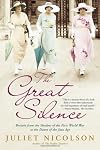
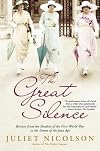
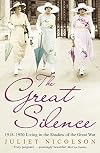
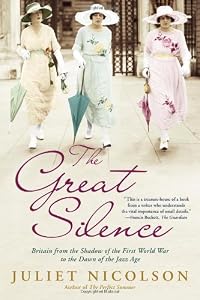
I should comment, finally, on the jacket design and subtitle chosen (presumably) by Juliet Nicolson's American publisher. When I was sitting with this book on my lap, my wife asked me why I was "reading such a girly book." Indeed, the purple color of the book jacket, the swirling cursive typeface, and the cover image of three young women in pastel dresses are all oddly out of place for this book. If anything, they suggest a romance novel. While my own imagined cover design -- featuring the powerful portrait "Grief" by Hugh Cecil, reproduced and discussed in the book -- might be TOO bleak, I notice the original UK edition of "The Great Silence" features a much more somber photo. It also subtitles the book "Living in the Shadow of the Great War," which I think is more accurate than "Britain from the Shadow of the First World War to the Dawn of the Jazz Age," which I think does a disservice to the scope of this book.
So read it with the dust jacket off if you want. But I definitely encourage students of history or social movements, Anglophiles, or just fans of moving stories well told, to read "The Great Silence." It would also be a powerful reminder to those tempted to glorify war, militarism, and "national greatness" of the huge and largely unforeseen costs of blithely sending young men into battle. show less
My initial assumption was that "The Great Silence" would be something like The Long Week-End: A Social History of Great Britain 1918-1939, the classic study of life in Britain between the wars by Robert Graves (who, as it happens, shows up several times in this book). In fact, "The Great Silence" is more narrowly focused in several senses. For one thing, the scope of the book lies mostly between 1918 and 1920 -- or, more precisely, between Armistice Day and the interment of the Unknown Warrior on the second anniversary of the armistice. But more importantly, instead of writing about trends and social movements, or getting mired in statistical or polling data, the author tells her story almost entirely through the eyes of specific people and their stories. What "The Great Silence" ended up reminding me of, far more than "The Long Week-End," was Walter Lord's Day of Infamy: The Classic Account of the Bombing of Pearl Harbor (not an obvious comparison, perhaps, but one that came to me because I've read and re-read Lord's book many times).
But while it's one thing to recount a discrete event like Pearl Harbor through the eyes of the participants, it's something much bigger and (I imagine) more difficult to survey an entire era, across places and social conditions, the same way. Juliet Nicolson has done a remarkable job. Her narrative moves with ease between the high and mighty on one hand and the maimed, destitute, and broken on the other, telling each story with grace and sympathy. In these pages, the Duke of Devonshire and Lady Diana Manners, for instance, share attention with maid Doris Scovell, pioneering and heroic plastic surgeon Harold Gillies, and three-year-old Pam Parish. It's kind of a pontillistic way of telling a story, and indeed I see some reviewers complaining that the author has missed "the big picture."
I would argue the individual stories ARE "the big picture." In fact, because the narrative here is so intensely personal, the sense of grief and loss, of deprivation and pain, can affect the reader as well. Events that were cathartic in their time, like the dedication of the Cenotaph or the interment of the Unknown Warrior mentioned before, can be cathartic for the reader too. But at the same time, "The Great Silence" contains, and ends on, notes of optimism and hope that lift the mood tremendously. They keep this from being a depressing book -- even for modern readers aware of what lies less than two decades ahead. It's an impressive emotional balance.
I should comment, finally, on the jacket design and subtitle chosen (presumably) by Juliet Nicolson's American publisher. When I was sitting with this book on my lap, my wife asked me why I was "reading such a girly book." Indeed, the purple color of the book jacket, the swirling cursive typeface, and the cover image of three young women in pastel dresses are all oddly out of place for this book. If anything, they suggest a romance novel. While my own imagined cover design -- featuring the powerful portrait "Grief" by Hugh Cecil, reproduced and discussed in the book -- might be TOO bleak, I notice the original UK edition of "The Great Silence" features a much more somber photo. It also subtitles the book "Living in the Shadow of the Great War," which I think is more accurate than "Britain from the Shadow of the First World War to the Dawn of the Jazz Age," which I think does a disservice to the scope of this book.
So read it with the dust jacket off if you want. But I definitely encourage students of history or social movements, Anglophiles, or just fans of moving stories well told, to read "The Great Silence." It would also be a powerful reminder to those tempted to glorify war, militarism, and "national greatness" of the huge and largely unforeseen costs of blithely sending young men into battle. show less
The Great Silence: Britain from the Shadow of the First World War to the Dawn of the Jazz Age, by Juliet Nicolson, covers just two years of British history, from the Armistice of 1918 to Armistice Day of 1920, but it packs a lot of history in that short period of time. About 1/3 of English men between the ages of 20 and 24 were killed or permanently wounded in World War I (which is not as high a percentage as France or Germany, but still), and the world that the survivors returned to was very different from the one they had left. There was scarcely a family in the United Kingdom that had not lost a son, father, brother, husband, and of those who did return, many suffered from what we now called post traumatic stress disorder, then known show more as "shell shock." There were new industries opened up by the war, including that of plastic surgery (because of the necessity for at least some kind of reconstruction of faces that had been blown apart), and Juliet Nicolson details these and other changes in the world of post-war England. She is the grand-daughter of Vita Sackville-West, a notable aristocrat of the Edwardian era, and so has access to documents and oral histories that others might not be able to attain, but she also chronicles the changes in the lives of the "lower classes" as well, of which there were many. Primarily, however, this book is about the grief of a nation and how it was, and was not, expressed in the collective culture. The famed British "stiff upper lip" resulted in a type of mourning that was silent and hidden, but the shock caused to the culture as a whole by the Great War was such that it couldn't just be ignored or denied, and Nicolson describes some of the ways in which it manifested over those first two years after the end of hostilities. A really interesting, well-written book, albeit lacking in footnotes (something I usually require when reading histories), but one that might only be to the tastes of a person, like me, who is interested in the historical changes, both small and large, brought about by calamitous events. show less
A collection of personal snapshots from the two years between Armistice Day and the Burial of the Unknown Soldier, anchored in the center by the two-minute Great Silence observed in all of Great Britain on Armistice Day 1919.
Ms. Nicolson writes "history from below" in the sense that this is not primarily the story of the politics of Britain of the time (except in the ways the movements from below affected them), but about how different people acted and reacted in the immediate aftermath of the trauma of World War I and the changes which immediately enveloped Britain. Butlers found their services no longer needed or afforded, the mobility offered by the automobile offered entrepreneurs new opportunity, and the newly-developed science of show more plastic surgery eased the suffering of men deformed by the ghastly wounds suffered at the front. Ms. Nicolson does not tell us these things happened; she shows us by telling the stories, reconstructed by diaries and letters, of those who lived the changes.
As a pastor, I was interested in how religion figured in this history. Religious observance declined after the war for three reasons: the lack of the corpse of the war dead meant no funerals (hadn't they ever heard of a memorial service?); and there were fewer marriages and fewer baptisms. But there was also a sense that religion had failed and simply become a cheerleader for the war. I don't know that this is untrue, but I wish that Ms. Nicolson had included among her snapshots religious folk who were trying to come to grips with that very question.
In Europe in 1919, Karl Barth wrote his monumental commentary on Romans, the first shot fired (if you will) by the Neo-Orthodox who rejected their teachers' blind acceptance of the necessity of war. In Britain, the monuments of the inter-war years include the Service of Lessons and Carols from Cambridge, begun in 1919 as a response to the tragedy of the war. 92 years later it survives and thrives, and is broadcast around the world, as much a relic of the time of The Great Silence as any, and a constructive Christian response at that.
Ms. Nicolson's book is well-written, its strength lying in her attention to detail, which makes the few typographical and factual errors more jarring. It is a work that may lead to further reading as we approach the hundredth anniversary of "The War to End All Wars." show less
Ms. Nicolson writes "history from below" in the sense that this is not primarily the story of the politics of Britain of the time (except in the ways the movements from below affected them), but about how different people acted and reacted in the immediate aftermath of the trauma of World War I and the changes which immediately enveloped Britain. Butlers found their services no longer needed or afforded, the mobility offered by the automobile offered entrepreneurs new opportunity, and the newly-developed science of show more plastic surgery eased the suffering of men deformed by the ghastly wounds suffered at the front. Ms. Nicolson does not tell us these things happened; she shows us by telling the stories, reconstructed by diaries and letters, of those who lived the changes.
As a pastor, I was interested in how religion figured in this history. Religious observance declined after the war for three reasons: the lack of the corpse of the war dead meant no funerals (hadn't they ever heard of a memorial service?); and there were fewer marriages and fewer baptisms. But there was also a sense that religion had failed and simply become a cheerleader for the war. I don't know that this is untrue, but I wish that Ms. Nicolson had included among her snapshots religious folk who were trying to come to grips with that very question.
In Europe in 1919, Karl Barth wrote his monumental commentary on Romans, the first shot fired (if you will) by the Neo-Orthodox who rejected their teachers' blind acceptance of the necessity of war. In Britain, the monuments of the inter-war years include the Service of Lessons and Carols from Cambridge, begun in 1919 as a response to the tragedy of the war. 92 years later it survives and thrives, and is broadcast around the world, as much a relic of the time of The Great Silence as any, and a constructive Christian response at that.
Ms. Nicolson's book is well-written, its strength lying in her attention to detail, which makes the few typographical and factual errors more jarring. It is a work that may lead to further reading as we approach the hundredth anniversary of "The War to End All Wars." show less
Picked this up in the library- it seemed kind of apposite for our current situation.
Asking "what was it LIKE?" in the immediate aftermath of WW1, the author tries to give an overall picture of Britain at that time. That's a pretty big ask, and she creates a collage of different experiences- from the Royals, the famous and the man in the street.
She looks at events- the interment of the Unknown Soldier, the first two minute silence, the increasing dissatisfaction and protest by the jobless demobbed men, the bereaved sadly coming to terms with their lot..
Bits are very moving. Some, while interesting, don't quite seem to gel. I was quite fascinated by Ottoline Morrell's lovers...but did that really have any bearing on the War? Or she show more begins a narrative...and then slides off to another, leaving you wanting more.
So interesting, not a heavy read, informative....fair. show less
Asking "what was it LIKE?" in the immediate aftermath of WW1, the author tries to give an overall picture of Britain at that time. That's a pretty big ask, and she creates a collage of different experiences- from the Royals, the famous and the man in the street.
She looks at events- the interment of the Unknown Soldier, the first two minute silence, the increasing dissatisfaction and protest by the jobless demobbed men, the bereaved sadly coming to terms with their lot..
Bits are very moving. Some, while interesting, don't quite seem to gel. I was quite fascinated by Ottoline Morrell's lovers...but did that really have any bearing on the War? Or she show more begins a narrative...and then slides off to another, leaving you wanting more.
So interesting, not a heavy read, informative....fair. show less
Brilliant. This is a fantastic book. It's rare to find someone who adores research and has the gift of storytelling. Not every author is capable of adding humanity to history, creating wonderful bits of scholarly achievement and leaving the reader somewhat less charmed. Nicolson delicately pieces the tales together. It's quite a bit like one of those pictures made of thousands of smaller images. You comprehend the parts and they make up the whole without losing anything in the process.
What a page-turner! Nicolson's book is very readable and although the presentation is disjointed (she jumps from one quote to the next and you'd better be wide awake before reading this), it makes it lively and very vivid. It gives a great sense of the period and of the atmosphere at the time. One caveat though: as the cover suggests, Nicolson's more interested in the wealthy and how society changed for them, sometimes with little mention of how those changes were huge advancements for other people (one example that comes to mind, her mentioning quite mournfully how domestic staff was hard to find after the War, ignoring how appalling the working conditions were for them, no wonder they wanted out).
Members
- Recently Added By
Lists

Books Read in 2014
2,343 works; 86 members
Author Information

6+ Works 1,546 Members
Juliet, Nicolson is the author of two works of history, The Great Silence: Britain from the Shadow of the First World War to the Dawn of the Jazz Age and The Perfect Summer: England 1911, Just Before the Storm, and a novel. Abdication. She lives with her husband in East Sussex, not far from Sissinghurst, where she spent her childhood. She has two show more daughters, Clemmie and Flora, and one granddaughter, Imogen. show less
Common Knowledge
- Original publication date
- 2009
- People/Characters
- Lady Diana Cooper; D. H. Lawrence; Mary of Teck, Queen Consort of the United Kingdom; George V, King of the United Kingdom
- Important places
- London, England, UK
- Important events
- World War I (1914 | 1918); Armistice Day - World War I; Interbellum (1918 | 1939); Jazz Age
- Epigraph
- Slowly, slowly, the wound to the soul begins to make itself felt, like a bruise which only slowly deepens its terrible ache, till it fills the psyche. And when we think we have recovered and forgotten, it is then that the ter... (show all)rible after-effects have to be encountered at their worst. -- D.H. Lawrence, Lady Chatterley's Lover
- Dedication
- For my brother Adam il miglior fabbro and for my daughters Clemmie and Flora luces meae vitae and for my husband Charlie sine qua non
- First words
- This is a book about silence, the silence that followed the 'incessant thunder' of the four years and four months of the First World War.
- Last words
- (Click to show. Warning: May contain spoilers.)In that moment, a glorious day in which alone in the silence of her own company it seemed that 'every colour was clearer, every air was fresher than on ordinary days - as though the world was having a birthday', she challenged anyone to contradict her when she cried, 'How can one help loving it?'
- Blurbers
- Brown, Craig; Ziegler, Philip; Rennison, Nick; Nicholson, Virginia
Classifications
- Genres
- History, Nonfiction, General Nonfiction
- DDC/MDS
- 941.083 — History & geography History of Europe British Isles Historical periods of British Isles 1837- Period of Victoria and House of Windsor 1910-1936 George V
- LCC
- DA577 .N47 — History of Europe, Asia, Africa and Oceania Great Britain History of Great Britain England History By period Modern, 1485- 20th century
- BISAC
Statistics
- Members
- 390
- Popularity
- 79,724
- Reviews
- 16
- Rating
- (3.72)
- Languages
- English
- Media
- Paper, Audiobook, Ebook
- ISBNs
- 10
- ASINs
- 7