
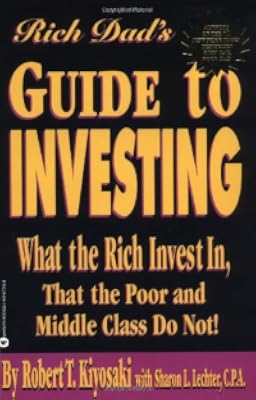
Rich Dad's Guide to Investing: What the Rich Invest in, That the Poor and the Middle Class Do Not!
by Robert T. Kiyosaki, Sharon L. Lechter
Rich Dad
On This Page
Description
Investing means different things to different people and there is a huge difference between passive investing and becoming an active, engaged investor. Rich Dad's Guide to Investing, one of the three core titles in the Rich Dad Series, covers the basic rules of investing, how to reduce your investment risk, how to convert your earned income into passive income plus Rich Dad's 10 Investor Controls.The Rich Dad philosophy makes a key distinction between managing your money and growing it and show more understanding key principles of investing is the first step toward creating and growing wealth. This book delivers guidance, not guarantees, to help anyone begin the process of becoming an active investor on the road to financial freedom. show lessTags
Recommendations


Member Reviews
I picked this up to listen to on the bus. I sometimes got annoyed with the gimmick of referring to his "rich dad". He does a lot of promoting of his other books and products.
To sum it up - start a business, invest using the business.
I did find his point of your home not being an asset. It has value which you could get when you sell, but until if in when you sell it is costing you money and bringing nothing in.
I wonder how his "poor dad" feels about being held up as what not to do? It seems like he considers his "poor dad" a failure.
To sum it up - start a business, invest using the business.
I did find his point of your home not being an asset. It has value which you could get when you sell, but until if in when you sell it is costing you money and bringing nothing in.
I wonder how his "poor dad" feels about being held up as what not to do? It seems like he considers his "poor dad" a failure.
A very controversial book. I believe Rich Dad is fictional. Some interesting information in it nonetheless. To become rich, one has to run a business: working a 9-5 job and a good education will not get your rich.
Bearing in mind that this book is directed at teaching your children, the first half is fairly introductory, but the second half launches into more tax-related ideas. In addition, I prefer a financial book that is a little more practical rather than heavy on the exhortation.
What I learned or what was reinforced:
* Don't quit your day job to become an investor!
* Keep learning, especially about finance and investment.
* The required financial knowledge is (1) accounting; (2) investment strategy; (3) market research; (4) law, specifically tax law.
* Paying yourself first means buying assets first and then paying your expenses, even if you miss a payment--with the admonition against piling up consumer debt, mainly credit card debt. (My thought show more is probably because it immediately accrues interest, late charges, and other fees. He could do a better job of explaining this.)
* Assets are things that generate you income without you being there. For example, royalties from books. Yay!
* Don't invest in something or buy an asset that you don't love; you won't take care of it.
* Go broke before you're 30; you'll still have time to recover.
* The US income tax was made permanent in 1913.
* Passive investments (for example, stocks, bonds, mutual funds, real estate) are generally taxed less than regular income.
* Corporations (probably LLCs too--but they are also superior to sole proprietorships) are not taxed as heavily as individuals and they can deduct many more expenses than individuals.
* Because the "rich" are more heavily invested in passive investments and corporations, they are not taxed as much as the poor or middle class.
* 1031 tax-deferred exchange = if you buy another property with the proceeds of another property sale, then you can defer taxes on that sale. Don't know if it still exists.
* Teach your kids how to invest. show less
What I learned or what was reinforced:
* Don't quit your day job to become an investor!
* Keep learning, especially about finance and investment.
* The required financial knowledge is (1) accounting; (2) investment strategy; (3) market research; (4) law, specifically tax law.
* Paying yourself first means buying assets first and then paying your expenses, even if you miss a payment--with the admonition against piling up consumer debt, mainly credit card debt. (My thought show more is probably because it immediately accrues interest, late charges, and other fees. He could do a better job of explaining this.)
* Assets are things that generate you income without you being there. For example, royalties from books. Yay!
* Don't invest in something or buy an asset that you don't love; you won't take care of it.
* Go broke before you're 30; you'll still have time to recover.
* The US income tax was made permanent in 1913.
* Passive investments (for example, stocks, bonds, mutual funds, real estate) are generally taxed less than regular income.
* Corporations (probably LLCs too--but they are also superior to sole proprietorships) are not taxed as heavily as individuals and they can deduct many more expenses than individuals.
* Because the "rich" are more heavily invested in passive investments and corporations, they are not taxed as much as the poor or middle class.
* 1031 tax-deferred exchange = if you buy another property with the proceeds of another property sale, then you can defer taxes on that sale. Don't know if it still exists.
* Teach your kids how to invest. show less
This book helps to find out HOW to use your money to make money for you.
Where: Trivandrum, Goa, Rishikesh
Where: Trivandrum, Goa, Rishikesh
Members
- Recently Added By
Author Information

239+ Works 18,812 Members
Robert Kiyosaki was born and raised in Hawaii, and is a fourth-generation Japanese-American. He attended college in New York, and after graduating, joined the Marine Corps and served in Vietnam as an officer and helicopter gunship pilot. After the war, Robert worked for the Xerox Corporation as a salesman. In 1977, he started a company that show more brought the first nylon Velcro 'surfer wallets' to market. In 1985 he founded an international education company that taught business and investing to students throughout the world. In 1994 Robert sold his business and retired at the age of 47. During this somewhat short-lived retirement, Robert, collaborating with co-author Sharon Lechter, a C.P.A. and his business partner, wrote the bestselling book "Rich Dad, Poor Dad". (Bowker Author Biography) show less

29 Works 16,961 Members
Series

Common Knowledge
- Original publication date
- 2000
Classifications
Statistics
- Members
- 1,292
- Popularity
- 18,749
- Reviews
- 9
- Rating
- (3.63)
- Languages
- 11 — Chinese, English, French, Indonesian, Italian, Japanese, Polish, Portuguese, Russian, Serbian, Spanish
- Media
- Paper, Audiobook, Ebook
- ISBNs
- 48
- UPCs
- 3
- ASINs
- 9