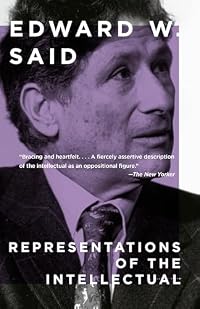
Representations of the Intellectual: The 1993 Reith Lectures
by Edward W. Said
On This Page
Description
"Celebrated humanist, teacher, and scholar, Edward W. Said here examines the ever-changing role of the intellectual today. In these six stunning essays - delivered on the BBC as the prestigious Reith Lectures - Said addresses the ways in which the intellectual can best serve society in the light of a heavily compromised media and of special interest groups who are protected at the cost of larger community concerns. Said suggests a recasting of the intellectual's vision to resist the lures of show more power, money, and specialization. in these powerful pieces, Said eloquently illustrates his arguments by drawing on such writers as Antonio Gramsci, Jean-Paul Sartre, Regis Debray, Julien Benda, and Adorno, and by discussing current events and celebrated figures in the world of science and politics: Robert Oppenheimer, Henry Kissinger, Dan Quayle, Vietnam, and the Gulf War." "Said sees the modern intellectual as an editor, journalist, academic, or political adviser - in other words, a highly specialized professional - who has moved from a position of independence to an alliance with powerful institutional organizations. He concludes that it is the exile-immigrant, the expatriate, and the amateur who must uphold the traditional role of the intellectual as the voice of integrity and courage, able to speak out against those in power."--BOOK JACKET. show lessTags
Recommendations


Member Reviews
“Representations of the Intellectual” is a compilation of the six Reith Lectures that Edward Said delivered over BBC Radio in 1993. The title is somewhat misleading: Said doesn’t really examine representations of intellectuals so much as offers a prescriptive way he thinks they should function within a society. His particular interest is the intellectual in the late twentieth century, confronted as they sometimes are on all fronts with ideological and political concerns. How is the intellectual to align himself or herself with these, or should they?
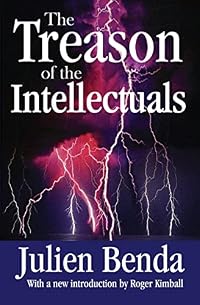
The title essay was for me the most interesting, drawing a sharp distinction between the conceptions of the intellectual developed by Antonio Gramsci and Julien Benda. Gramsci himself show more discerns between two types of intellectuals. Traditional intellectuals are the “teachers, priests, and administrators, who continue to do the same thing from generation to generation,” while organic intellectuals are “directly connected to classes or enterprises that use intellectuals to organize interests, gain more power, get more control” (p. 4). Gramsci thought that everyone has the potential to be an intellectual, even if some people do not function as intellectuals in society. In his 1927 essay “The Betrayal of the Intellectuals,” Julien Benda’s decidedly less demotic, even Platonic, ideal of an intellectual suggests that they are “a tiny band of super-gifted and morally endowed philosopher-kings who constitute the conscience of mankind” (p. 4-5). Benda thought intellectuals had largely given up the objective, dispassionate analysis of issues and had become corrupted by special interests, politics, and vulgar nationalism. Said uses Gramsci and Benda as touchstones throughout the essays for what he thinks the intellectual should, and shouldn’t, strive toward.
The rest of the essays revolve around a small number of reoccurring themes. The intellectual should always wear the mantle of the exile if not literally, then at least figuratively. Henry Kissinger and Zbigniew Brzezinski are two such figures, even though Said displays sublime self-control in not pointing out that they both used their intellectual firepower to further the hegemonic interests of the most powerful nation in the world. Said also favors the approach of the amateur over that of the professional. The professional is epitomized by the “impossible to understand classroom technician, hired by committee, anxious to please various patrons and agencies, bristling with academic credentials and a social authority that does not promote debate but established reputations and intimidates non-experts” (p. 72). Instead, the amateur (literally, one spurred on by care and affection) works outside, or at least in addition to, his or her narrow specialization in an effort to understand matters in a broader context.
This is a solid foundation, but left a lot of important questions are completely unconsidered. What about those intellectuals who seemingly do align themselves with avowed political concerns? Do Noam Chomsky’s endorsement of anarcho-syndicalism and continued skepticism regarding many American foreign policy decisions mean that he cannot be considered an intellectual? Apparently not, as Said refers to him approvingly at least once.
And while the scope of a set of six lectures, each originally a radio address with a duration of thirty minutes, is almost necessarily narrow, the essays don’t address the dynamic change in the role of the intellectual over the centuries. While Said’s ideal of the intellectual is almost necessarily a public intellectual, such a thing would have never existed in medieval Europe. Would the fact that a member of the medieval clerisy was almost always a member of the Church change anything here? Or that the Renaissance artist was always beholden to a wealthy Maecenas, whether religious or secular? I realize that these questions are beyond the scope of Said’s project, but I found myself wishing for a book-length treatment that would have given them thoughtful consideration.
Most of the material here is a noncontroversial adumbration of what has been said about intellectuals by others: the intellectual should (excuse the cliché) “speak truth to power,” shouldn’t be the tool of political or ideological interests, should eschew narrow professionalism. Having previously read Said’s “Orientalism” and “On Late Style,” both of which were innovative and thought-provoking, I found these essays to be relatively conservative. For the most part, the intellectual as exile, as someone not beholden to deeply entrenched ideological or political interests, and as passionate amateur are not new. Reading Said always leaves me wanting the wild-eyed radical that he is so often accused of being by predominant American neoconservatives, although in this case, I was left with something much more pragmatic and altogether cautious. show less
The title essay was for me the most interesting, drawing a sharp distinction between the conceptions of the intellectual developed by Antonio Gramsci and Julien Benda. Gramsci himself show more discerns between two types of intellectuals. Traditional intellectuals are the “teachers, priests, and administrators, who continue to do the same thing from generation to generation,” while organic intellectuals are “directly connected to classes or enterprises that use intellectuals to organize interests, gain more power, get more control” (p. 4). Gramsci thought that everyone has the potential to be an intellectual, even if some people do not function as intellectuals in society. In his 1927 essay “The Betrayal of the Intellectuals,” Julien Benda’s decidedly less demotic, even Platonic, ideal of an intellectual suggests that they are “a tiny band of super-gifted and morally endowed philosopher-kings who constitute the conscience of mankind” (p. 4-5). Benda thought intellectuals had largely given up the objective, dispassionate analysis of issues and had become corrupted by special interests, politics, and vulgar nationalism. Said uses Gramsci and Benda as touchstones throughout the essays for what he thinks the intellectual should, and shouldn’t, strive toward.
The rest of the essays revolve around a small number of reoccurring themes. The intellectual should always wear the mantle of the exile if not literally, then at least figuratively. Henry Kissinger and Zbigniew Brzezinski are two such figures, even though Said displays sublime self-control in not pointing out that they both used their intellectual firepower to further the hegemonic interests of the most powerful nation in the world. Said also favors the approach of the amateur over that of the professional. The professional is epitomized by the “impossible to understand classroom technician, hired by committee, anxious to please various patrons and agencies, bristling with academic credentials and a social authority that does not promote debate but established reputations and intimidates non-experts” (p. 72). Instead, the amateur (literally, one spurred on by care and affection) works outside, or at least in addition to, his or her narrow specialization in an effort to understand matters in a broader context.
This is a solid foundation, but left a lot of important questions are completely unconsidered. What about those intellectuals who seemingly do align themselves with avowed political concerns? Do Noam Chomsky’s endorsement of anarcho-syndicalism and continued skepticism regarding many American foreign policy decisions mean that he cannot be considered an intellectual? Apparently not, as Said refers to him approvingly at least once.
And while the scope of a set of six lectures, each originally a radio address with a duration of thirty minutes, is almost necessarily narrow, the essays don’t address the dynamic change in the role of the intellectual over the centuries. While Said’s ideal of the intellectual is almost necessarily a public intellectual, such a thing would have never existed in medieval Europe. Would the fact that a member of the medieval clerisy was almost always a member of the Church change anything here? Or that the Renaissance artist was always beholden to a wealthy Maecenas, whether religious or secular? I realize that these questions are beyond the scope of Said’s project, but I found myself wishing for a book-length treatment that would have given them thoughtful consideration.
Most of the material here is a noncontroversial adumbration of what has been said about intellectuals by others: the intellectual should (excuse the cliché) “speak truth to power,” shouldn’t be the tool of political or ideological interests, should eschew narrow professionalism. Having previously read Said’s “Orientalism” and “On Late Style,” both of which were innovative and thought-provoking, I found these essays to be relatively conservative. For the most part, the intellectual as exile, as someone not beholden to deeply entrenched ideological or political interests, and as passionate amateur are not new. Reading Said always leaves me wanting the wild-eyed radical that he is so often accused of being by predominant American neoconservatives, although in this case, I was left with something much more pragmatic and altogether cautious. show less
One of those rare books that makes you feel less alone.
A good introduction to the main ideas of Edward Said.
The eith Lectures and broadcast by the BBC
They have a great web site
http://www.bbc.co.uk/radio4/reith2008/index.shtml
There is an archive - from 1999 , 2007 plus some excerpts from some of the earlier classics., but, alas , not this one.
They have a great web site
http://www.bbc.co.uk/radio4/reith2008/index.shtml
There is an archive - from 1999 , 2007 plus some excerpts from some of the earlier classics., but, alas , not this one.
Ratings
Members
- Recently Added By
Lists

Universtiy of Toronto - NMC473/2173H - Intellectuals of the Arab World
91 works; 2 members
Author Information

105+ Works 16,734 Members
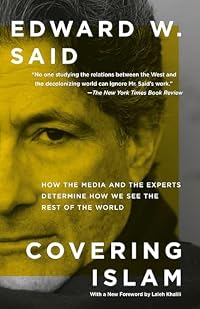
Born in Jerusalem and educated at Victoria College in Cairo and at Princeton and Harvard universities, Edward Said has taught at Columbia University since 1963 and has been a visiting professor at Harvard and Johns Hopkins University. He has had an unusual dual career as a professor of comparative literature, a recognized expert on the novelist show more and short story writer Joseph Conrad, (see Vol. 1) and as one of the most significant contemporary writers on the Middle East, especially the Palestinian question and the plight of Palestinians living in the occupied territories. Although he is not a trained historian, his Orientalism (1978) is one of the most stimulating critical evaluations of traditional Western writing on Middle Eastern history, societies, and literature. In the controversial Covering Islam (1981), he examined how the Western media have biased Western perspectives on the Middle East. A Palestinian by birth, Said has sought to show how Palestinian history differs from the rest of Arabic history because of the encounter with Jewish settlers and to present to Western readers a more broadly representative Palestinian position than they usually obtain from Western sources. Said is presently Old Dominion Foundation Professor in the Humanities at Columbia, editor of Arab Studies Quarterly, and chair of the board of trustees of the Institute of Arab Studies. He is a member of the Palestinian National Council as well as the Council on Foreign Relations in New York. (Bowker Author Biography) Edward W. Said is University Professor of English & Comparative Literature at Columbia University. He is the author of nineteen books, including "Orientalism" (which was nominated for a National Book Critics Circle Award), "Culture & Imperialism", "The End of the Peace Process", & "Out of Place", a memoir. He lives in New York City. (Bowker Author Biography) show less
Series
Belongs to Publisher Series
Reith Lectures (1993)
Heibonsha Library (236)
Common Knowledge
- Canonical title*
- Manifestaties van de intellectueel
- Original title
- representations of the intellectual
- Original publication date
- 1994
- Dedication*
- Vooe ben Sonnenberg
*Some information comes from Common Knowledge in other languages. Click "Edit" for more information.
Classifications
- Genres
- Nonfiction, General Nonfiction, Philosophy, History, Literature Studies and Criticism
- DDC/MDS
- 305.552 — Society, Government, and Culture Social sciences, sociology & anthropology Social group - Age, Gender, Ethnicity People by social and economic levels Middle Class Intelligentsia, Intellectuals
- LCC
- HM213 .S225 — Social sciences Sociology (General) Sociology These are obsolete numbers no longer used
- BISAC
Statistics
- Members
- 623
- Popularity
- 46,562
- Reviews
- 4
- Rating
- (4.01)
- Languages
- 14 — Chinese, Dutch, English, Finnish, French, German, Greek, Italian, Japanese, Norwegian (Bokmål), Portuguese, Spanish, Swedish, Turkish
- Media
- Paper, Ebook
- ISBNs
- 25
- ASINs
- 3