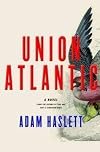
Union Atlantic
by Adam Haslett
On This Page
Description
At the heart of this novel lies a test of wills between a young banker, Doug Fanning, and a retired schoolteacher, Charlotte Graves, whose two dogs have begun to speak to her. When Doug builds an ostentatious mansion on land that Charlotte's grandfather donated to the town of Finden, Massachusetts, she determines to oust him in court. As a senior manager of Union Atlantic bank, a major financial conglomerate, Doug is embroiled in the company's struggle to remain afloat. It is Charlotte's show more brother, Henry Graves, the president of the New York Federal Reserve, who must keep a watchful eye on Union Atlantic and the entire financial system. Drawn into Doug and Charlotte's intensifying conflict is Nate Fuller, a troubled high-school senior who unwittingly stirs powerful emotions in each of them. show lessTags
Recommendations















Member Reviews
Adam Haslett is one of a group of talented writers (Jonathan Dee, Michael Mewshaw, Dan Chaon) describing turn of the century social and personal dilemmas in their novels. The novelty of the books is not in the themes explored; they appear in fiction at the beginning of each century. Themes involving social responsibility, personal accountability, the rule of law, ethics, insight, and absolute/relative truth have been explored by many great authors(e.g., Thomas Mann in The Magic Mountain). It is the interpretation of time in its current context, how it is structured and understood by societies and individuals, that make these contemporary authors stand out now.
Union Atlantic is an exciting story of high finance with well-developed and show more interesting characters who try to make sense of the times they are in and gain insight into their own psychological development. The action is centered on the activities of a New York bank that grew as a traditional money lending institution in the volatile economy of the first decade of the 21st Century. As a result of aggressive financial tactics, at first within the letter of the law, Union Atlantic distanced itself from tradition and became a leader in international trading. The novel concerns the consequences of the separation of traditional ethics and current banking practices, the rejection of historical rules and the establishment of risky procedures justified by present opportunities.
The characters are affected by their social history and current events in a similar way in the post 9/11 world. Nate associates with economically advantaged teenage peers who are largely ignorant of history. The focus of his life involves trying to understand his emerging personal desires without the historical context of abiding moral standards. Doug, at 37, is the chief high stakes organizer at Union Atlantic. He was educated in traditional business practices, but understands his personal responsibility on a short term basis, as if old standards are irrelevant in the current financial climate. Charlotte, a retired high school history teacher, understands the connection between American history and her own life path. She sees a common pattern in the apparent chaos of both time lines, rejecting her comfortable solitude after realizing her inner life is only one part of her story.
The integrity of the bank depends on public trust and the parallel integrity of the characters depends personal trust. The bank can stay in business if the public has faith in the long term propriety of its transactions. The current context allows for some violation of this standard as long as the current activities show a profit. The characters can live with themselves as long as they have faith in the long term propriety of love. The current context allows for some violation of this standard as long as immediate needs are met. The problem with both violations is that the phrase, `as long as,' in the novel is short term. The real dilemma for Union Atlantic and the characters is the integration of lessons of the past with actions in present circumstances.
I strongly recommend Adam Haslett's novel, Union Atlantic to readers who like an exciting story and insightful character development. I predict that the themes will be repeated in a new context by novelists in the first decade of the 22nd Century. show less
Union Atlantic is an exciting story of high finance with well-developed and show more interesting characters who try to make sense of the times they are in and gain insight into their own psychological development. The action is centered on the activities of a New York bank that grew as a traditional money lending institution in the volatile economy of the first decade of the 21st Century. As a result of aggressive financial tactics, at first within the letter of the law, Union Atlantic distanced itself from tradition and became a leader in international trading. The novel concerns the consequences of the separation of traditional ethics and current banking practices, the rejection of historical rules and the establishment of risky procedures justified by present opportunities.
The characters are affected by their social history and current events in a similar way in the post 9/11 world. Nate associates with economically advantaged teenage peers who are largely ignorant of history. The focus of his life involves trying to understand his emerging personal desires without the historical context of abiding moral standards. Doug, at 37, is the chief high stakes organizer at Union Atlantic. He was educated in traditional business practices, but understands his personal responsibility on a short term basis, as if old standards are irrelevant in the current financial climate. Charlotte, a retired high school history teacher, understands the connection between American history and her own life path. She sees a common pattern in the apparent chaos of both time lines, rejecting her comfortable solitude after realizing her inner life is only one part of her story.
The integrity of the bank depends on public trust and the parallel integrity of the characters depends personal trust. The bank can stay in business if the public has faith in the long term propriety of its transactions. The current context allows for some violation of this standard as long as the current activities show a profit. The characters can live with themselves as long as they have faith in the long term propriety of love. The current context allows for some violation of this standard as long as immediate needs are met. The problem with both violations is that the phrase, `as long as,' in the novel is short term. The real dilemma for Union Atlantic and the characters is the integration of lessons of the past with actions in present circumstances.
I strongly recommend Adam Haslett's novel, Union Atlantic to readers who like an exciting story and insightful character development. I predict that the themes will be repeated in a new context by novelists in the first decade of the 22nd Century. show less
Here's a novel that takes the most recent financial meltdown and gives it character(s). There's the hotshot banker who's shorting the Nikkei, risking the solvency of his employer; there's the brittle, brilliant, slightly senile old woman who reviles him and wants to see his McMansion razed; there's the woman's brother, who works for the Federal Reserve and will soon find himself dealing with crises both professional and personal. This book reads like a thriller but stays with you because the characters are memorable, even the ones it would be easy to revile. The POV changes several times, and the author makes you feel that any one of the people he's created would be worth following for a few hundred pages. In the novel's longest scene, show more a chapter set at a 4th of July party, all the POVs converge in a virtuosic manner that arouses a "Wow." Highly recommended. show less
Watching the Congressional hearings into Goldman Sachs made me appreciate the prescience of Adam Haslett's brilliant novel, Union Atlantic.
Written in the year before the economic collapse of 2009, Haslett's novel features a young gun investment banker, Doug Fanning, whom we first meet in 1988 when he is stationed on a US naval ship that is escorting Kuwaiti tankers through the Straits of Hormuz. Fanning sees an unidentified plane on his radar, and alerts his commander. A decision is made to fire upon the plane and 290 people lost their lives as their Iranian Airbus passenger jet was shot down by the Americans.
The incident gets covered up, as well as the fact that Fanning failed to tell his commander that the jet was ascending, not show more descending as the commander was told. This incident and its aftermath leads Fanning to become the kind of man who later sets in motion a financial disaster that threatens the U.S. banking system.
Fanning becomes a big success as an investment banker at Union Atlantic. He takes risks there as well, and as long as he produces big profits for the bank and in turn himself, he can cut all the corners he likes. His boss is willfully ignorant of Fanning's schemes.
When Fanning builds a huge McMansion next to property owned by Charlotte Graves, he underestimates her. The land was owned by her grandfather, and Charlotte believes his house is obscene. Charlotte, a retired teacher, is eccentric, slipping into insanity. She believes that her two dogs are the incarnated Malcolm X and Cotton Mather, and they frequently share their conflicting advice with Charlotte.
Charlotte ends up tutoring Nate, a teenage boy whose father recently committed suicide. Nate and his mother are barely existing together. He breaks into Fanning's home, and ends up in a dangerous sexual relationship with Fanning. Fanning wants Nate to help get Charlotte off his back, and he is willing to use Nate's vulnerability to get what he wants.
When a colleague working for Fanning runs a scheme that unravels, Charlotte brother Henry Graves, the president of the New York Federal Reserve, becomes involved in trying to keep this from ruining the entire entangled U. S. economy. (Hank Paulson, anyone?)
How Haslett weaves these stories together is a wonder. He doesn't write this novel, he crafts it. It took me along time to read this book because I frequently reread passages, they were that beautiful. Of Nate realizing that Charlotte needed him, he writes
These last many months the intuition of others' needs had become Nate's second nature, as if his father's going had cut him a pair of new, lidless eyes that couldn't help but see into a person such as this this: marooned and specter-driven.
His characters are vivid and complex. Nate is flailing about, wanting to be loved and willing to debase himself to do it. Charlotte is a genius, bordering on insane, and Fanning is amoral, sinking further into the morass.
It is astonishing that a fiction writer created this dialogue in 2008, when Henry the NY Fed Chair says to the CEO of Union Atlantic
"Let me start by saying that if you or your board is under the impression that Union Atlantic is too big to fail, you're mistaken. There's no question here of a bailout. If you go under, the markets will take a hit, but with enough liquidity in the system we can cut you loose. I hope you understand that." This, of course, was a bluff. Henry has already begun receiving calls from the Treasury Department.
This novel is one of the best books I have read this decade. The story is relevant and the characters are powerful. Haslett is a true craftsmen. If you like good fiction, this is a book you must read. show less
Written in the year before the economic collapse of 2009, Haslett's novel features a young gun investment banker, Doug Fanning, whom we first meet in 1988 when he is stationed on a US naval ship that is escorting Kuwaiti tankers through the Straits of Hormuz. Fanning sees an unidentified plane on his radar, and alerts his commander. A decision is made to fire upon the plane and 290 people lost their lives as their Iranian Airbus passenger jet was shot down by the Americans.
The incident gets covered up, as well as the fact that Fanning failed to tell his commander that the jet was ascending, not show more descending as the commander was told. This incident and its aftermath leads Fanning to become the kind of man who later sets in motion a financial disaster that threatens the U.S. banking system.
Fanning becomes a big success as an investment banker at Union Atlantic. He takes risks there as well, and as long as he produces big profits for the bank and in turn himself, he can cut all the corners he likes. His boss is willfully ignorant of Fanning's schemes.
When Fanning builds a huge McMansion next to property owned by Charlotte Graves, he underestimates her. The land was owned by her grandfather, and Charlotte believes his house is obscene. Charlotte, a retired teacher, is eccentric, slipping into insanity. She believes that her two dogs are the incarnated Malcolm X and Cotton Mather, and they frequently share their conflicting advice with Charlotte.
Charlotte ends up tutoring Nate, a teenage boy whose father recently committed suicide. Nate and his mother are barely existing together. He breaks into Fanning's home, and ends up in a dangerous sexual relationship with Fanning. Fanning wants Nate to help get Charlotte off his back, and he is willing to use Nate's vulnerability to get what he wants.
When a colleague working for Fanning runs a scheme that unravels, Charlotte brother Henry Graves, the president of the New York Federal Reserve, becomes involved in trying to keep this from ruining the entire entangled U. S. economy. (Hank Paulson, anyone?)
How Haslett weaves these stories together is a wonder. He doesn't write this novel, he crafts it. It took me along time to read this book because I frequently reread passages, they were that beautiful. Of Nate realizing that Charlotte needed him, he writes
These last many months the intuition of others' needs had become Nate's second nature, as if his father's going had cut him a pair of new, lidless eyes that couldn't help but see into a person such as this this: marooned and specter-driven.
His characters are vivid and complex. Nate is flailing about, wanting to be loved and willing to debase himself to do it. Charlotte is a genius, bordering on insane, and Fanning is amoral, sinking further into the morass.
It is astonishing that a fiction writer created this dialogue in 2008, when Henry the NY Fed Chair says to the CEO of Union Atlantic
"Let me start by saying that if you or your board is under the impression that Union Atlantic is too big to fail, you're mistaken. There's no question here of a bailout. If you go under, the markets will take a hit, but with enough liquidity in the system we can cut you loose. I hope you understand that." This, of course, was a bluff. Henry has already begun receiving calls from the Treasury Department.
This novel is one of the best books I have read this decade. The story is relevant and the characters are powerful. Haslett is a true craftsmen. If you like good fiction, this is a book you must read. show less
Union Atlantic, at least on its surface, is a novel about international finance. If this sounds as unappealing to you as it does to me, hang in there for a moment and hear a more compelling argument to read this powerful and masterfully controlled portrait of contemporary American culture. More than the plot (which is remarkably clear and engaging), Adam Haslett’s debut novel is about characters – brilliantly nuanced characters - and the way that they navigate power and ethics in an age that seems to disregard all of the rules of history.
Charlotte Graves is a retired history teacher living outside of Boston in her family’s decaying home. She is self-consciously brilliant, an old-school east coast liberal who is slowly losing her show more mental faculties with age. On the property next door that was once donated as a nature preserve by her grandfather, a monstrous McMansion is being built by Doug Fanning. Doug is a violently ambitious young banker who seems to have no capacity for empathy. By disregarding the rules of ethics in finance, he has made his bank, Union Atlantic, into a rising international power. These natural enemies share a common link in the third player in this drama, Nate Fuller, a sad and passive eighteen year old boy who develops a strong attachment to each of them.
Conflict comes from without (Doug’s not-quite-legal banking strategies spiral into a ripped-from-the-headlines catastrophe) and within (Charlotte’s lawsuit against their town for the rights to Doug’s property pits neighbor against neighbor, with Nate’s loyalties hanging in the balance). And while the drama of the novel is compelling and real, it is these impossibly human characters that move the story from first page to last. show less
Charlotte Graves is a retired history teacher living outside of Boston in her family’s decaying home. She is self-consciously brilliant, an old-school east coast liberal who is slowly losing her show more mental faculties with age. On the property next door that was once donated as a nature preserve by her grandfather, a monstrous McMansion is being built by Doug Fanning. Doug is a violently ambitious young banker who seems to have no capacity for empathy. By disregarding the rules of ethics in finance, he has made his bank, Union Atlantic, into a rising international power. These natural enemies share a common link in the third player in this drama, Nate Fuller, a sad and passive eighteen year old boy who develops a strong attachment to each of them.
Conflict comes from without (Doug’s not-quite-legal banking strategies spiral into a ripped-from-the-headlines catastrophe) and within (Charlotte’s lawsuit against their town for the rights to Doug’s property pits neighbor against neighbor, with Nate’s loyalties hanging in the balance). And while the drama of the novel is compelling and real, it is these impossibly human characters that move the story from first page to last. show less
Who are those investment crooks who scammed us out of billions? Just ordinary greedy people like the well-drawn characters in Adam Haslett's excellent new book about a bank called Union Atlantic and the world-wide machinations which brought it to its knees, momentarily, until We the People came to its aid. He also includes some likeable if odd individuals and multiple narrators to broaden the picture of our economy just a few years ago and some intense gay sex.
Who are those investment crooks who scammed us out of billions? Just ordinary greedy people like the well-drawn characters in Adam Haslett's excellent new book about a bank called Union Atlantic and the world-wide machinations which brought it to its knees, momentarily, until We the People came to its aid. He also includes some likeable if odd individuals and multiple narrators to broaden the picture of our economy just a few years ago and some intense gay sex.
"Union Atlantic" is a sensitive, engrossing intersection of four lives in the battle for control of a pristine piece of real estate just outside of Boston, where the suburbs give way to what is left of idyllic and bucolic townships. A master-of- the-universe options trader,, a lonely, spinster former school teacher, her brother, who leads with integrity a branch of the U.S. Federal Reserve, a very insecure, manipulated teenage boy and other characters around them are either destroyed, compromised, or damaged by the fight over the property. A few of the characters, even though they either create damage or are damaged, emerge with small gains in their humanity.
The amoral options trader at the center of the book could have been pulled from show more the headlines of the newspapers chronicling the excesses of the 2008-2010 financial crisis. He is villainous, creates ruin at his job, on the McMansion he has built on the disputed property, and particularly against the teenage boy, but he allows himself one small action that likely does not redeem him, but shows that even the most egregious villains may be capable of small gestures of compassion.
Reading "Union Atlantic" kept me up all night; the story propels like a market crash. show less
The amoral options trader at the center of the book could have been pulled from show more the headlines of the newspapers chronicling the excesses of the 2008-2010 financial crisis. He is villainous, creates ruin at his job, on the McMansion he has built on the disputed property, and particularly against the teenage boy, but he allows himself one small action that likely does not redeem him, but shows that even the most egregious villains may be capable of small gestures of compassion.
Reading "Union Atlantic" kept me up all night; the story propels like a market crash. show less
Members
- Recently Added By
Published Reviews
ThingScore 88
In “Union Atlantic,” swiftly and confidently, Haslett unwinds the ball of yarn that is the global financial crisis to reveal its core: a knot of ineluctable yearnings and individual needs.
added by Shortride
“Union Atlantic’’ is a smart, eloquent novel about our financial wrack and ruin, but it’s also a fun novel, notable for its ability to be both brainy and soap-dishy.
added by Shortride
Haslett is a major talent. Union Atlantic should cement his reputation as one of America's great young authors -- there aren't many writers this original, and this intelligent, both intellectually and emotionally, around these days. It's been years since a novel has captured the zeitgeist of contemporary America this well; it's been years since a new author has convinced us, with just two show more books, that there might be nothing he can't do. show less
added by Shortride
Lists

Indie Next Picks
196 works; 4 members

Books Read in 2011
684 works; 20 members
Author Information

9+ Works 3,106 Members
Adam Haslett is a graduate of Swarthmore College and the Iowa Writers' Workshop. His work has appeared in Zoetrope: All-Story, The Yale Review, BOMB magazine, and on National Public Radio's "Selected Shorts." He has been a finalist for a National Magazine Award and received fellowships from the Provincetown Fine Arts Work Center and the show more Michener/Copernicus Society of America. He is currently a student at Yale Law School show less
Awards and Honors
Awards
Notable Lists
Series
Belongs to Publisher Series
Gallimard, Folio (5322)
rororo (25258)
Common Knowledge
- Canonical title
- Union Atlantic
- Original title
- Union Atlantic
- Original publication date
- 2010
- People/Characters
- Charlotte Graves; Doug Fanning; Nate Fuller
- Important places
- Boston, Massachusetts, USA
- Dedication
- for my mother, Nancy Faunce Haslett
- First words
- Their second night in port at Bahrain someone on the admiral^s staff decided the crew of the Vincennes deserved at least a free pack of cigarettes each.
- Last words
- (Click to show. Warning: May contain spoilers.)There were documents and a computer in the offices of the oil depot at Umm Qasr and someone wanted them secured.
- Original language*
- Amerikanisch
*Some information comes from Common Knowledge in other languages. Click "Edit" for more information.
Classifications
Statistics
- Members
- 598
- Popularity
- 49,012
- Reviews
- 23
- Rating
- (3.37)
- Languages
- 9 — Czech, Dutch, English, French, German, Italian, Norwegian (Bokmål), Portuguese, Spanish
- Media
- Paper, Audiobook, Ebook
- ISBNs
- 25
- ASINs
- 4