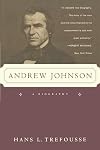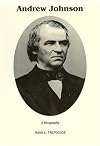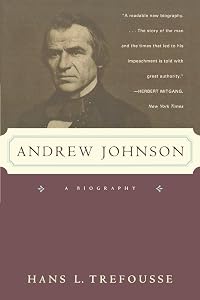
Andrew Johnson: A Biography
by Hans L. Trefousse
On This Page
Description
A study of President Johnson's public life and achievements as the man who succeeded Lincoln to the presidency in a time of political upheaval.Tags
Recommendations












Member Reviews
The cover blurb calls this "A readable new biography..." which seemed a strange blurb to me....was readable the best, the most flattering adjective that could be found for this work? It turns out, maybe it was. It is readable, but at times it can be a bit of a slog; it never really sings the way the best histories do. That being said, it is packed with information about Andrew Johnson, and it seems to be trying to impart that information without taking sides regarding his effectiveness as a politician. In the end, it seems he was more effective as president than is often thought, but unfortunately one of his main goals was to maintain a culture of white supremacy, so it might have been better had he not been so effective. But its the show more most detailed look I've ever seen at our 17th president, and worth reading to better understand not just the man, but how his presidency affected American culture for over a century. show less
I felt this was an interesting biography, balancing the personal man with the private man.
one couldn't help bt admire his dedication to the idea of the union, though some of his quotes about slavery are enough to erase any admiration.
one couldn't help bt admire his dedication to the idea of the union, though some of his quotes about slavery are enough to erase any admiration.
Take any list of the worst presidents in American history, and Andrew Johnson's name will feature prominently at the top of it. On one level, this is hardly surprising. Succeeding as he did the assassinated Abraham Lincoln, he faced the formidable challenge of restoring the peace after the bloodiest and most divisive conflict in American history. Given the task at hand and laboring as he did in the shadow of the martyred president, criticism was inevitable. Yet as Hans Trefousse shows in this book, Johnson's own rigid adherence to his beliefs prevented the sort of compromising that might have smoothed the path toward his goals and forestalled the impeachment that forever distinguishes his term in office.
The irony in Trefousse's account show more is that such rigidity was uncharacteristic in his youth. As a budding politician in antebellum Tennessee, Johnson often shifted positions as he sought to define his political identity to voters. His impoverished background, however, served as the foundation for his unwavering support for the rights of the poor, and his admiration of Andrew Jackson ensured that the would be identified with the Democratic Party. Trefousse makes the interesting case that Johnson was in many respects an adherent not as much to Jacksonian Democracy but to the Old Republican ideas of Thomas Jefferson. Such views would put him increasingly at odds with the industrializing nation that emerged in his lifetime, yet this proved less of an issue in his home state than it would when he became president later on.
As an ambitious border-state politician, the outbreak of the Civil War posed the greatest challenge of Johnson's career, and in terms of his ambitions he made what would turn out to be the correct choice. But Trefousse makes it clear that Johnson decision to stay with the union did not entail any reconsideration of his views on race. This became an issue once he became president, as he supported generous terms of reunification that left the freedmen in a legal position little different from slavery. Johnson's stubborn commitment to his views alienated the Republicans in Congress, empowering the Radicals among their ranks to push for impeachment. Trefousse shows the impeachment as a rushed affair, as the trial quickly demonstrated the hollowness of the prosecution's case. Johnson's victory proved a Pyrrhic one, though, as he found himself reduced to irrelevance in the aftermath of his acquittal. Hungering for a return to a national stage, he saw his election to the Senate in 1875 as a vindication by the people, albeit one cut short by a series of strokes that killed him soon afterward.
Trefousse's book serves as a solid account of the political career of America's 17th president. Having written biographies of some of the other key figures in the impeachment controversy, he brings considerable insight to bear on the central act of Johnson's political career, showing it as a far messier and more muddled affair than might otherwise appear to be the case. Yet his description of Johnson's pre-presidential career suffers from an absence of similar insight, and provides little more than a chronicle of his career and achievements. Nonetheless, his book stands as the best biography available of this controversial figure, one that makes a convincing argument that his place in history was ultimately defined by his inability to practice that central skill of a successful politician — the art of compromise. show less
The irony in Trefousse's account show more is that such rigidity was uncharacteristic in his youth. As a budding politician in antebellum Tennessee, Johnson often shifted positions as he sought to define his political identity to voters. His impoverished background, however, served as the foundation for his unwavering support for the rights of the poor, and his admiration of Andrew Jackson ensured that the would be identified with the Democratic Party. Trefousse makes the interesting case that Johnson was in many respects an adherent not as much to Jacksonian Democracy but to the Old Republican ideas of Thomas Jefferson. Such views would put him increasingly at odds with the industrializing nation that emerged in his lifetime, yet this proved less of an issue in his home state than it would when he became president later on.
As an ambitious border-state politician, the outbreak of the Civil War posed the greatest challenge of Johnson's career, and in terms of his ambitions he made what would turn out to be the correct choice. But Trefousse makes it clear that Johnson decision to stay with the union did not entail any reconsideration of his views on race. This became an issue once he became president, as he supported generous terms of reunification that left the freedmen in a legal position little different from slavery. Johnson's stubborn commitment to his views alienated the Republicans in Congress, empowering the Radicals among their ranks to push for impeachment. Trefousse shows the impeachment as a rushed affair, as the trial quickly demonstrated the hollowness of the prosecution's case. Johnson's victory proved a Pyrrhic one, though, as he found himself reduced to irrelevance in the aftermath of his acquittal. Hungering for a return to a national stage, he saw his election to the Senate in 1875 as a vindication by the people, albeit one cut short by a series of strokes that killed him soon afterward.
Trefousse's book serves as a solid account of the political career of America's 17th president. Having written biographies of some of the other key figures in the impeachment controversy, he brings considerable insight to bear on the central act of Johnson's political career, showing it as a far messier and more muddled affair than might otherwise appear to be the case. Yet his description of Johnson's pre-presidential career suffers from an absence of similar insight, and provides little more than a chronicle of his career and achievements. Nonetheless, his book stands as the best biography available of this controversial figure, one that makes a convincing argument that his place in history was ultimately defined by his inability to practice that central skill of a successful politician — the art of compromise. show less
Andrew Johnson is one of the more intriguing characters in US history - at least for me. He was a Democrat, albeit a Unionist Democrat, that served as Vice President under Republican Abraham Lincoln. He professed to be concerned for black freedmen to the point of even referring to himself as their "Moses", yet repeated expressed white supremacist views and implemented Reconstruction policies seemingly without regard for the effect on freedmen in the South. He's the first US president to be impeached, with precident-setting results for executive-legislative relations ever since. My hope with Hans Trefousse's Andrew Johnson: A Biography - the first full biography of Johnson I've read - was to better understand this complex man, especially show more where he impacted post-Civil War events.
Johnson is presented here as the classic self-made man - humble beginnings, self assurance and hard work leading to material success, the desire to excel in politics to validate his success. He presented himself as a populist and Jacksonian Democrat his whole political career, and in fact on many occasions was able to translate that persona into real support from the people, at least some segments of the populace. Yet the same determination that led to his success turned into sheer pig-headedness when the country needed the president and Congress to put the nation back together again after the Civil War. While more than one factor was in play, it's clear that without some compromise, the southern states were given latitude to put a de facto slave culture back in place.
Trefousse's work is a functional biography - it presents the man and attempts to understand him - but it was a bit of a long slog. Frankly, the first half of the book was rather dry and throughout the whole book, I never felt I really got Andrew Johnson in the way other authors have made other presidents come alive. The second half of the book certainly picked up more interest, with all the drama associated with the conflict between Johnson and those with more radical ideas about how to reconstruct the Union. I suppose part of my reaction to the book came from my dislike of the man presented here and the things he stood for. However inappropriate that might be for historical study, it certainly made it hard for me to connect with the work. show less
Johnson is presented here as the classic self-made man - humble beginnings, self assurance and hard work leading to material success, the desire to excel in politics to validate his success. He presented himself as a populist and Jacksonian Democrat his whole political career, and in fact on many occasions was able to translate that persona into real support from the people, at least some segments of the populace. Yet the same determination that led to his success turned into sheer pig-headedness when the country needed the president and Congress to put the nation back together again after the Civil War. While more than one factor was in play, it's clear that without some compromise, the southern states were given latitude to put a de facto slave culture back in place.
Trefousse's work is a functional biography - it presents the man and attempts to understand him - but it was a bit of a long slog. Frankly, the first half of the book was rather dry and throughout the whole book, I never felt I really got Andrew Johnson in the way other authors have made other presidents come alive. The second half of the book certainly picked up more interest, with all the drama associated with the conflict between Johnson and those with more radical ideas about how to reconstruct the Union. I suppose part of my reaction to the book came from my dislike of the man presented here and the things he stood for. However inappropriate that might be for historical study, it certainly made it hard for me to connect with the work. show less
This biography ties together what has been for me a lot of frustration in trying to understand, if that is even possible fully, Andrew Johnson’s role in the failures of reconstruction. My earlier readings regarding reconstruction had not revealed enough of Johnson, the man, to allow me to move beyond this momentous time in history. I am always returning to this period seeking to understand better. In his brief Preface, Trefousse credits a mass of newly accessible documentation from the University of Tennessee as inspiration for this “reassessment” of Johnson’s life. Sixty-two pages of notes offer more than ample references to sources.
Andrew Johnson was a self-made man who was placed into a difficult position by his place in time. This enigmatic man was the only Southern Senator who remained loyal to the Union at the time the Civil War began. He believed whole-heartedly in the Union and the Constitution and throughout his life fought to preserve them. But he was a contradiction. He was a Democrat that served as Lincoln's (a Republican) Vice President, he was a white supremacist that was concerned about freed men of color, he was a politician who lost only two elections - one early one late in career - but was always looking for vindication by the people.
Johnson was a stubborn man who appeared to believe that he was always right when it came to political matters and show more here lies his difficulties. Since he was a Democrat in a Republican administration per se, he had little support for his plans for the Reconstruction of the nation at the end of the war and after Lincoln's assassination. He used the Presidential veto 29 times and was overridden 15. His personal feelings for other politicians frequently got in the way of vital legislation. However, he held ground in his belief of the powers of the Constitution and was vindicated at his impeachment proceedings by acquittal.
I still think I need more details concerning the impeachment process, so another book is in order for that historical event. As a President I don['t think that he was great, but he wasn't as bad IMHO, as history makes him out. show less
Johnson was a stubborn man who appeared to believe that he was always right when it came to political matters and show more here lies his difficulties. Since he was a Democrat in a Republican administration per se, he had little support for his plans for the Reconstruction of the nation at the end of the war and after Lincoln's assassination. He used the Presidential veto 29 times and was overridden 15. His personal feelings for other politicians frequently got in the way of vital legislation. However, he held ground in his belief of the powers of the Constitution and was vindicated at his impeachment proceedings by acquittal.
I still think I need more details concerning the impeachment process, so another book is in order for that historical event. As a President I don['t think that he was great, but he wasn't as bad IMHO, as history makes him out. show less
Not the best biography I've ever read. Author assumes a fair amount of knowledge on behalf of the reader. Author advocates the position that Andrew Johnson was a man of his times with very good political skills but a man who did not keep up with his times and set the foundations for a century of racism b
Members
- Recently Added By
Lists

The Presidents
42 works; 2 members

Best Biographies of U.S. Presidents
61 works; 6 members
Author Information

22+ Works 710 Members
Hans L. Trefousse is Distinguished Professor of History Emeritus at Brooklyn College and the Graduate Center of the City University of New York.
Common Knowledge
- Original title
- Andrew Johnson : a biography
- Original publication date
- 1989
- People/Characters
- Andrew Johnson
- Important places
- USA; Tennessee, USA
- First words
- When Andrew Johnson, the seventeenth president of the United States, was born, on December 29, 1808, his native Raleigh was still a raw settlement.
Classifications
- Genres
- Nonfiction, Biography & Memoir, History, General Nonfiction
- DDC/MDS
- 973.8 — History & geography History of North America United States The Gilded Age, Reconstruction, Spanish American War (1865-1901)
- LCC
- E667 .T74 — History of the United States United States Late nineteenth century, 1865-1900 Johnson's administration, April 15, 1865-1869
- BISAC
Statistics
- Members
- 209
- Popularity
- 156,466
- Reviews
- 10
- Rating
- (3.39)
- Languages
- English
- Media
- Paper
- ISBNs
- 4
- ASINs
- 5