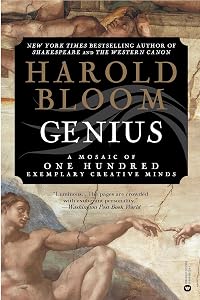
Genius: A Mosaic of One Hundred Exemplary Creative Minds
by Harold Bloom
On This Page
Description
From the Bible to Ralph Ellison, America's most prominent and bestselling literary critic takes an enlightening look at the concept of genius through the ages in a celebration of the greatest creative writers of all time.Tags
Recommendations






Member Reviews
I wonder whether any reader can begin to review Harold Bloom’s Genius without first heaving a sigh. This sigh has a multiplicity of meanings. What unfortunately strikes the reader first as he peruses these one hundred capsule biographies of literary luminaries, these one hundred assessments of “the work in the life,” as he calls it, are Bloom’s many defects as a guide. He stubbornly insists on structuring (pretending to structure?) his tour on the sefirot of the kabbalah, to no discernible end. Each grouping of artists (or “lustre,” in Bloom’s bizarre, quasi-Emersonian lingo) either feels arbitrary or could have been motivated without the kabbalistic tomfoolery—e.g., do we really need to understand the first thing about show more the sefirot Tiferet in order to broadly appreciate the logic of a lustre that includes Baudelaire, Rimbaud, Valery, Hugo, and Nerval, all French writers of the 19th century? I think not. You walk away from Genius knowing as little about the kabbalah as you knew going in, and caring less.
Also, Bloom cannot let pass a single, tedious opportunity, however tangential, to criticize Marxist or feminist literary theorists (the “school of resentment” he calls them—the irony, it burns). He can be counted on, without provocation, to disparage political correctness, “scientism,” T.S. Eliot, the current state of academia (in precipitous decline since 1967, apparently), and George W. Bush. His censure is so scattershot that you’re bound to agree with him on something—and still Bloom will aggravate you to no end with his hobby horses. He is the sort of critic who thinks it a pretty neat trick to introduce a passage of no particular beauty or import by observing that it must make crawl the skin of feminist critics—and then to move on without further comment. His work is done. You could call Bloom’s default mode of criticism the “school of spite.” He is, in short, a curmudgeon.
Now, in fairness, every reader, even Harold Bloom, is entitled to his or her idiosyncrasies—otherwise, we readers would have little to gain from talking to each other. What we’re not entitled to do, while demanding the attention of others, is to erect ideologies out of the bricks of our idiosyncrasies. Bloom does too much of this.
And yet… the sigh you heave upon finishing Genius has a multiplicity of meanings. Occasionally Bloom’s idiosyncrasies stay idiosyncrasies, and they humanize him and his analyses. He recounts dashing from one of Nabokov’s lectures when the master ventured his judgment that Gogol was a superior writer to Austen. (Who could have posed such a comparison?) Introducing Yeats, Bloom identifies himself as a skeptic regarding the occult, but goes on to admit that he avoids séances, because, “they upset me.” The inherent charm of this admission catches the reader completely off-guard. And then there is his failure of articulation when it comes time to explain his veneration for the demanding poetry of Hart Crane—this failure to articulate persists until we learn that a young Harold Bloom received a gift of a volume of Crane’s poetry from an older sister.
You sigh as you finish Genius because you want more of the criticism wherein Bloom is simply himself—neither a perpetuator of picayune academic spats, nor a lightweight critic of contemporary politics—but rather a prodigious, enthusiastic, and eccentric reader, like nothing so much as one of the standouts at a very good book club. And when he’s on, Bloom’s enthusiasm is catching—it’s impossible to read Genius without wishing to be better-read. Not only does Genius contain hundreds of book recommendations; it also projects an air of encouragement, an idea that great literature is not merely accessible to, but is the birthright of every person.
I hesitated, finally, to break ground on the hundredth biography (of Ralph Ellison), knowing that when I was through, the spell would be broken—I’d need something new to do on shiftless weekend afternoons. No, even worse: I read Genius over a period of two languorous months. Finishing it was like losing a sudden friend, one who disappears before being assimilated into the furnishings of the rest of your life. Admittedly, this friend was frequently exasperating, long-winded, and smug, but he was also knowledgeable, humane, articulate, and monstrously well-read. Bloom is one of only a handful of university critics who consider the laity to be a proper audience for their craft—he is the only university critic I know of who has made it his mission both to embolden the lay reader to attempt the great works of literature, and to warrant to the lay reader his or her soul’s capacity to be enlarged in the attempt. show less
Also, Bloom cannot let pass a single, tedious opportunity, however tangential, to criticize Marxist or feminist literary theorists (the “school of resentment” he calls them—the irony, it burns). He can be counted on, without provocation, to disparage political correctness, “scientism,” T.S. Eliot, the current state of academia (in precipitous decline since 1967, apparently), and George W. Bush. His censure is so scattershot that you’re bound to agree with him on something—and still Bloom will aggravate you to no end with his hobby horses. He is the sort of critic who thinks it a pretty neat trick to introduce a passage of no particular beauty or import by observing that it must make crawl the skin of feminist critics—and then to move on without further comment. His work is done. You could call Bloom’s default mode of criticism the “school of spite.” He is, in short, a curmudgeon.
Now, in fairness, every reader, even Harold Bloom, is entitled to his or her idiosyncrasies—otherwise, we readers would have little to gain from talking to each other. What we’re not entitled to do, while demanding the attention of others, is to erect ideologies out of the bricks of our idiosyncrasies. Bloom does too much of this.
And yet… the sigh you heave upon finishing Genius has a multiplicity of meanings. Occasionally Bloom’s idiosyncrasies stay idiosyncrasies, and they humanize him and his analyses. He recounts dashing from one of Nabokov’s lectures when the master ventured his judgment that Gogol was a superior writer to Austen. (Who could have posed such a comparison?) Introducing Yeats, Bloom identifies himself as a skeptic regarding the occult, but goes on to admit that he avoids séances, because, “they upset me.” The inherent charm of this admission catches the reader completely off-guard. And then there is his failure of articulation when it comes time to explain his veneration for the demanding poetry of Hart Crane—this failure to articulate persists until we learn that a young Harold Bloom received a gift of a volume of Crane’s poetry from an older sister.
You sigh as you finish Genius because you want more of the criticism wherein Bloom is simply himself—neither a perpetuator of picayune academic spats, nor a lightweight critic of contemporary politics—but rather a prodigious, enthusiastic, and eccentric reader, like nothing so much as one of the standouts at a very good book club. And when he’s on, Bloom’s enthusiasm is catching—it’s impossible to read Genius without wishing to be better-read. Not only does Genius contain hundreds of book recommendations; it also projects an air of encouragement, an idea that great literature is not merely accessible to, but is the birthright of every person.
I hesitated, finally, to break ground on the hundredth biography (of Ralph Ellison), knowing that when I was through, the spell would be broken—I’d need something new to do on shiftless weekend afternoons. No, even worse: I read Genius over a period of two languorous months. Finishing it was like losing a sudden friend, one who disappears before being assimilated into the furnishings of the rest of your life. Admittedly, this friend was frequently exasperating, long-winded, and smug, but he was also knowledgeable, humane, articulate, and monstrously well-read. Bloom is one of only a handful of university critics who consider the laity to be a proper audience for their craft—he is the only university critic I know of who has made it his mission both to embolden the lay reader to attempt the great works of literature, and to warrant to the lay reader his or her soul’s capacity to be enlarged in the attempt. show less
Please be warned. The minds referred to in the title are those only of dead authors. It seems like half were poets.
And your reviewer is otherwise widely read but does not like 99% of poetry nor 85% of great poetry. I do love some of it, say some Homer, Ovid, Tu Fu, Khayyám (FitzGerald), Milton, Shakespeare, Lewis Carroll, Pushkin (Falan), or Thomas Hardy. Half of those are not in the book. But generally poetry is a nuisance [Mencken, Second Prejudices VI].
Bloom makes lots of analogies among his creative poetic geniuses, so he is comparing a lot that I would not care to read with a lot of other that I have not read or never heard of. If you are a poet or love the stuff, then you might add a star.
Then there are the analogies between some show more of the prose writers whom I have never read or hardly heard of. Some of his body of criticism does rest on his examination of influences among writers upon one another, yet I got a sense that here Bloom conceded generously to the temptation of showing off his wide erudition, which apparently began before he started elementary school. Or maybe he stole from his "The Anxiety of Influence", which I have not read. He does include quotations from the writings of his geniuses, helping the reader to form his own opinions.
This then is a book intended for professional literati. If you are one such literato, then you might add a star. An allowance should be made for value of this book to a reader who finds it in his hands and is becoming interested in dipping into great classic literature: the chapters on authors of those works might tempt or guide that reader to some of the greatest treasures of western civilization.
There are other sources of possible annoyance. Bloom tries to relate any convenient thing to Gnosticism, Jewish mysticism, or homoeroticism. I knew already just enough about the former two to be not further interested and am afraid to look up the third. To his arguable credit, he tries not to conceal his disgust with postmodernism and grievance studies that have stained or captured sectors of academia, his home.
That said, I mostly enjoyed much of the book, mostly that about the older classics. Not a lot. But it is long, and maybe I should never have opened it. show less
And your reviewer is otherwise widely read but does not like 99% of poetry nor 85% of great poetry. I do love some of it, say some Homer, Ovid, Tu Fu, Khayyám (FitzGerald), Milton, Shakespeare, Lewis Carroll, Pushkin (Falan), or Thomas Hardy. Half of those are not in the book. But generally poetry is a nuisance [Mencken, Second Prejudices VI].
Bloom makes lots of analogies among his creative poetic geniuses, so he is comparing a lot that I would not care to read with a lot of other that I have not read or never heard of. If you are a poet or love the stuff, then you might add a star.
Then there are the analogies between some show more of the prose writers whom I have never read or hardly heard of. Some of his body of criticism does rest on his examination of influences among writers upon one another, yet I got a sense that here Bloom conceded generously to the temptation of showing off his wide erudition, which apparently began before he started elementary school. Or maybe he stole from his "The Anxiety of Influence", which I have not read. He does include quotations from the writings of his geniuses, helping the reader to form his own opinions.
This then is a book intended for professional literati. If you are one such literato, then you might add a star. An allowance should be made for value of this book to a reader who finds it in his hands and is becoming interested in dipping into great classic literature: the chapters on authors of those works might tempt or guide that reader to some of the greatest treasures of western civilization.
There are other sources of possible annoyance. Bloom tries to relate any convenient thing to Gnosticism, Jewish mysticism, or homoeroticism. I knew already just enough about the former two to be not further interested and am afraid to look up the third. To his arguable credit, he tries not to conceal his disgust with postmodernism and grievance studies that have stained or captured sectors of academia, his home.
That said, I mostly enjoyed much of the book, mostly that about the older classics. Not a lot. But it is long, and maybe I should never have opened it. show less
While I am very glad that he introduced me to the category of Essayists, I found him to be both pedantic and condescending. In short, nearly unbearable. Yet I did find his organisation of the work by Kabbalistic sephirot to be intriguing.
While I am very glad that he introduced me to the category of Essayists, I found him to be both pedantic and condescending. In short, nearly unbearable. Yet I did find his organisation of the work by Kabbalistic sephirot to be intriguing.
Impressive encyclopedia survey of some 100 writers Bloom considers to have some aspect of genius. Organization is haphazard and arbitrary, but Bloom admits as much, listing them in an unusual Gnostic way.
Alternately witty and pompous in equal measure, but no doubt extremely informative.
Of particular note is that this is the last book in my 2011 reading challenge. Fitting.
Alternately witty and pompous in equal measure, but no doubt extremely informative.
Of particular note is that this is the last book in my 2011 reading challenge. Fitting.
Harold Bloom takes 100 creative minds worthy of being called 'Genius' in his estimation and explains why he chose each person. Since the man is a literary critic he doesn't go into music or art criticism. Thus, you will not find Mozart or Delacroix being reviewed in these pages.
Professor Bloom starts out by describing his strange way of organizing the authors. Bloom goes by the Kabbalah and organizes them by the Sefirot. So there are ten different Sefirot and each Sefirot contains ten authors. Some of them I had not heard much of before. Others he chooses for reasons I did not expect. For instance, take Victor Hugo, the great Poetic genius of France. I seriously had not heard that he was a poet, and had only heard of him from Les show more Miserables(sic) and The Hunchback of Notre Dame.
In any case, I suppose I really need to step up my reading game, but I am glad that I heard of the Lion's Share of these authors. Not that it matters much. show less
Professor Bloom starts out by describing his strange way of organizing the authors. Bloom goes by the Kabbalah and organizes them by the Sefirot. So there are ten different Sefirot and each Sefirot contains ten authors. Some of them I had not heard much of before. Others he chooses for reasons I did not expect. For instance, take Victor Hugo, the great Poetic genius of France. I seriously had not heard that he was a poet, and had only heard of him from Les show more Miserables(sic) and The Hunchback of Notre Dame.
In any case, I suppose I really need to step up my reading game, but I am glad that I heard of the Lion's Share of these authors. Not that it matters much. show less
While i may not agree with Harold Bloom's politics, i greatly enjoy reading about his appreciation for classic authors. He has helped me enjoy some works more deeply.
This is a fun book to browse through now and then.
This is a fun book to browse through now and then.
Members
- Recently Added By
Author Information

Harold Bloom was born on July 11, 1930 in New York City. He earned his Bachelor of Arts from Cornell in 1951 and his Doctorate from Yale in 1955. After graduating from Yale, Bloom remained there as a teacher, and was made Sterling Professor of Humanities in 1983. Bloom's theories have changed the way that critics think of literary tradition and show more has also focused his attentions on history and the Bible. He has written over twenty books and edited countless others. He is one of the most famous critics in the world and considered an expert in many fields. In 2010 he became a founding patron of Ralston College, a new institution in Savannah, Georgia, that focuses on primary texts. His works include Fallen Angels, Till I End My Song: A Gathering of Last Poems, Anatomy of Influence: Literature as a Way of Life and The Shadow of a Great Rock: A Literary Appreciation of The King James Bible. Harold Bloom passed away on October 14, 2019 in New Haven, at the age of 89. (Bowker Author Biography) show less
Some Editions
Awards and Honors
Distinctions
Common Knowledge
- Original title
- Genius: A Mosaic of One Hundred Exemplary Creative Minds
- Alternate titles
- Genius: A Mosaic of 100 Exemplary Creative Minds
- Original publication date
- 2002
- People/Characters
- William Shakespeare; Miguel de Cervantes; John Milton; Leo Tolstoy; Lucretius; Virgil (show all 99); Augustine of Hippo (354-430); Dante Alighieri (1265-1321); Geoffrey Chaucer; The Yahwist; Socrates (c.&thinsp | 470&ndash | 399 BC); Plato (c.428-347 BC); Paul the Apostle (of Tarsus "Saul"); Muhammad; Samuel Johnson; James Boswell; Johann Wolfgang von Goethe (1749-1832); Sigmund Freud; Thomas Mann; Friedrich Nietzsche (1844-1900); Søren Kierkegaard; Franz Kafka; Marcel Proust; Samuel Beckett; Molière; Henrik Ibsen; Anton Chekhov; Oscar Wilde; Luigi Pirandello; John Donne; Alexander Pope; Jonathan Swift; Jane Austen; Lady Murasaki; Nathaniel Hawthorne; Herman Melville; Charlotte Brontë; Emily Brontë; Virginia Woolf; Ralph Waldo Emerson; Emily Dickinson; Robert Frost; Wallace Stevens; T. S. Eliot; William Wordsworth; Percy Bysshe Shelley; John Keats; Giacomo Leopardi; Alfred Lord Tennyson; Algernon Charles Swinburne; Dante Gabriel Rossetti; Christina Rossetti; Walter Pater; Hugo von Hoffmannsthal; Victor Hugo; Gerard de Nerval; Charles Baudelaire; Arthur Rimbaud; Paul Velery; Homer; Luis vaz de Camoes; James Joyce; Alejo Carpentier; Octavio Paz; Stendhal; Mark Twain (Samuel Langhorne Clemens); William Faulkner; Ernest Hemingway; Flannery O'Connor; Walt Whitman; Fernando Pessoa; Hart Crane; Federico García Lorca; Luis Cernuda; George Eliot; Willa Cather; Edith Wharton; F. Scott Fitzgerald; Iris Murdoch; Gustave Flaubert; Jose Maria Eca de Queiroz; Joaquim Maria Machado de Assis; Jorge Luis Borges; Italo Calvino; William Blake; D. H. Lawrence; Tennessee Williams; Rainer Maria Rilke; Eugenio Montale; Honoré de Balzac; Lewis Carroll (Charles Lutwidge Dodgson); Henry James; Robert Browning; William Butler Yeats; Charles Dickens; Fyodor Dostoevsky; Isaac Babel; Paul Celan; Ralph Ellison
- Important places
- London, England, UK; Florence, Tuscany, Italy; Tuscany, Italy
- Epigraph
- Ah that our Genius were a little more a genius!
—Ralph Waldo Emerson, "Experience" - Dedication
- To the beloved memory of Mirjana Kalezic
- First words
- Why these one hundred?
--Preface - Last words
- (Click to show. Warning: May contain spoilers.)There is a heroic pathos in such play, but the future of genius is always metaphorical.
- Blurbers
- Hecht, Anthony; Abrams, M. H.
- Original language
- American English
Classifications
- Genres
- Literature Studies and Criticism, Nonfiction, Biography & Memoir, History, General Nonfiction
- DDC/MDS
- 153.98 — Philosophy & psychology Psychology Conscious mental processes and intelligence Intelligence and aptitudes Genius
- LCC
- BF412 .B58 — Philosophy, Psychology and Religion Psychology Psychology Consciousness. Cognition
- BISAC
Statistics
- Members
- 1,513
- Popularity
- 15,230
- Reviews
- 11
- Rating
- (3.72)
- Languages
- 6 — English, French, German, Italian, Portuguese, Spanish
- Media
- Paper
- ISBNs
- 13
- ASINs
- 10