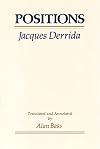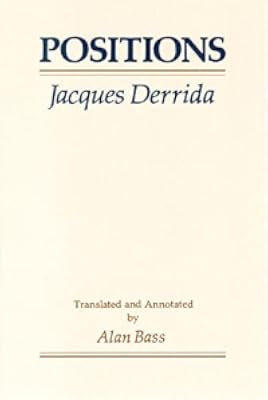
Positions
by Jacques Derrida
On This Page
Description
Positions is a collection of three interviews with Jacques Derrida that illuminate and make more accessible the complex concepts and terms treated extensively in such works as Writing and Difference and Dissemination. Derrida takes positions on his detractors, his supporters, and the two major preoccupations of French intellectual life, Marxism and psychoanalysis. The interviews included in this volume offer a multifaceted view of Derrida. "Implications: Interview with Henri Ronse" contains show more a succinct statement of principles. "Seminology and Grammatology: Interview with Julia Kristeva" provides important clarifications of the role played by linguistics in Derrida's work. "Positions: Interview with Jean-Louis Houdebine and Guy Scarpetta" is a wide-ranging discussion that touches on many of the polemics that Derrida's work has provoked. Alan Bass, whose translation of Writing and Difference was highly praised for its clarity, accuracy, and readability, has provided extremely useful critical notes, full of vital information, including historical background. show lessTags
Recommendations










Member Reviews
When I try to decipher a text I do not constantly ask myself if I will finish by answering yes or no, as happens in France at determined periods of history, and generally on Sunday.
The above citation was chosen to reflect a contrast, one of styles - if not intentions. The epigram's glibness is useful to distract from the challenging depths of such a slim book. I dare say I spent more time per page than I have since I was a student. It did require a week to absorb this book, though right from the start Derrida questions whether he (or anyone) is an author and challenges the privilege given to a term like "book". Dodging those critiques I was impressed that Derrida offers "idealized" approach to his theory: by cutting and pasting aspects show more of Of Gramamtology both around and within Writing and Difference, he creates a hypertext of immense poetics and possible analysis. Some call him a madman or charlatan, I admire him, especially this questioning of words and concepts -- even if, it must be undertaken conceptually with words.
It is entertaining to approach this early Derrida (1967-1972) as he interrogates (defends?) his own work, almost in the third person. That of course led me to think of Stalin, perhaps even SSM's [b:Young Stalin|826564|Young Stalin|Simon Sebag Montefiore|https://d.gr-assets.com/books/1356455250s/826564.jpg|994440]. I'm obviously not comparing the work and thought of the two men, though both were outsiders, trained in a disciplined thought, who both challenged and disrupted the framework of these operating systems,. It is likely prudent to walk away from that spontaneous comparison and think instead of Charlie Parker. Is there an effective spacing in the context of Jay McShann?
The middle discussion in Positions is between Derrida and Julia Kristeva. I read this twice and remain lost at sea.
The titular essay is essentially a defense of Derrida's grammar against the challenge of Marxist thought.
Don't you see, once again, I do not believe that one can speak, even from a Marxist point of view, of a homogenous Marxist text that would instantaneously liberate the concept of contradiction from its speculative, teleological, and eschatological horizon.
The debate then concludes with a sparring of missives from the interlocutors. I find the flow and play of Derrida's work to be immensely joyful, even if at times it is inscrutable. show less
The above citation was chosen to reflect a contrast, one of styles - if not intentions. The epigram's glibness is useful to distract from the challenging depths of such a slim book. I dare say I spent more time per page than I have since I was a student. It did require a week to absorb this book, though right from the start Derrida questions whether he (or anyone) is an author and challenges the privilege given to a term like "book". Dodging those critiques I was impressed that Derrida offers "idealized" approach to his theory: by cutting and pasting aspects show more of Of Gramamtology both around and within Writing and Difference, he creates a hypertext of immense poetics and possible analysis. Some call him a madman or charlatan, I admire him, especially this questioning of words and concepts -- even if, it must be undertaken conceptually with words.
It is entertaining to approach this early Derrida (1967-1972) as he interrogates (defends?) his own work, almost in the third person. That of course led me to think of Stalin, perhaps even SSM's [b:Young Stalin|826564|Young Stalin|Simon Sebag Montefiore|https://d.gr-assets.com/books/1356455250s/826564.jpg|994440]. I'm obviously not comparing the work and thought of the two men, though both were outsiders, trained in a disciplined thought, who both challenged and disrupted the framework of these operating systems,. It is likely prudent to walk away from that spontaneous comparison and think instead of Charlie Parker. Is there an effective spacing in the context of Jay McShann?
The middle discussion in Positions is between Derrida and Julia Kristeva. I read this twice and remain lost at sea.
The titular essay is essentially a defense of Derrida's grammar against the challenge of Marxist thought.
Don't you see, once again, I do not believe that one can speak, even from a Marxist point of view, of a homogenous Marxist text that would instantaneously liberate the concept of contradiction from its speculative, teleological, and eschatological horizon.
The debate then concludes with a sparring of missives from the interlocutors. I find the flow and play of Derrida's work to be immensely joyful, even if at times it is inscrutable. show less
Tough to rate this, since I disagree with Derrida's positions on most things. But this is clear compared to the essays which are being discussed (in English, in Writing and Difference; Margins of Philosophy; Dissemination). And it's short. If only someone would write a good critique of all this stuff that takes structuralism as a starting point. That I could give 5 stars.
Probably the best introduction to Derrida's early work.
100 DER 7
Ratings
Members
- Recently Added By
Author Information

402+ Works 19,760 Members
Jacques Derrida was born in El-Biar, Algeria on July 15, 1930. He graduated from the École Normal Supérieure in 1956. He taught philosophy and logic at both the University of Paris and the École Normal Supérieure for around 30 years. His works of philosophy and linguistics form the basis of the school of criticism known as deconstruction. This show more theory states that language is an inadequate method to give an unambiguous definition of a work, as the meaning of text can differ depending on reader, time, and context. During his lifetime, he wrote more than 40 books on various aspects of deconstruction including Of Grammatology, Glas, The Postcard: From Socrates to Freud and Beyond, and Ulysses Gramophone: Hear Say Yes in Joyce. He died of pancreatic cancer on October 9, 2004 at the age of 74. (Bowker Author Biography) show less
Series
Belongs to Publisher Series
Common Knowledge
- Original title
- Positions
- Original publication date
- Éditions de Minuit, Paris, 1972
- Original language
- Francese
Classifications
Statistics
- Members
- 436
- Popularity
- 70,686
- Reviews
- 5
- Rating
- (3.43)
- Languages
- 10 — English, Estonian, Finnish, French, German, Italian, Polish, Portuguese, Romanian, Spanish
- Media
- Paper
- ISBNs
- 19
- ASINs
- 4