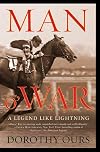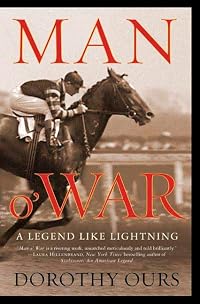
Man o' War: A Legend Like Lightning
by Dorothy Ours 
On This Page
Description
His trainer said that managing him was like holding a tiger by the tail. His owner compared him to "chain lightning." His jockeys found their lives transformed by him, in triumphant and distressing ways. All of them became caught in a battle for honesty.Born in 1917, Man o' War grew from a rebellious youngster into perhaps the greatest racehorse of all time. He set such astonishing speed records that The New York Times called him a "Speed Miracle." Often he won with so much energy in reserve show more that experts wondered how much faster he could have gone. Over the years, this and other mysteries would envelop the great Man o' War.The truth remained problematic. Even as Man o' War---known as "Big Red"---came to power, attracting record crowds and rave publicity, the colorful sport of Thoroughbred racing struggled for integrity. His lone defeat, suffered a few weeks before gamblers fixed the 1919 World Series, spawned lasting rumors that he, too, had been the victim of a fix.Tackling old beliefs with newly uncovered evidence, Man o' War: A Legend Like Lightning shows how human pressures collided with a natural phenomenon and brings new life to an American icon. The genuine courage of Man o' War, tribulations of his archrival, Sir Barton (America's first Triple Crown winner), and temptations of their Hall of Fame jockeys and trainers reveal a long-hidden tale of grace, disgrace, and elusive redemption. show lessTags
Recommendations










Member Reviews
If you don't like horses, pass this review right on by. If you grew up
like I did, thinking that horses were about the most beautiful creatures on
the face of the earth--Thoroughbreds in particular--you might just be
interested.
The problem with new biographies of horse racing legends is that they are
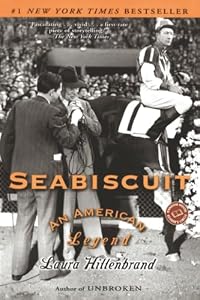
all going to be compared to Lauren Hillenbrand's marvelous book about
Seabiscuit. Hillenbrand chose the perfect racing legend. Seabiscuit was a
true rags-to-riches character. He raced during desperate times (the
Depression) and was fortunate enough to find fascinating people to take care
of him. The blend of history, society, people and horse was mesmerizing.
Ours probably thought that she'd chosen well, too. In a recent poll, Man o'
War was chosen show more as The Best Racehorse of the Twentieth Century. He was
beautiful, well-bred, won 20 of 21 races, carried tremendous weight on his
back and broke many track records. People fought their way to the racetrack
whenever he was to run. He was bred by a millionaire and raced by another.
His first jockey's license wasn't renewed and he lived under a cloud the
rest of his life. Got to be as interesting as Seabiscuit, right?
No, it doesn't. The only interesting millionaire in the pack was the owner
of Sir Barton, one of Red's rivals, and too much of the book was about Sir
Barton rather than Man o' War. At the end of the book, the reason for it was
clear, but it was still irksome. Despite its flaws, I liked the book. I
learned just how dishonest horse racing could be back then. How gamblers
could pay jockeys to fix races. How easy it was for trainers to dope their
horses so they'd run better. (Ever wonder why heroin is often called
"horse"?) I also learned things about Man o' War that I'd never known.
Unfortunately, I have to compare Ours's book to Hillenbrand's. Although a
page-turner, it falls short. show less
like I did, thinking that horses were about the most beautiful creatures on
the face of the earth--Thoroughbreds in particular--you might just be
interested.
The problem with new biographies of horse racing legends is that they are
all going to be compared to Lauren Hillenbrand's marvelous book about
Seabiscuit. Hillenbrand chose the perfect racing legend. Seabiscuit was a
true rags-to-riches character. He raced during desperate times (the
Depression) and was fortunate enough to find fascinating people to take care
of him. The blend of history, society, people and horse was mesmerizing.
Ours probably thought that she'd chosen well, too. In a recent poll, Man o'
War was chosen show more as The Best Racehorse of the Twentieth Century. He was
beautiful, well-bred, won 20 of 21 races, carried tremendous weight on his
back and broke many track records. People fought their way to the racetrack
whenever he was to run. He was bred by a millionaire and raced by another.
His first jockey's license wasn't renewed and he lived under a cloud the
rest of his life. Got to be as interesting as Seabiscuit, right?
No, it doesn't. The only interesting millionaire in the pack was the owner
of Sir Barton, one of Red's rivals, and too much of the book was about Sir
Barton rather than Man o' War. At the end of the book, the reason for it was
clear, but it was still irksome. Despite its flaws, I liked the book. I
learned just how dishonest horse racing could be back then. How gamblers
could pay jockeys to fix races. How easy it was for trainers to dope their
horses so they'd run better. (Ever wonder why heroin is often called
"horse"?) I also learned things about Man o' War that I'd never known.
Unfortunately, I have to compare Ours's book to Hillenbrand's. Although a
page-turner, it falls short. show less
My all time favorite race horse is Man O' War. I don't know why, but this book gave me a good reason to put him at the top of my list. He was such a phenomenon that we will never know how great he actually was. I don't believe that the people in his life could really comprehend what they had in their possession. Makes me wish I could have seen him.
I thought I knew all about Man o' War, until I read this book. Lots of details tell the true story of the greatest horse of all.
Ratings
Members
- Recently Added By
Author Information

2 Works 221 Members
Dorothy Ours is a LibraryThing Author, an author who lists their personal library on LibraryThing.
Common Knowledge
- Original publication date
- 2006
- People/Characters
- Man o' War; August Belmont II; Samuel D. Riddle; Johnny Loftus; Clarence Kummer; Earl Sande
- Dedication
- To all of my teachers, human and otherwise.
- First words
- In the green hills of Kentucky, nine days after riding his first winner, an apprentice jockey named John Patrick Loftus got an offer to sell his soul.
Prologue: The horse reminded his owner of lightning, but not ordinary streak lightning that flashes once and rolls away. - Last words
- (Click to show. Warning: May contain spoilers.)Imagination can carry them back in time, where a red horse is bounding toward the finish line, setting the bar for legends to come.
Classifications
- Genres
- Sports and Leisure, Nonfiction, General Nonfiction, Biography & Memoir, History
- DDC/MDS
- 798.400929 — Arts & recreation Recreation, sports, and performing arts Equestrian sports and animal racing Horse racing
- LCC
- SF355 .M3 .O97 — Agriculture Animal husbandry. Animal science Animal culture Horses Racing
- BISAC
Statistics
- Members
- 181
- Popularity
- 180,025
- Reviews
- 4
- Rating
- (4.11)
- Languages
- English
- Media
- Paper, Ebook
- ISBNs
- 3
- ASINs
- 4