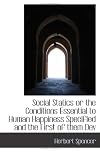
Social Statics
by Herbert Spencer
On This Page
Description
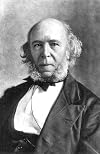
Herbert Spencer (1820-1903) was regarded by the Victorians as the foremost philosopher of the age, the prophet of evolution at a time when the idea had gripped the popular imagination. Until recently Spencer's posthumous reputation rested almost excusively on his social and political thought, which has itself frequently been subject to serious misrepresentation. But historians of ideas now recognise that an acquaintance with Spencer's thought is essential for the proper understanding of many show more aspects of Victorian intellectual life, and the present selection is designed to answer this need. It provides a cross-section of Spencer's works from his more popular and approachable essays to a number of the volumes of the Synthetic Philosophy itself. Volume III: Social Statics, Or the Conditions Essential to Human Happiness specified and then the fifst of them Developed. show lessTags
Recommendations



























Member Reviews
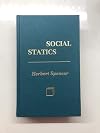
This is, I believe, the last American printing of the first edition of "Social Statics" . . . until modern times. Included is an "Introductory Note" and a "New Preface," the former explaining Herbert Spencer's Synthetic Philosophy, and the latter cautioning readers that Spencer had withdrawn a number of positions advanced in the volume at hand. Both are fascinating.
I am one of the few libertarians who think Spencer was right later to abridge the present work, getting rid of the Deism, the land socialism, and the near-anarchism . . . and even elements of his early feminism.
I am one of the few libertarians who think Spencer was right later to abridge the present work, getting rid of the Deism, the land socialism, and the near-anarchism . . . and even elements of his early feminism.
Herbert Spencer's first mature statement of his individualist liberalism. A classic of libertarian political thought, it is still worth reading today. Between the green boards of this edition one can find some provocative (and later chucked) chapters such as "The Divine Idea," "The Right to the Use of the Earth," and that classic of near-anarchism, "The Right to Ignore the State."
Ratings
Members
- Recently Added By
Lists

Books in the Bibliography of Freethinkers by Susan Jacoby
155 works; 1 member

Books cited in Progress by Samuel McDonald
160 works; 1 member
Author Information

128+ Works 1,260 Members
Herbert Spencer, an English philosopher-scientist, was---with the anthropologists Edward Burnett Tylor and Lewis Henry Morgan---one of the three great cultural evolutionists of the nineteenth century. A contemporary of Charles Darwin (see Vol. 5), he rejected special creation and espoused organic evolution at about the same time. He did not, show more however, discover, as did Darwin, that the mechanism for evolution is natural selection. He was immensely popular as a writer in England, and his The Study of Sociology (1873) became the first sociology textbook ever used in the United States. With the recent revival of interest in evolution, Spencer may receive more attention than he has had for many decades. (Bowker Author Biography) show less
Classifications
- Genres
- Sociology, Nonfiction, Philosophy, History, Science & Nature, Politics and Government, General Nonfiction
- DDC/MDS
- 303.4 — Society, government, & culture Social sciences, sociology & anthropology Social processes Social change
- LCC
- HM51 .S7 — Social sciences Sociology (General) Sociology These are obsolete numbers no longer used
- BISAC
Statistics
- Members
- 54
- Popularity
- 557,074
- Reviews
- 2
- Rating
- (4.50)
- Languages
- English
- Media
- Paper, Ebook
- ISBNs
- 13
- ASINs
- 7