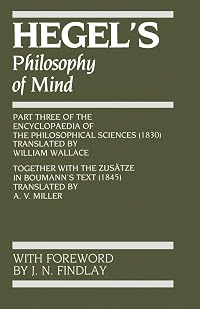
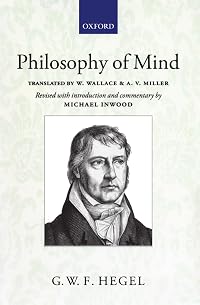
Hegel: Philosophy of Mind
by Georg Wilhelm Friedrich Hegel
Hegel's Encyclopaedia of the Philosophical Sciences (Philosophy of Mind)
On This Page
Description
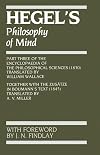
The present reissue of Wallace's translation of Hegel's Philosophy of Mind includes the Zusatze or lecture-notes which, in the collected works, accompany the first section entitled "Subjective Mind" and which Wallace omitted from his translation. Professor J. N. Findlay has written a Foreword and this replaces Wallace's introductory essays.Tags
Recommendations














Member Reviews
This was the last volume of Hegel's three volume Encyclopedia of Philosophical Sciences and was also the conclusion to his system. The subsequent works were largely expansions and lectures fleshing out what was laid out in the Phenomenology Of Spirit/Mind (his introduction to the encyclopedia), the Science Of Logic, the Philosophy Of Nature and the Philosophy Of Mind (the last three being the encyclopedia). I have now read all of the above. I am no where close to being a Hegelian, but I thought him well worth reading and I do recommend him but not without reading Fichte and Schelling as well. They all have their strengths and weaknesses.
There wasn't a whole lot new here. A lot of it was a recapitulation of ideas already set forth in show more previous works. He does go more into his concept of freedom though. Of course, freedom is a process that needs to be worked out, just as optimum consciousness is a process involving spirit/mind, objectivity/subjectivity, particularity/universality, etc -all notions discussed before. Much of this work deals with the psychology of freedom, if one can use the phrase and it not be an anachronism. I did note that Hegel addresses the charge of pantheism that was often leveled at philosophy, and at Idealism specifically, at the time; I found his response interesting. The last part of the book was probably the most engaging.
It appears to be the first time he went into more detail as to the political ramifications of his system. This is something he expanded on in the Philosophy Of Right.
This translation was by William Wallace, who also translated the Science Of Logic edition that I read previously. I wanted to read older translations because I am intending to research British and American Idealism in the future and these older translations are important context and/or material for that. I have seen some criticisms of Wallace's translations but I think it a fair one; and being acquainted with German Idealism already, I think he got the concepts across adequately. His introduction was a bit long, taking up half the book; but being interested in the influence that German Idealism had on the English speaking West is partly what I am interested in, so I wasn't that bothered by the length of the introduction. The print, I will say, is very small, so the book would actually be longer than it appears if the font were a more appropriate size.
I am considering reading Hegel's Philosophy Of Right and the Philosophy Of History next, but there's some works of Schelling I'd still like to read first. show less
There wasn't a whole lot new here. A lot of it was a recapitulation of ideas already set forth in show more previous works. He does go more into his concept of freedom though. Of course, freedom is a process that needs to be worked out, just as optimum consciousness is a process involving spirit/mind, objectivity/subjectivity, particularity/universality, etc -all notions discussed before. Much of this work deals with the psychology of freedom, if one can use the phrase and it not be an anachronism. I did note that Hegel addresses the charge of pantheism that was often leveled at philosophy, and at Idealism specifically, at the time; I found his response interesting. The last part of the book was probably the most engaging.
It appears to be the first time he went into more detail as to the political ramifications of his system. This is something he expanded on in the Philosophy Of Right.
This translation was by William Wallace, who also translated the Science Of Logic edition that I read previously. I wanted to read older translations because I am intending to research British and American Idealism in the future and these older translations are important context and/or material for that. I have seen some criticisms of Wallace's translations but I think it a fair one; and being acquainted with German Idealism already, I think he got the concepts across adequately. His introduction was a bit long, taking up half the book; but being interested in the influence that German Idealism had on the English speaking West is partly what I am interested in, so I wasn't that bothered by the length of the introduction. The print, I will say, is very small, so the book would actually be longer than it appears if the font were a more appropriate size.
I am considering reading Hegel's Philosophy Of Right and the Philosophy Of History next, but there's some works of Schelling I'd still like to read first. show less
Hegel is to Kant - like Einstein is to Newton - this is not for the faint of mind - hard work and a community of others is important if you want to understand Hegel.
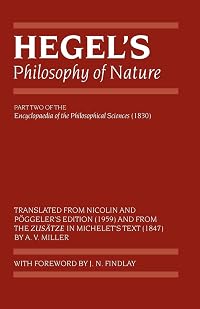
Together with the Zusatze in Boumann's text (1845), translated by A.V. Miller
Ratings
Members
- Recently Added By
Lists

Art of Reading
188 works; 5 members
Author Information

888+ Works 16,595 Members
Born the son of a government clerk in Stuttgart, Germany, George Wilhelm Friedrich Hegel received his education at Tubingen in theology. Arguably the most influential philosopher of the nineteenth century, Hegel's lectures---most notably at the University of Berlin from 1818 to his death---deeply influenced not only philosophers and historians but show more generations of political activists of both the Right and Left, champions of the all-powerful nation-state on the one hand and Karl Marx on the other. His lectures at Berlin were the platform from which he set forth the system elaborated in his writings. At the heart of Hegel's philosophy is his philosophy of history. In his view, history works in a series of dialectical steps---thesis, antithesis, synthesis. His whole system is founded on the great triad---the Idea as thesis, Nature as antithesis, and the Spirit as synthesis. The Idea is God's will; Nature is the material world, including man; Spirit is man's self-consciousness of the Idea, his coming to an understanding of God's will. The formation over time of this consciousness is History. Spirit does not exist in the abstract for Hegel, but is comprehended in "peoples," cultures, or civilizations, in practice states. Hegelian Freedom is only possible in organized states, where a National Spirit can be realized. This National Spirit, a part of the World Spirit, is realized in History largely through the actions of World Historical Individuals, heroes such as Napoleon, who embody that Spirit. A profound misunderstanding of this doctrine led many German intellectuals to subvert it into a narrow, authoritarian nationalism that glorified the "state" as an end in itself. Although Hegel saw his philosophy as universal, applicable throughout the world, the focus and inspiration of his thought was European. And in his own even smaller world, he was content to support and work for the Prussian state, which he believed to be the highest development of history up to that time. (Bowker Author Biography) show less
Some Editions
Series

Common Knowledge
- Canonical title
- Hegel: Philosophy of Mind
- Original publication date
- 1830, 1845
Classifications
Statistics
- Members
- 218
- Popularity
- 149,619
- Reviews
- 3
- Rating
- (3.80)
- Languages
- 5 — English, German, Greek, Hungarian, Italian
- Media
- Paper, Audiobook, Ebook
- ISBNs
- 24
- ASINs
- 6