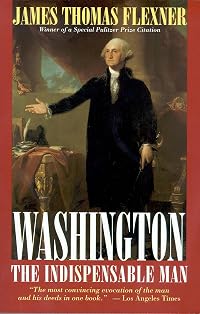
Washington: The Indispensable Man
by James Thomas Flexner
On This Page
Description
James Thomas Flexner's masterful four-volume biography of America's first president, which received a special Pulitzer Prize citation and a National Book Award for its concluding installment, is the definitive chronicle of Washington's life and a classic work of American history. In graceful and dramatic prose, Flexner peels back the myths surrounding Washington to reveal the true complexity of his character. The only founding father from Virginia to free all his slaves, Washington was a show more faithful husband who harbored deep romantic feelings for his best friend's wife. An amateur soldier, he prepared for his role as commander in chief of the Continental army by sending out to Philadelphia bookshops for treatises on military strategy. As president, he set many democratic precedents-including the two-term limit and the appointment of an advisory cabinet-yet routinely excluded his vice president, John Adams, from important decisions. The George Washington that emerges in these pages is a shrewd statesman, a wise commander and a brave patriot. In tracing Washington's evolution from privileged son of the landed gentry to "the indispensable man" without whom the United States as we know it would not exist, Flexner presents a hero worthy of admiration not only for his remarkable strengths, but also for his all-too-human weaknesses. show lessTags
Recommendations











Member Reviews
Flexner wrote a massive four volume biography of Washington, which he then condensed into this more approachable 400 page book. As the subtitle, The Indispensible Man indicates, Flexner places Washington in his keystone role in the history of America. Washington rose from the lower-ranks of the Virginia planter aristocracy through land speculation, and a minor military career in the French and Indian Wars. Snubbed by British officers, he focused on American independence in economic matters, and then when the Revolution occurred, became the leader of the Continental Army, and the first President, setting the traditions for the American republic.
Again and again, Washington's virtues are persistence and equanimity. At many points where show more others would have given up in despair, or resorted to personal attacks, Washington held firm to his course. He held the army together through desperate retreats and the bitter winter at Valley Forge. As President, he managed conflict between Hamilton's Federalists and Jefferson's Democratic-Republicans. Washington did not always choose wisely, and particularly in his old age, and following the break with Thomas Jefferson, he became more partisan, more paranoid, less able to unify the country and plot a wise course. In large part, he did what few others could, and well-earned his place in history.
Flexner deserves credit for earnestly engaging with the slavery issue at the end of the book, as I was waiting for it to come up. Washington was born into a slave society, but in Flexner's account, slowly turned against it. He wanted to end the slave system at Mount Vernor, but was constrained by the lack of alternatives. He freed what slaves he could, but many were property of Martha Washington (nee Custis), and would pass to the Custises. And while this is a good look at the man and the period, it lacks the vividness of a truly great biography. show less
Again and again, Washington's virtues are persistence and equanimity. At many points where show more others would have given up in despair, or resorted to personal attacks, Washington held firm to his course. He held the army together through desperate retreats and the bitter winter at Valley Forge. As President, he managed conflict between Hamilton's Federalists and Jefferson's Democratic-Republicans. Washington did not always choose wisely, and particularly in his old age, and following the break with Thomas Jefferson, he became more partisan, more paranoid, less able to unify the country and plot a wise course. In large part, he did what few others could, and well-earned his place in history.
Flexner deserves credit for earnestly engaging with the slavery issue at the end of the book, as I was waiting for it to come up. Washington was born into a slave society, but in Flexner's account, slowly turned against it. He wanted to end the slave system at Mount Vernor, but was constrained by the lack of alternatives. He freed what slaves he could, but many were property of Martha Washington (nee Custis), and would pass to the Custises. And while this is a good look at the man and the period, it lacks the vividness of a truly great biography. show less
In his bibliography in the back, Flexner divides published biographies of Washington into "three major categories--the historically sound, the goody-goody, and the debunking." Flexner's four volume biography of George Washington won a Pulitzer Prize citation and a National Book Award. This one volume version of that work seems to strike a good balance between the critical and admiring and, based on primary sources, from what I can tell, deserves to be put among those "historically sound." It's certainly well-written, fascinating and made me appreciate why Flexner subtitled this biography of Washington "The Indispensable Man" and why he claimed in his Introduction Washington was a "great and good man."
I thought I knew fairly well the show more basic outline of George Washington's life and of the Revolutionary and Federal period, but this book gave me a new appreciation of all that is owed to Washington--not just by Americans, but by all who support a republican form of government. I had known that people urged Washington to become America's king and he refused. I knew he had defused an officers' rebellion that could have "groomed and saddled the horses of fascism" and I knew his refusal to accept a third term of office meant he ensured an orderly transition and republican form of succession rather than dying in office and creating a kind of elective monarchy--and that ever after his example of staying only two terms in office was followed by every American president thereafter until breached by Franklin Roosevelt--and that the limitation was then grafted unto the US Constitution so Washington's precedent couldn't again be violated. Presented here again and again are traps Washington avoided that could have destroyed the embryo republic. Among the things I didn't know was just how turbulent were Washington's two terms of office as he set precedents that put flesh onto the skeleton of the Constitution. Certainly Flexner's account doesn't reflect well on either Alexander Hamilton or Thomas Jefferson, each of whom formed around him the first nascent political parties.
From time to time you can tell this book's origins as a more succinct account gathered from Flexner's expansive four-volume biography. For instance, Flexner calls Washington's stepson John Parke Custis a "monster" but doesn't really give us the details to justify that statement. Some of the chapters definitely feel sketchy. As he says in his introduction, in this one-volume work he just wanted to hit the highlights, although this book is far more than an outline, and Washington's character and personality does come through, especially in frequent quotes from letters and diaries and other first-hand accounts. Although admiring on the whole, Flexner doesn't pass over the man's flaws. There is an entire chapter dealing with "Washington and Slavery" and Flexner depicts both Washington's foolish youthful mistakes and sad mental decline in his old age. My next reads are biographies of John Adams and Thomas Jefferson and it will be interesting to see how those books complicate the picture. show less
I thought I knew fairly well the show more basic outline of George Washington's life and of the Revolutionary and Federal period, but this book gave me a new appreciation of all that is owed to Washington--not just by Americans, but by all who support a republican form of government. I had known that people urged Washington to become America's king and he refused. I knew he had defused an officers' rebellion that could have "groomed and saddled the horses of fascism" and I knew his refusal to accept a third term of office meant he ensured an orderly transition and republican form of succession rather than dying in office and creating a kind of elective monarchy--and that ever after his example of staying only two terms in office was followed by every American president thereafter until breached by Franklin Roosevelt--and that the limitation was then grafted unto the US Constitution so Washington's precedent couldn't again be violated. Presented here again and again are traps Washington avoided that could have destroyed the embryo republic. Among the things I didn't know was just how turbulent were Washington's two terms of office as he set precedents that put flesh onto the skeleton of the Constitution. Certainly Flexner's account doesn't reflect well on either Alexander Hamilton or Thomas Jefferson, each of whom formed around him the first nascent political parties.
From time to time you can tell this book's origins as a more succinct account gathered from Flexner's expansive four-volume biography. For instance, Flexner calls Washington's stepson John Parke Custis a "monster" but doesn't really give us the details to justify that statement. Some of the chapters definitely feel sketchy. As he says in his introduction, in this one-volume work he just wanted to hit the highlights, although this book is far more than an outline, and Washington's character and personality does come through, especially in frequent quotes from letters and diaries and other first-hand accounts. Although admiring on the whole, Flexner doesn't pass over the man's flaws. There is an entire chapter dealing with "Washington and Slavery" and Flexner depicts both Washington's foolish youthful mistakes and sad mental decline in his old age. My next reads are biographies of John Adams and Thomas Jefferson and it will be interesting to see how those books complicate the picture. show less
An excellent one-volume abridgment of Flexner's old multivolume biography of Washington, updated here with a fine and comprehensive array of portraits, paintings, photographs of contemporary objects, full-color maps of battles, and primary source documents referenced in the text. Flexner's account of Washington manages to strip a bit of the demigod veneer off Washington without trashing him. Not quite as good as Chernow's biography, but the illustrations make it a fine and indispensable companion to that biography. I would recommend reading both. (Never read just one biography of a person.)
I learned a lot. Washington is far more human to me now, but I like him even better
"Washington: The Indispensable Man" is full of great information. Based on the author's 4-volume set (!) this covers the main points of most of Washington's life. Unfortunately, I found a good bit of Flexner's writing to be oddly worded and somewhat stuffy. I'm all for not ending sentences in prepositions, but many of his sentences seems to work very hard to follow that rule. There's little casualness to his style which can make for a more arduous read.
This superior one-volume editon of Flexner's monumental four-volume biography of Washington is both well-written and researched. A fitting biography worthy of its subject, and as close as I've gotten recently to a Presidential page-turner.
This was required reading for a history course that I was enrolled in a few years back, but I ended up dropping the course and never sold the texts back. It is an interesting and relatively short biography on George Washington; at 400 pages, it is MUCH shorter than Flexner's FOUR VOLUME long version. The writing was very dry at points, and I really had to stay focused or I'd find myself "reading" pages without really reading them. Still, it is a thorough account of a fascinating man and a very important era in our country's history. I especially enjoyed the sections that highlighted Washington's childhood and early adult life as well as his post-Presidency years. In addition to that, the chapter describing his views on slavery was very show more enlightening. My only issue with this book is that Flexner seemed to have significant distaste for John Adams, which was evident whenever he was mentioned in the text. show less
Members
- Recently Added By
Lists

George Washington Books
12 works; 1 member

Presidential Books
15 works; 2 members

Founding Father
104 works; 11 members
Best U.S. History Books (1754-1828)
363 works; 18 members
Author Information

53+ Works 3,391 Members
Some Editions
Work Relationships
Has as a student's study guide
Common Knowledge
- Original title
- Washington : the indispensable man
- Original publication date
- 1974
- People/Characters
- George Washington
- Important places
- USA
- Important events
- American Revolution (1775 | 1783)
- Related movies
- George Washington (1984 | IMDb)
- Dedication
- To Beatrice, my wife
- Original language
- English
Classifications
- Genres
- History, Nonfiction, Biography & Memoir, General Nonfiction
- DDC/MDS
- 973.4 — History & geography History of North America United States Constitutional period (1789-1809)
- LCC
- E312 .F556 — History of the United States United States Revolution to the Civil War, 1775/1783-1861 By period 1789-1809. Constitutional period Washington's administrations, 1789-1797
- BISAC
Statistics
- Members
- 1,185
- Popularity
- 21,139
- Reviews
- 11
- Rating
- (4.09)
- Languages
- English, Polish
- Media
- Paper, Ebook
- ISBNs
- 15
- ASINs
- 12