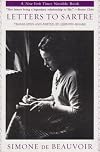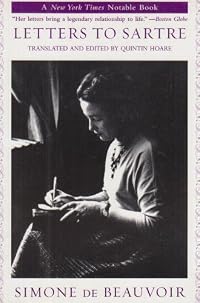
Letters to Sartre
by Simone de Beauvoir
On This Page
Description
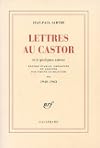
In 1983 de Beauvoir published Sartre's letters, maintaining that her own to him had been lost. They were found by de Beauvoir's adopted daughter, and published to a storm of controversy in France. Tracing the emotional and triangular complications of her life with Sartre, the letters reveal her not only as manipulative and dependent but Simonealso as vulnerable, passionate, jealous and committed.Tags
Recommendations









































Member Recommendations

Member Reviews
I love the fact that Simone de Beauvoir referred to Sartre as “My dear little being.”
She loves everything about him from his "little fingers", ″arms″, and ″lips/lip″ to his ″boring sweaters″ and ″little 'not so round' face.″
Sartre calls her “Beaver,” lovingly!
She loves everything about him from his "little fingers", ″arms″, and ″lips/lip″ to his ″boring sweaters″ and ″little 'not so round' face.″
Sartre calls her “Beaver,” lovingly!
″When I’m with you nothing seems so terrible as leaving you yet faraway the least little fear is unbearable. I love you passionately. I’m empty and unhappy without you...I love you with something tragic and with complete abandonment.″ she wrote.
Simone Lucie Ernestine Marie Bertrand de Beauvoir (1908-1986), was a French writer, intellectual, existentialist philosopher, political activist, feminist and social theorist, who was closely associated with Jean-Paul Sartre and Existentialism.
These letters were published posthumously in 1990. The editor wrote in his Introduction, “the publication of her correspondence… demonstrated the radical incompatibility of her and Sartre’s whole conception of free human relations… with the somewhat rose-tinted, soft-edged public image she had herself at times helped to create… What provoked the outraged reaction of so many to the posthumous publication of these letters? At least three strands converged here. First, traditional sexism… show more Secondly… ideological Reaction: the posturing of intellectual yuppiedom… More significant was a third strand made up of former of still-would-be sympathizers, who now felt De Beauvoir had revealed herself in her letters to be dismayingly OTHER than the idealized image of her they had so long been nurturing…De Beauvoir’s letters to Sartre … are love letters … and they are concurrently the unsparing account of those other---‘contingent’---loves allowed for in her pact with Sartre… De Beauvoir herself is a validly heroic figure… [who] produced a work which stands and will stand as the baseline of all aspirations for equality between the sexes in the modern world.” (Pg. vii-ix)
Those looking for philosophical sophistication in these letters will mostly go away disappointed; but for those wanting insight into De Beauvoir’s mind and personality, and for details of her relationship with Sartre---as well as with various other lovers (female and male)---this collection will be a “page-turner.” show less
These letters were published posthumously in 1990. The editor wrote in his Introduction, “the publication of her correspondence… demonstrated the radical incompatibility of her and Sartre’s whole conception of free human relations… with the somewhat rose-tinted, soft-edged public image she had herself at times helped to create… What provoked the outraged reaction of so many to the posthumous publication of these letters? At least three strands converged here. First, traditional sexism… show more Secondly… ideological Reaction: the posturing of intellectual yuppiedom… More significant was a third strand made up of former of still-would-be sympathizers, who now felt De Beauvoir had revealed herself in her letters to be dismayingly OTHER than the idealized image of her they had so long been nurturing…De Beauvoir’s letters to Sartre … are love letters … and they are concurrently the unsparing account of those other---‘contingent’---loves allowed for in her pact with Sartre… De Beauvoir herself is a validly heroic figure… [who] produced a work which stands and will stand as the baseline of all aspirations for equality between the sexes in the modern world.” (Pg. vii-ix)
Those looking for philosophical sophistication in these letters will mostly go away disappointed; but for those wanting insight into De Beauvoir’s mind and personality, and for details of her relationship with Sartre---as well as with various other lovers (female and male)---this collection will be a “page-turner.” show less
Ratings
Members
- Recently Added By
Lists

Epistolary Non-Fiction (Letters and Correspondence)
99 works; 5 members
Author Information

233+ Works 28,790 Members
Simone de Beauvoir, 1908 - 1986 Simone de Beauvoir was born January 9, 1908 in Paris, France to a respected bourgeois family. Her father was a lawyer, her mother a housewife, and together they raised two daughters to be intelligent, inquisitive individuals. de Beauvoir attended the elementary school Cours Desir in 1913, then L'Institute Sainte show more Nary under the tutelage of Robert Garric, followed by the Institute Catholique in Paris, before finally attending the Sorbonne, where she graduated from in 1929. It was there that she met the man who would become her life long friend and companion, John Paul Sartre, who contributed to her philosophy of life. She is perhaps best know for her novel entitled "The Second Sex", which describes the ideal that women are an indescribable "other", something "made, not born", and a declaration of feminine independence. After graduating from the Sorbonne, de Beauvoir went on to teach Latin at Lycee Victor Duruy, philosophy at a school in Marseilles, and a few other teaching positions before coming to teach at the Sorbonne. During the course of her twelve years of teaching, from 1931 to 1943, de Beauvoir developed the basis for her philosophical thought. She used her formal philosophy background to also comment on feminism and existentialism. Her personal philosophy was that freedom of choice is man's utmost gift of value. Acts of goodness make one more free, acts of evil decrease that selfsame freedom. In 1945, de Beauvoir and Sartre founded and edited Le Temps Modernes, a monthly review of philosophical thought and trends. In 1943, with the money she had earned from teaching, de Beauvoir turned her full attention to writing, producing first "L'Envitee", then "Pyrrhus et Cineas" in 1944. In 1948, she wrote perhaps her most famous philosophical work, "The Ethics of Ambiguity". "The Second Sex", regarded by many as the seminal work in the field of feminism, is her most famous work. Other works include "The Coming of Age", which addresses society's condemnation of old age, the award winning novel "The Mandarins", "A Very Easy Death", about the death of her mother and a four part biography. In "The Woman Destroyed", a collection of two long stories and one short novel, de Beauvoir discusses middle age. One of her last novels was in the form of a diary recording; it told of the slow death of her life-long compatriot, Jean Paul Sartre. On April 14, 1986, Simone de Beauvoir, one of the mothers of feminism, passed away in her home in Paris. (Bowker Author Biography) show less
All Editions
Some Editions
Work Relationships
Common Knowledge
- People/Characters
- Jean-Paul Sartre; Simone de Beauvoir
Classifications
- Genres
- Nonfiction, Biography & Memoir, Literature Studies and Criticism, Philosophy, Sexuality and Gender Studies
- DDC/MDS
- 921 — History & geography Biography & genealogy Philosophers and psychologists
- LCC
- PQ2603 .E362 .Z49513 — Language and Literature French, Italian, Spanish and Portuguese literatures French literature Modern literature 1900-1960
- BISAC
Statistics
- Members
- 269
- Popularity
- 119,346
- Reviews
- 2
- Rating
- (3.97)
- Languages
- Dutch, English, German
- Media
- Paper, Ebook
- ISBNs
- 7
- ASINs
- 5