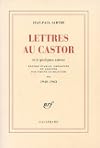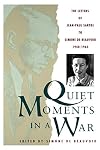
Quiet Moments In A War: The Letters of John Paul Sartre to Simone deBeauvoir
by Jean-Paul Sartre
131 Members (3.80)
On This Page
Description
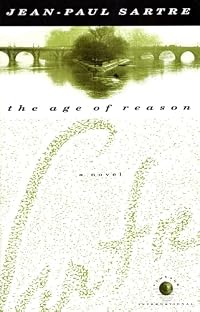
Quiet Moments in a War, the companion volume to the acclaimed Witness to My Life, reveals Jean-Paul Sartre at the peak of his powers and renown, engaged in an exchange of ideas and intimacies with his "beloved Beaver," Simone de Beauvoir. Spanning the years 1940-1963, these letters describe Sartre's war - as a soldier, a prisoner of the Germans, and a man of the Resistance - and chart his path to fame with the publication of his major works. From September 1939 to June. 1940, Sartre wrote show more Beauvoir almost daily from the front as he waited for the Germans to attack. It was a time of great productivity for Sartre, as he wrote the novel The Age of Reason and sketched out Being and Nothingness. In late 1940, he wrote his first play while interned in a German prison camp. The letters after his release reveal the wartime uncertainties and delays in securing a production of The Flies, an existential retelling of the Oresteia with a thinly. Veiled protest against acquiescence toward the German occupation. After 1942 there are fewer letters, as the couple was less often apart, but extraordinary ones. In almost every one, there is mention of a new play, novel, or essay underway. In 1946, Sartre writes Beauvoir from New York, where No Exit has opened and he is the toast of the town: "Here it is the same as in Paris: everyone is talking about me and everywhere I'm dragged through the mud"; and in 1959, from the. Irish estate of John Huston, where the two men were working on a film about Freud. The collection ends in 1963, with a simple statement written by Beauvoir after Sartre's death and shortly before her own: "This letter is the last that received from Sartre. Thereafter, during our brief separations, we used the telephone." Quiet Moments in a War completes the extraordinary correspondence of one of modern history's most celebrated couples, and documents the emergence of a. Great intellectual figure. show lessTags
Recommendations









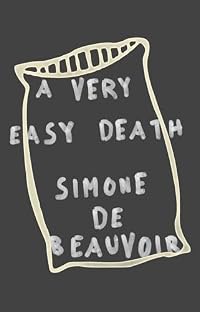
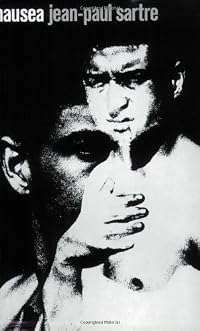

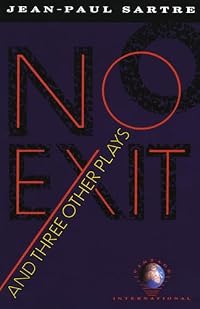


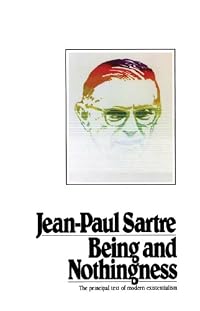









Member Recommendations

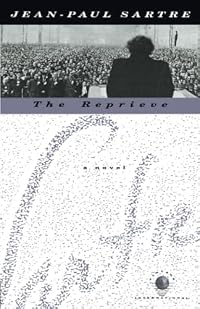
Witness to My Life: The Letters of Jean-Paul Sartre to Simone De Beauvoir, 1926-1939 by Jean-Paul Sartre
Cecrow Prior years of Sartre's letters to de Beauvoir
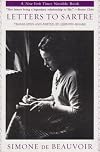
Cecrow Flip side of the coin
Member Reviews
Members
- Recently Added By
Author Information

705+ Works 57,222 Members
Sartre is the dominant figure in post-war French intellectual life. A graduate of the prestigious Ecole Normale Superieure with an agregation in philosophy, Sartre has been a major figure on the literary and philosophical scenes since the late 1930s. Widely known as an atheistic proponent of existentialism, he emphasized the priority of existence show more over preconceived essences and the importance of human freedom. In his first and best novel, Nausea (1938), Sartre contrasted the fluidity of human consciousness with the apparent solidity of external reality and satirized the hypocrisies and pretensions of bourgeois idealism. Sartre's theater is also highly ideological, emphasizing the importance of personal freedom and the commitment of the individual to social and political goals. His first play, The Flies (1943), was produced during the German occupation, despite its underlying message of defiance. One of his most popular plays is the one-act No Exit (1944), in which the traditional theological concept of hell is redefined in existentialist terms. In Red Gloves (Les Mains Sales) (1948), Sartre examines the pragmatic implications of the individual involved in political action through the mechanism of the Communist party and a changing historical situation. His highly readable autobiography, The Words (1964), tells of his childhood in an idealistic bourgeois Protestant family and of his subsequent rejection of his upbringing. Sartre has also made significant contributions to literary criticism in his 10-volume Situations (1947--72) and in works on Baudelaire, Genet, and Flaubert. In 1964 he was awarded the Nobel Prize in Literature and refused it, saying that he always declined official honors. (Bowker Author Biography) show less
Common Knowledge
- Canonical title
- Quiet Moments In A War: The Letters of John Paul Sartre to Simone deBeauvoir
- Original title
- Lettres au Castor et à quelques autres, tome 2 : 1940-1963
- People/Characters
- Jean-Paul Sartre; Simone de Beauvoir
- Important events
- World War II
Classifications
- Genres
- Fiction and Literature, Biography & Memoir, Literature Studies and Criticism
- DDC/MDS
- 848.91409 — Literature & rhetoric French & related literatures French miscellaneous writings 1900- 1900-1999 1945-1999 Individual authors
- LCC
- PQ2637 .A82 .Z483 — Language and Literature French, Italian, Spanish and Portuguese literatures French literature Modern literature 1900-1960
- BISAC
Statistics
- Members
- 131
- Popularity
- 244,551
- Rating
- (3.80)
- Languages
- 5 — Dutch, English, French, German, Spanish
- Media
- Paper, Ebook
- ISBNs
- 10
- ASINs
- 1