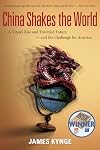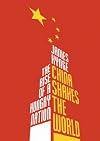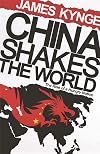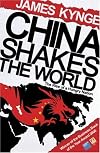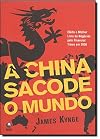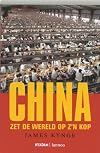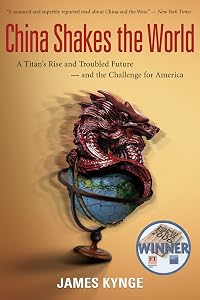
China Shakes the World: A Titan's Rise and Troubled Future -- and the Challenge for America
by James Kynge
On This Page
Description
Journalist Kynge traces the shock waves from Beijing to Tuscany to the Midwest as China's hunger for jobs, raw materials, energy, and food--and its export of goods, workers, and investments--drastically reshape world trade and politics. As we become increasingly dependent on China's products and markets, the slightest change in the Chinese economy quickly reaches us. Drawing on his years in the country and his fluency in Mandarin, Kynge probes beyond the statistics to unearth the reasons for show more China's explosive growth. He sounds the alarm as China's systemic weaknesses--rampant fraud, crippling environmental crises, corrupt banking systems, faltering government institutions--threaten greater global disruptions. Through stories of entrepreneurs and visionaries, factory workers and store clerks at the center of it all, Kynge explains how this spectacular change occurred--how it affects our jobs, our communities, and our local department stores--and what it will mean for the twenty-first century.--From publisher description. show lessTags
Recommendations


Member Reviews
This is a book about China's rise and what it means for us and the future, written by the FT correspondent in Beijing.
The first half is a detailed and frankly rather worring look at why it is difficult for anyone else in the world to compete with China as a manufacturer - a huge workforce willing to work hard for little pay, but also China's increasing ability to improve the quality of the goods it produces, buy the quality it can't make itself, and even put money into R&D as the sector starts to mature. It's very well written, though, and an easy read, with lots of personal stories, of the Chinese businessmen who came from nothing, as well as the losers (in China and the West).
The second half is billed as a counterbalance to this, show more demonstrating some of the weaknesses of China's rise. But this section is a lot more haphazard - at times, it feels as if it contains an anecdote or two about every major issue, from environmental degradation and corruption to China's support for pariah states and the question of Taiwan. It's rather like reading a collection of magazine articles - enjoyable, but it can be hard to discern the thread of the argument. Especially as most of the stories Kynge tells are pretty depressing, but he ends (rather abruptly) on an optimistic note, suggesting that China will never 'bite the hand that feeds it'.
However, I would still recommend this, as a good overview of what China is at the start of the 21st century, and what the issues will be in the future. show less
The first half is a detailed and frankly rather worring look at why it is difficult for anyone else in the world to compete with China as a manufacturer - a huge workforce willing to work hard for little pay, but also China's increasing ability to improve the quality of the goods it produces, buy the quality it can't make itself, and even put money into R&D as the sector starts to mature. It's very well written, though, and an easy read, with lots of personal stories, of the Chinese businessmen who came from nothing, as well as the losers (in China and the West).
The second half is billed as a counterbalance to this, show more demonstrating some of the weaknesses of China's rise. But this section is a lot more haphazard - at times, it feels as if it contains an anecdote or two about every major issue, from environmental degradation and corruption to China's support for pariah states and the question of Taiwan. It's rather like reading a collection of magazine articles - enjoyable, but it can be hard to discern the thread of the argument. Especially as most of the stories Kynge tells are pretty depressing, but he ends (rather abruptly) on an optimistic note, suggesting that China will never 'bite the hand that feeds it'.
However, I would still recommend this, as a good overview of what China is at the start of the 21st century, and what the issues will be in the future. show less
This book gives a general overview of the economic reforms taking place in China over the last 30-something years and makes for interesting, if sobering, reading. The author describes the intensive development of the Chinese economy and and how such fast paced growth, on a massive scale, is impacting the rest of the world. China's economies of scale and sheer productivity do make you wonder how any 'developed' country can possibly compete with it in the manufacturing sector.
The raw statistics behind China however are astonishing and I would have liked more of these, possibly in tables in an appendix for ease of access. Some maps would also have been helpful to picture geographically the different regions talked about, instead of having show more to consult an external source.
These are niggles however. This book is very readable and conveys a lot of information for relatively few pages. The author combines business journalism and statistics with stories about individuals and their lives and careers. This really helps to provide a human context for the bigger picture he is describing. It is also well sourced with what looks to be a good bibliography. Excellent. show less
The raw statistics behind China however are astonishing and I would have liked more of these, possibly in tables in an appendix for ease of access. Some maps would also have been helpful to picture geographically the different regions talked about, instead of having show more to consult an external source.
These are niggles however. This book is very readable and conveys a lot of information for relatively few pages. The author combines business journalism and statistics with stories about individuals and their lives and careers. This really helps to provide a human context for the bigger picture he is describing. It is also well sourced with what looks to be a good bibliography. Excellent. show less
While written 11 years ago, what this book reports is still true. China's business practices have pretty much undermined the rest of the world's economy, and their workers are putting in long hours for very low pay to provide the world with low price goods that no country in the Americas or Europe can compete with. Anyone hoping to see a return of American prosperity through home grown manufacturing should wake up. It'll never happen, unless they're willing to work for 2 or 3 dollars an hour and put in 15 hour days. That's not likely to happen, and everyone will want to continue to pay the lowest possible prices at stores like Wal Mart for goods made in China, so learn to live with it.
My only complaint with this book was that it felt like nine long magazine articles cobbled together into a book. That makes sense based on the history of Kynge writing for the Financial Times. Aside from that, I found these stories very interesting and thought provoking. I had to put the book down frequently to think about the events and examples from the book. I feel that it does an excellent job of blending human interest stories with government and business reporting. There is a reason that it has won so many awards - because it does an excellent job of portraying the rise of a very complicated and nuanced nation.
Carefully balanced and beautifully human view of China's perhaps-not-quite-inexorable rise.
Describing a country as huge as China is not an easy task, and specially when the country has its own set of contradictions, they have a communist government using capitalist methods to achieve necessary growth and momentum in the economy that keeps the country stable socially. James Kynge has done a wonderful job in describing the country, studying the different contradictions that the China story has to offer and also helps the reader to understand the implications of the rising nation. The narrative is a balanced one,and the fact that the author has spent a major part of his life in China and understands Mandarin, the local language gives an inside peep to the story which a mandarin illiterate guy could not have given.
There are many show more books written on China, but they delve too deep into the politics and policies of the dragon nation and fail to give its implication in a proper manner, however the author, through the book tries to cover as comprehensively as possible the different meaning and implication of the rising nation.
A must read if you want to understand the country show less
There are many show more books written on China, but they delve too deep into the politics and policies of the dragon nation and fail to give its implication in a proper manner, however the author, through the book tries to cover as comprehensively as possible the different meaning and implication of the rising nation.
A must read if you want to understand the country show less
This is a great book about China and it's impact on the rest of the world - both positive and negative. James Kynge lives in Beijing, speaks Mandarin, and first went to China in 1982. He was the Financial Times bureau chief from 1998 to 2005.
To get an idea of the profound changes in China it's worth quoting from the book;
"It must be said that from a global perspective, China's emergence is of enormous economic benefit. The value created by the release of 400 million people from poverty, the migration of over 120 million from farms where they perhaps raised chickens to factories where they churn out electronics, the quantum leap in education standards for tens of millions of children, the construction of a first world infrastructure, show more the growth of over forty cities with populations of over one million, the commercialisation of housing and the vaulting progress up the technology ladder have helped unleash one of the greatest ever surges in general prosperity. The prime beneficiary of this has been China itself, but the mobilisation of wealth on such a scale is necessarily, in aggregate terms, lifting the fortunes of the planet. Some specific advantages are already present. Beijing's towering pile of foreign currency reserves, which in late 2005 stood over $710 billion, has been used to a large extent to buy US Treasury bonds. Not only has that helped the American government to finance public spending and pay for the war in Iraq, but it has also assisted in keeping interest rates low. The depressed level of US interest rates has, in it's turn, set a standard for the world and led to a property boom in most developed countries. At the same time, the manufacture of ever cheaper products such as those on sale in Yiwu has meant that people's purchasing power has strengthened."
Nevertheless, he also explores aggressive Chinese nationalism, the abandonment of principle in the UN security council, the wrecking of their environment and the corruption of the new Capitalist (Communist in name only) dictatorship. show less
To get an idea of the profound changes in China it's worth quoting from the book;
"It must be said that from a global perspective, China's emergence is of enormous economic benefit. The value created by the release of 400 million people from poverty, the migration of over 120 million from farms where they perhaps raised chickens to factories where they churn out electronics, the quantum leap in education standards for tens of millions of children, the construction of a first world infrastructure, show more the growth of over forty cities with populations of over one million, the commercialisation of housing and the vaulting progress up the technology ladder have helped unleash one of the greatest ever surges in general prosperity. The prime beneficiary of this has been China itself, but the mobilisation of wealth on such a scale is necessarily, in aggregate terms, lifting the fortunes of the planet. Some specific advantages are already present. Beijing's towering pile of foreign currency reserves, which in late 2005 stood over $710 billion, has been used to a large extent to buy US Treasury bonds. Not only has that helped the American government to finance public spending and pay for the war in Iraq, but it has also assisted in keeping interest rates low. The depressed level of US interest rates has, in it's turn, set a standard for the world and led to a property boom in most developed countries. At the same time, the manufacture of ever cheaper products such as those on sale in Yiwu has meant that people's purchasing power has strengthened."
Nevertheless, he also explores aggressive Chinese nationalism, the abandonment of principle in the UN security council, the wrecking of their environment and the corruption of the new Capitalist (Communist in name only) dictatorship. show less
Members
- Recently Added By
Published Reviews
ThingScore 100
Kynge does an admirable job of capturing the sweep and scale of the changes racing across China.
added by lampbane
Lists

Paul French's Ultimate China Bookshelf
31 works; 1 member
Author Information

2+ Works 393 Members
James Kynge is the former China bureau chief of the Financial Times in Beijing
Awards and Honors
Common Knowledge
- Alternate titles
- China shakes the world
- Important places
- China
- Dedication
- To Lucy, Tom, Ella, and Ollie
- First words
- By the time I got there, there was only a scar.
Classifications
- Genres
- Economics, Nonfiction, General Nonfiction, Business, History, Politics and Government
- DDC/MDS
- 330.951 — Society, government, & culture Economics Jobs & Careers Economic geography and history Asia China and Korea
- LCC
- HC427.95 .K96 — Social sciences Economic history and conditions Economic history and conditions By region or country
- BISAC
Statistics
- Members
- 392
- Popularity
- 79,555
- Reviews
- 12
- Rating
- (3.73)
- Languages
- Dutch, English, German, Portuguese
- Media
- Paper
- ISBNs
- 12
- UPCs
- 1
- ASINs
- 2