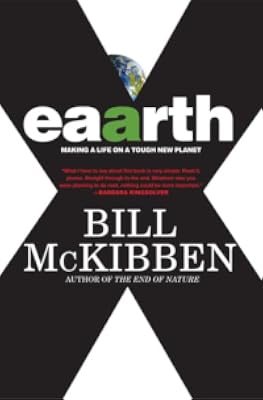
Eaarth: Making a Life on a Tough New Planet
by Bill McKibben
On This Page
Description
McKibben's earliest warnings about global warming went largely unheeded. In this book, he argues that we can meet the challenges of a new "Eaarth"--still recognizable but suddenly and violently out of balance--by building the kind of societies and economies that can hunker down, concentrate on essentials, and create the type of community that will allow us to weather trouble on an unprecedented scale.Tags
Recommendations




Member Reviews
This is not an easy book to read. Its central message is one we do not want to hear. Author Bill McKibben contends that global warming is not a threat; it is a reality. And he gives plenty of evidence to support that claim. We no longer live on the planet we have known as Earth. We are entering a new reality on a new planet. The change is great enough, according to McKibben, to require a new name for our planet—Eaarth. But just as you are ready to plunge into total despair about the future of humanity, McKibben gives us the obligatory hopeful ending. Though climate change is already underway, we can lessen its affects by acting now. What we need to do, says McKibben, is go small and local. The author does a fine job showing us how our show more intertwined global systems threaten the well-being of the planet and us. He also points to what we need to do. And there are signs that those positive changes are occurring. What has me fearful is that those in power will not have the courage and the will to do what is required for our survival. When we still have decision makers in business and government in denial about the reality of global warming or believing that we still have plenty of time to act, I am not too hopeful that we are going to be able to prevent catastrophic consequences for us and the rest of the planet’s inhabitants.
I recommend McKibbin’s book. It is time we get real about what is happening on our planet. We must begin to shape a new life on a new planet. Welcome to Eaarth. show less
I recommend McKibbin’s book. It is time we get real about what is happening on our planet. We must begin to shape a new life on a new planet. Welcome to Eaarth. show less
 This review was written for LibraryThing Early Reviewers.
Eaarth is at once hopeful and devastating. Bill McKibben doesn't pull any punches about the effects of global warming on our planet. The consequences of our pursuit for fossil fuel (and its burning) have made a lasting impact which is already effecting day-to-day living. The 'natural' disasters that we've been plagued with in ever-increasing frequency are a direct result of the imbalance which is a direct result of global warming. I say 'natural' because these freak weather events would most likely not have occurred if we hadn't pumped so much poison into the air and bumped up the global temperature (and it's only been pushed up one degree at this point). However, McKibben doesn't just harp on the horrors we've inflicted on the planet show more and its many inhabitants. He has solid ideas for ways we can adapt to our new environment on this completely new planet we created. His advice is to rely on communities and strive for living greener lives. (I've oversimplified of course because to give away more would defeat the purpose of you reading his excellent book.) If you're interested in environmental sciences and/or you're interested in the fate of our planet and our very way of life then I recommend you read this book ASAP. show less
Eaarth is at once hopeful and devastating. Bill McKibben doesn't pull any punches about the effects of global warming on our planet. The consequences of our pursuit for fossil fuel (and its burning) have made a lasting impact which is already effecting day-to-day living. The 'natural' disasters that we've been plagued with in ever-increasing frequency are a direct result of the imbalance which is a direct result of global warming. I say 'natural' because these freak weather events would most likely not have occurred if we hadn't pumped so much poison into the air and bumped up the global temperature (and it's only been pushed up one degree at this point). However, McKibben doesn't just harp on the horrors we've inflicted on the planet show more and its many inhabitants. He has solid ideas for ways we can adapt to our new environment on this completely new planet we created. His advice is to rely on communities and strive for living greener lives. (I've oversimplified of course because to give away more would defeat the purpose of you reading his excellent book.) If you're interested in environmental sciences and/or you're interested in the fate of our planet and our very way of life then I recommend you read this book ASAP. show less
This book is not an attempt to educate or persuade skeptics about the reality of climate change; there are many books that do that. McKibben takes the reality of climate change as a given – which is entirely reasonable given the strength of the scientific consensus about climate change, which is as clear and solid as anything science can produce.
Instead, the book is about the consequences of climate change and what they will mean for the way we live. McKibben persuasively argues that it is to late too avoid significant impacts from global warming, which are becoming increasingly evident and will inevitably worsen in the coming decades - though we must act quickly reign in greenhouse gas emissions if we are to avoid a global show more catastrophe. McKibben then makes the case that the complex, interconnected global economy of endless growth that we have grown accustomed to is no longer viable, and that a society organized around smaller, more localized economies to sustainably provide for basic human needs provides the best hope for adapting to the challenges of this new planet. McKibben may not be have all of the answers, but he is surely asking the right questions. What is clear is that our way of life will inevitably change; the endless growth of the global economy simply cannot continue indefinitely. The question is whether we will fearfully try to pretend that we can go on this way forever until society crashes into panic and chaos, or whether we will have the courage and foresight to acknowledge that it must inevitably change and fashion a simpler, more solid and sustainable way of life to take its place. We need to be thinking and talking about this now, and this book is a good place to start. show less
Instead, the book is about the consequences of climate change and what they will mean for the way we live. McKibben persuasively argues that it is to late too avoid significant impacts from global warming, which are becoming increasingly evident and will inevitably worsen in the coming decades - though we must act quickly reign in greenhouse gas emissions if we are to avoid a global show more catastrophe. McKibben then makes the case that the complex, interconnected global economy of endless growth that we have grown accustomed to is no longer viable, and that a society organized around smaller, more localized economies to sustainably provide for basic human needs provides the best hope for adapting to the challenges of this new planet. McKibben may not be have all of the answers, but he is surely asking the right questions. What is clear is that our way of life will inevitably change; the endless growth of the global economy simply cannot continue indefinitely. The question is whether we will fearfully try to pretend that we can go on this way forever until society crashes into panic and chaos, or whether we will have the courage and foresight to acknowledge that it must inevitably change and fashion a simpler, more solid and sustainable way of life to take its place. We need to be thinking and talking about this now, and this book is a good place to start. show less
This is one of those books that may alter your entire view of the world. In it, Bill McKibben offers something new. He's not trying to convince anyone that global warming exists -- and thank God for that, it's a thankless task and tedious reading for anyone with a bit of common sense -- but rather talk to us about how we can possibly go on living on a world we've nearly destroyed. The first half of the book may be the most depressing thing I've ever read. Yes, it was more depressing that Cormac McCarthy's The Road. At points I honestly didn't know if I could keep reading. I persevered because, well, that's the least my gas-guzzling butt can do, right? Once McKibben breaks it all down for you how climate change is going to impact our show more Earth, and sooner and harsher than we've been told, he starts building you back up, reminding you of human ingenuity and about how before this whole Industrial Revolution started, humans kinda knew how to take care of themselves on a local scale. And he talks about how we can get back to those traditional things that actually worked pretty well, add in some modern ingenuity and, perhaps, manage to save ourselves in the process. What McKibben's written here should be required reading for every American. show less
This review was written for LibraryThing Early Reviewers.I'm very impressed with Bill McKibben, 350.org, and the "Do the Math" documentary film. This book makes a compelling case that we've already passed the point where we can avoid the brunt of climate change impacts, that we've created a new planet on which life will soon become much more challenging. No more limitless growth, no more readily available fuel resources to power our economies. "Too big to fail" takes on new meaning in the context of our global economy in general, the industrial fuel and food systems in particular. He points out that local, small, and resilient cultural paradigms offer us the best chance to "gracefully manage our decline" as the inevitable effects of global warming exert their influence on human societies. To show more say that the book was sobering, and a bit discouraging, would be an understatement. Bill makes clear that we have our work cut out for us, and we can't delay taking action any longer. Very well done! show less
In the first part of this book, McKibben makes the case that global climate change has now essentially passed the point of no return. The climate has already been altered, he claims, in dangerous, chaotic ways that few of us are fully aware of, and that is still only the tip of the rapidly-melting iceberg. Even measures such as emission reductions and the development of green energy technologies, he says, worthy and laudable as they are, are not remotely enough to counter the chain reaction of warming that is occurring, and the alteration of the planet into a much more hostile environment is now inevitable. I honestly have no idea whether McKibben is right about this -- although I sincerely hope he isn't -- but he does at the very least show more make it sound plausible. Terrifying, but plausible.
In the second part, he offers up the idea that the only way to survive in this future is by paring back, choosing sustainability over growth, and shifting the emphasis of our government, agriculture, and energy production onto the local level. Again, I'm not convinced by all of it, but he makes some serious and reasonable points on the subject; we're not talking about a back-to-nature hippie pipe dream here.
What I do know is that, whether McKibben is right or not, he is worth reading. If nothing else, this is an interesting and thought-provoking contribution to the current environmental discussion and debate. show less
In the second part, he offers up the idea that the only way to survive in this future is by paring back, choosing sustainability over growth, and shifting the emphasis of our government, agriculture, and energy production onto the local level. Again, I'm not convinced by all of it, but he makes some serious and reasonable points on the subject; we're not talking about a back-to-nature hippie pipe dream here.
What I do know is that, whether McKibben is right or not, he is worth reading. If nothing else, this is an interesting and thought-provoking contribution to the current environmental discussion and debate. show less
This review was written for LibraryThing Early Reviewers.Members
- Recently Added By
Published Reviews
ThingScore 75
"...in the strongest sections, McKibben brings his own vision and experiences to bear, whether writing about the comfort of an abandoned Adirondack mill town or the joy of watching people across the globe unite around a simple message."
added by SqueakyChu
Lists

Adult Books for YA Readers
194 works; 6 members

Climate Change
39 works; 2 members
Author Information

50+ Works 6,671 Members
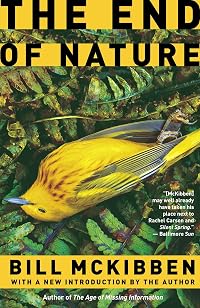
Bill McKibben grew up in Lexington, Massachusetts. He was president of the Harvard Crimson newspaper in college. Immediately after college he joined the New Yorker magazine as a staff writer, and wrote much of the "Talk of the Town" column from 1982 to early 1987. After quitting this job, he soon moved to the Adirondack Mountains of upstate New show more York. His first book, The End of Nature, was published in 1989 by Random House after being serialized in the New Yorker. It is regarded as the first book for a general audience about climate change, and has been printed in more than 20 languages. Several editions have come out in the United States, including an updated version published in 2006. His next book, The Age of Missing Information, was published in 1992. It is an account of an experiment: McKibben collected everything that came across the 100 channels of cable tv on the Fairfax, Virginia system (at the time among the nation's largest) for a single day. He spent a year watching the 2,400 hours of videotape, and then compared it to a day spent on the mountaintop near his home. This book has been widely used in colleges and high schools, and was reissued in 2006. McKibben's latest book is entitled, Eaarth: Making a Life on a Tough New Planet. Bill currently resides with his wife, writer Sue Halpern, and his daughter, Sophie in Ripton, Vermont. He is a scholar in residence at Middlebury College. 030 (Bowker Author Biography) show less
Awards and Honors
Awards
Distinctions
Notable Lists
Common Knowledge
- Alternate titles
- Earth
- Original publication date
- 2010-04
- Dedication
- For Phil Aroneau, Will Bates, Kelly Blynn, May Boeve, Jamie Henn, Jeremy Osborn, Jon Warnow, and the thousands and thousands of people who work with us at 350.org
- First words
- I'm writing these words on a gorgeous spring afternoon, perched on a bank of a brook high along the spine of the Green Mountains, a mile or so from my home in the Vermont mountain town of Ripton.
- Last words
- (Click to show. Warning: May contain spoilers.)But we still must live on the world we've created - lightly, carefully, gracefully.
- Blurbers
- Weisman, Alan ; Kingsolver, Barbara
Classifications
Statistics
- Members
- 861
- Popularity
- 31,603
- Reviews
- 33
- Rating
- (3.83)
- Languages
- Chinese, Czech, English
- Media
- Paper, Audiobook, Ebook
- ISBNs
- 16
- ASINs
- 9