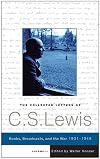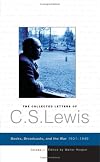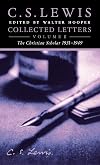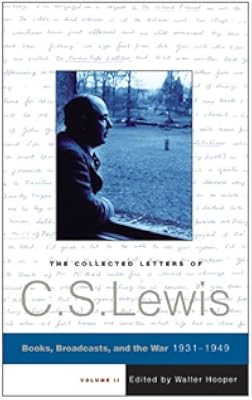
The Collected Letters of C.S. Lewis, Volume 2: Books, Broadcasts, and the War, 1931-1949
by C. S. Lewis
The Collected Letters of C. S. Lewis (2)
On This Page
Description
C. S. Lewis was a prolific letter writer, and his personal correspondence reveals much of his private life, reflections, friendships, and the progress of his thought. This second of a three-volume collection contains the letters Lewis wrote after his conversion to Christianity, as he began a lifetime of serious writing. Lewis corresponded with many of the twentieth century's major literary figures, including J. R. R. Tolkien and Dorothy Sayers. Here we encounter a surge of letters in show more response to a new audience of laypeople who wrote to him after the great success of his BBC radio broadcasts during World War II -- talks that would ultimately become his masterwork, Mere Christianity. Volume II begins with C. S. Lewis writing his first major work of literary history, The Allegory of Love, which established him as a scholar with imaginative power. These letters trace his creative journey and recount his new circle of friends, "The Inklings," who meet regularly to share their writing. Tolkien reads aloud chapters of his unfinished The Lord of the Rings, while Lewis shares portions of his first novel, Out of the Silent Planet. Lewis's weekly letters to his brother, Warnie, away serving in the army during World War II, lead him to begin writing his first spiritual work, The Problem of Pain. After the serialization of The Screwtape Letters, the director of religious broadcasting at the BBC approached Lewis and the "Mere Christianity" talks were born. With his new broadcasting career, Lewis was inundated with letters from all over the world. His faithful, thoughtful responses to numerous questions reveal the clarity and wisdom of his theological and intellectual beliefs. Volume II includes Lewis's correspondence with great writers such as Owen Barfield, Arthur C. Clarke, Sheldon Vanauken, and Dom Bede Griffiths. The letters address many of Lewis's interests -- theology, literary criticism, poetry, fantasy, and children's stories -- as well as reveal his relationships with close friends and family. But what is apparent throughout this volume is how this quiet bachelor professor in England touched the lives of many through an amazing discipline of personal correspondence. Walter Hooper's insightful notes and comprehensive biographical appendix of the correspondents make this an irreplaceable reference for those curious about the life and work of one of the most creative minds of the modern era. show lessTags
Recommendations








Member Reviews
The New Lewis
My impressions upon completing Volume 2 of Lewis's Collected Letters:
(1) Regardless of your opinion of Christianity, it would be hard to deny that the contrast between the pre-conversion Lewis of Volume 1 and the post-conversion Lewis of Volume 2 is pretty remarkable.
(2) One thing remarkable about the Lewis of Volume 2 is his ability to speak the truth in love. I hope that when I need to criticize I do it as kindly as Lewis does.
(3) Whatever type of love Lewis felt for Mrs. Moore in earlier days, it seems pretty clear that in Volume 2 it is charity (and living up to a commitment).
(4) Fans of Lewis naturally gravitate to the writings of the other Inklings, thinking perhaps that they're in for more of the same, but Volume 2 show more shows how different the Inklings really were from one another, and that they were often bound together more by friendship than a common worldview.
(5) The sense of impending doom at the start of WWII when Warnie is still in the army is overwhelming.
(6) The part of Volume 2 after WWII is dominated by Lewis's thank-you notes to Americans who sent him packages of food, paper, etc. The insight into "Austerity Britain" is useful, but these notes get a bit tiresome after a while.
(7) Hooper-haters really need to cut him some slack. This book (at least, my British edition) is physically beautiful, and Hooper has (in my opinion) done a great job with the contents. His annotations are exactly what's needed to put the letters in context--no more, no less. (Compare his restraint to the out-of-control annotators of the new Norton editions.)
(8) It takes a very good book *about* Lewis to come close to matching the quality of Lewis's own writings, even those not intended for publication. I look forward to starting Volume 3 this evening! show less
My impressions upon completing Volume 2 of Lewis's Collected Letters:
(1) Regardless of your opinion of Christianity, it would be hard to deny that the contrast between the pre-conversion Lewis of Volume 1 and the post-conversion Lewis of Volume 2 is pretty remarkable.
(2) One thing remarkable about the Lewis of Volume 2 is his ability to speak the truth in love. I hope that when I need to criticize I do it as kindly as Lewis does.
(3) Whatever type of love Lewis felt for Mrs. Moore in earlier days, it seems pretty clear that in Volume 2 it is charity (and living up to a commitment).
(4) Fans of Lewis naturally gravitate to the writings of the other Inklings, thinking perhaps that they're in for more of the same, but Volume 2 show more shows how different the Inklings really were from one another, and that they were often bound together more by friendship than a common worldview.
(5) The sense of impending doom at the start of WWII when Warnie is still in the army is overwhelming.
(6) The part of Volume 2 after WWII is dominated by Lewis's thank-you notes to Americans who sent him packages of food, paper, etc. The insight into "Austerity Britain" is useful, but these notes get a bit tiresome after a while.
(7) Hooper-haters really need to cut him some slack. This book (at least, my British edition) is physically beautiful, and Hooper has (in my opinion) done a great job with the contents. His annotations are exactly what's needed to put the letters in context--no more, no less. (Compare his restraint to the out-of-control annotators of the new Norton editions.)
(8) It takes a very good book *about* Lewis to come close to matching the quality of Lewis's own writings, even those not intended for publication. I look forward to starting Volume 3 this evening! show less
Ratings
Members
- Recently Added By
Author Information

534+ Works 523,659 Members
C. S. (Clive Staples) Lewis, "Jack" to his intimates, was born on November 29, 1898 in Belfast, Ireland. His mother died when he was 10 years old and his lawyer father allowed Lewis and his brother Warren extensive freedom. The pair were extremely close and they took full advantage of this freedom, learning on their own and frequently enjoying show more games of make-believe. These early activities led to Lewis's lifelong attraction to fantasy and mythology, often reflected in his writing. He enjoyed writing about, and reading, literature of the past, publishing such works as the award-winning The Allegory of Love (1936), about the period of history known as the Middle Ages. Although at one time Lewis considered himself an atheist, he soon became fascinated with religion. He is probably best known for his books for young adults, such as his Chronicles of Narnia series. This fantasy series, as well as such works as The Screwtape Letters (a collection of letters written by the devil), is typical of the author's interest in mixing religion and mythology, evident in both his fictional works and nonfiction articles. Lewis served with the Somerset Light Infantry in World War I; for nearly 30 years he served as Fellow and tutor of Magdalen College at Oxford University. Later, he became Professor of Medieval and Renaissance English at Cambridge University. C.S. Lewis married late in life, in 1957, and his wife, writer Joy Davidman, died of cancer in 1960. He remained at Cambridge until his death on November 22, 1963. (Bowker Author Biography) show less
Series

Work Relationships
Common Knowledge
- Canonical title
- The Collected Letters of C.S. Lewis, Volume 2: Books, Broadcasts, and the War, 1931-1949
- People/Characters
- C. S. Lewis; Warren Lewis
- Important places
- England, UK
- Important events
- World War II (1939 | 1945); World War II, British Home Front
- First words
- "I have just passed on from believing in God to definitely believing in Christ - in Christianity."
- Last words
- (Click to show. Warning: May contain spoilers.)To Dorothy L. Sayers (W):, Dec. 28/49: One's real friends are precisely the people one never gets time to write to.
Yours sincerely
C. S. Lewis
Classifications
Statistics
- Members
- 329
- Popularity
- 96,577
- Reviews
- 1
- Rating
- (4.36)
- Languages
- English
- Media
- Paper, Ebook
- ISBNs
- 5
- UPCs
- 1
- ASINs
- 5