Peake's Progress
by Mervyn Peake, Maeve Gilmore (Editor)
On This Page
Description
Mervyn Peake (1911-1968) was a prolific and astonishingly original writer and artist, who touched at one time or another on almost every literary form. "Peakes Progress" is a selection, compiled by his widow, Maeve Gilmore, from every period of his work as a writer and draughtsman. It contains a remarkable work from childhood. ?The White Chief of the ?Umzimbooboo Kaffirs, the early ?Mr. Slaughterboard, which foreshadows the Titus books, two plays, ?the Wit to Woo and ?Noahs Ark, a broadcast show more version of ?Mr. Pye, and a generous selection of Peakes short stories, poems and nonsense verses as well as his drawings. Including a new preface written by Mervyn Peakes son, Sebastian, this edition of Peakes Progress is published to coincide with the centenary of Peakes birth. show lessTags
Recommendations





















Member Reviews
An extraordinary collection of poems, plays, short stories and drawings, displaying something of Peake's extraordinary range, and also exposing recurring themes, especially islands, isolation, and the longing for security. There is even a story he wrote when he was 11, though it has the very un-PC title, "The White Chief of the Umzibooboo Kaffirs"! It also has Peake's own introduction to a collection of his pictures.
Darkstones to Gormenghast
I had already read Boy in Darkness, a Titus novella (my review HERE) and seen some of the pictures, but most of the other material was new to me, including other short works that have prototypical Gormenghast aspects. In one of these, The House of Darkstones, Lord Groan has the violet eyes that end show more up being so typical of Titus. He was also "taller than there was any need to be" and meets Mr Stewflower on, of course, an island.
Glassblowers
Peake was mesmerised watching the unspoken choreography of glassblowers, the graceful grotesqueness of cathode-ray tube production. He sketched, painted, and wrote prose, and a famous poem.
Peake's painting of glassblowers at work
The factory:
“Darkness, brickwork; hall after mammoth hall, pseudo archaic, absurd, begrimed, impressive, sinister; a setting for some film of gloomy passion… In this huge womb, fires roar.”
On sand:
“Far from the full-wailing strands, it has become the burning mother of transparency. Sand… It has found it purpose. And from its huge transmutation lucence breaks.”
Poetry
One often hears how being a war artist at the liberation of Belsen affected Peake, but some of his wartime poetry set in the London blitz is very powerful too.
There is a horrifically vivid poem, The Consumptive of Belsen (there are several versions, of varying length) and associated pictures. He explicitly wrestles with the guilt of not only observing but recording:
“Is this my traffic? For my schooled eye to see
The ghost of a great painting, line and hue,
In this doomed girl of tallow?”
Also:
“a huddled boy whose eyes had died...
his eyes like broken glass –
the shattered panes of a deserted house."
Peake's picture of a consumptive at Belsen
Chinese Influence
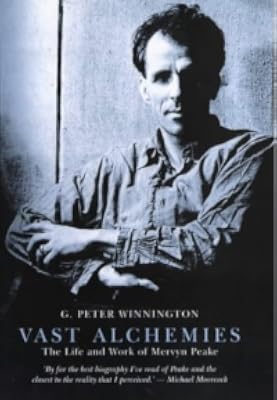
This book also reminds one of the lasting influence of his Chinese childhood - even down to the way he held a pencil like a Chinese calligraphy brush. See my reviews of his biographies for more details, especially Winnington’s Vast Alchemies, which I reviewed HERE.
Nonsense
Then, in total contrast to the war poems, there are nonsense poems (slightly reminiscent of Lear, Carroll and Belloc, complete with nonsense illustrations), and, as if to emphasise the fact he was an artist as well as a writer, some poems about great artists. See my separate review of A Book of Nonsense HERE .
All My Peake Reviews
All my Peake/Gormenghast reviews (including biographies/memoirs and books about his art) are on a shelf,
HERE. show less
Darkstones to Gormenghast
I had already read Boy in Darkness, a Titus novella (my review HERE) and seen some of the pictures, but most of the other material was new to me, including other short works that have prototypical Gormenghast aspects. In one of these, The House of Darkstones, Lord Groan has the violet eyes that end show more up being so typical of Titus. He was also "taller than there was any need to be" and meets Mr Stewflower on, of course, an island.
Glassblowers
Peake was mesmerised watching the unspoken choreography of glassblowers, the graceful grotesqueness of cathode-ray tube production. He sketched, painted, and wrote prose, and a famous poem.
Peake's painting of glassblowers at work
The factory:
“Darkness, brickwork; hall after mammoth hall, pseudo archaic, absurd, begrimed, impressive, sinister; a setting for some film of gloomy passion… In this huge womb, fires roar.”
On sand:
“Far from the full-wailing strands, it has become the burning mother of transparency. Sand… It has found it purpose. And from its huge transmutation lucence breaks.”
Poetry
One often hears how being a war artist at the liberation of Belsen affected Peake, but some of his wartime poetry set in the London blitz is very powerful too.
There is a horrifically vivid poem, The Consumptive of Belsen (there are several versions, of varying length) and associated pictures. He explicitly wrestles with the guilt of not only observing but recording:
“Is this my traffic? For my schooled eye to see
The ghost of a great painting, line and hue,
In this doomed girl of tallow?”
Also:
“a huddled boy whose eyes had died...
his eyes like broken glass –
the shattered panes of a deserted house."
Peake's picture of a consumptive at Belsen
Chinese Influence
This book also reminds one of the lasting influence of his Chinese childhood - even down to the way he held a pencil like a Chinese calligraphy brush. See my reviews of his biographies for more details, especially Winnington’s Vast Alchemies, which I reviewed HERE.
Nonsense
Then, in total contrast to the war poems, there are nonsense poems (slightly reminiscent of Lear, Carroll and Belloc, complete with nonsense illustrations), and, as if to emphasise the fact he was an artist as well as a writer, some poems about great artists. See my separate review of A Book of Nonsense HERE .
All My Peake Reviews
All my Peake/Gormenghast reviews (including biographies/memoirs and books about his art) are on a shelf,
HERE. show less
Mervyn Peake's Gormenghast trilogy ranks among the most haunting works of twentieth-century literature, yet it was just one facet of his wide-ranging creativity. Peake's Progress includes sketches for the Titus books, short stories, love poetry, nonsense poetry, 'The Rhyme of the Flying Bomb', a satirical drama, and a radio version of his novel Mr. Pye. Caricatures, far darker drawings, stage designs and marvelous illustrations for Treasure Island and The Hunting of the Snark reveal his equal talent for the visual arts. Peake was a true original, by turn witty, whimsical, nostalgic, grotesque, savage and disquieting.
Only read a few pieces in this compendium of Peake- but Boy in Darkness is one and it is great! A little side story of the Gormenghast universe.
Fantasy, Peake
Ratings
Members
- Recently Added By
Author Information

48+ Works 17,172 Members

Some Editions
Work Relationships
Common Knowledge
- Original publication date
- 1978
Classifications
Statistics
- Members
- 170
- Popularity
- 192,638
- Reviews
- 4
- Rating
- (4.29)
- Languages
- English
- Media
- Paper, Audiobook
- ISBNs
- 8
- ASINs
- 3