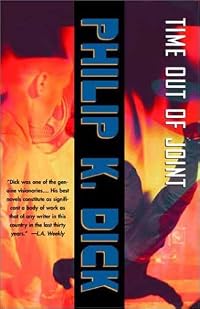
Time Out of Joint
by Philip K. Dick
On This Page
Description
From the Hugo Award-winning author of The Man in the High Castle, Philip K. Dick's twisty and paranoid Time Out of Joint is "marvelous, terrifying fun, especially if you've ever suspected that the world is an unreal construct built solely to keep you from knowing who you really are. Which it is, of course" (Rolling Stone). "The time is out of joint, O curs'd spite, That ever I was born to set it right!" (William Shakespeare's Hamlet, Act I, Scene V) Ragle Gumm has a unique job: every day he show more wins a newspaper contest. And when he isn't consulting his charts and tables, he enjoys his life in a small town in 1959. At least, that's what he thinks. But then strange things start happening. He finds a phone book where all the numbers have been disconnected, and a magazine article about a famous starlet he's never heard of named Marilyn Monroe. Plus, everyday objects are beginning to disappear and are replaced by strips of paper with words written on them like "bowl of flowers" and "soft drink stand." When Ragle skips town to try to find the cause of these bizarre occurrences, his discovery could make him question everything he has ever known. show lessTags
Recommendations











Member Reviews
It is always fascinating to see how a writer from the 1950's imagines the future, and it's weird to read such a story from the perspective of 2016. There is a beautiful portrait of the carefree suburban '50s USA. (the place the conservatives always want to take us back to). But hovering over this utopia is a sense of unease and disquiet which is masterfully drawn out by the writer. The story, about a world that is not what it seems, is a favourite theme of PK Dick, and it has inspired many similar films and books since. This one is the original, and it's a true classic.
I loved it. Between this and Eye in the Sky, wow, you can see why PKD made such a name for himself in his early career. This book has both a great overarching mystery and some highly imaginative individual scenes I'll never forget.
The theme here, almost four decades before The Truman Show, was already becoming an obsession for Philip K Dick: that the ordinary world is not what it seems; and that behind it, or beneath it, beyond it in some way, is the real thing.
It’s the late 1950s and in a small unnamed town the middle-aged Ragle Gumm lives with his sister and her husband. Although he doesn’t go out to work, he does have one talent: solving a daily puzzle run by the Gazette newspaper. He’s been its champion for two-and-a-half years now, makes a modest but steady income and has become a celebrity as a result; but it’s harder work even than a regular job and the strain is beginning to show.
The town itself seems ordinary enough, except for show more occasional jarring details: like absentmindedly reaching for a light-cord in a dark bathroom…to find it isn’t there, to find it was never there in fact and that what is there is a wall-switch. Or finding a magazine containing an article about a world-famous film star…who no one has heard of. “We can put everything we know together, he realized, but it doesn’t tell us anything, except that something is wrong. And we knew that to start with. The clues we are getting don’t give us a solution; they only show us how far-reaching the wrongness is.” It’s the classic dilemma: is your “world” really a sham of some kind, or is this you in the early stages of a breakdown? How can you possibly tell, from the inside so to speak? If it is all a sham, who is behind it and why? And above all, what happens if you put that “world” to the test and try breaking out, try leaving?
This is one of Dick’s early novels and the writing is comparatively unhurried—he takes his own good time unravelling Ragle’s world. And while perhaps not as meticulously thought through as Truman would be forty years later, even this early in his career the main obsessions are already there: the nature of reality, conspiracies and paranoia, madness or the fear of madness—and escape. show less
It’s the late 1950s and in a small unnamed town the middle-aged Ragle Gumm lives with his sister and her husband. Although he doesn’t go out to work, he does have one talent: solving a daily puzzle run by the Gazette newspaper. He’s been its champion for two-and-a-half years now, makes a modest but steady income and has become a celebrity as a result; but it’s harder work even than a regular job and the strain is beginning to show.
The town itself seems ordinary enough, except for show more occasional jarring details: like absentmindedly reaching for a light-cord in a dark bathroom…to find it isn’t there, to find it was never there in fact and that what is there is a wall-switch. Or finding a magazine containing an article about a world-famous film star…who no one has heard of. “We can put everything we know together, he realized, but it doesn’t tell us anything, except that something is wrong. And we knew that to start with. The clues we are getting don’t give us a solution; they only show us how far-reaching the wrongness is.” It’s the classic dilemma: is your “world” really a sham of some kind, or is this you in the early stages of a breakdown? How can you possibly tell, from the inside so to speak? If it is all a sham, who is behind it and why? And above all, what happens if you put that “world” to the test and try breaking out, try leaving?
This is one of Dick’s early novels and the writing is comparatively unhurried—he takes his own good time unravelling Ragle’s world. And while perhaps not as meticulously thought through as Truman would be forty years later, even this early in his career the main obsessions are already there: the nature of reality, conspiracies and paranoia, madness or the fear of madness—and escape. show less
No puedo empezar sin hacer mención a la criminal sinopsis de la contraportada de esta novela, que creo que ha seguido sucediendo incluso en ediciones de otras editoriales (véase Minotauro). Yo cometí el error de leerla y me fastidió toda la lectura, porque no hacía otra cosa que esperar, porque ya sabía que tenía que suceder, lo destripado en dicha sinopsis. Una cosa es picar la curiosidad del lector contando algo que suceda en los primeros capítulos, porque algo hay que contar, eso es indiscutible. Pero que desvelen hechos que tienen lugar en el último cuarto de novela, eso es imperdonable, un crimen. Y el hecho es más grave si cabe cuando estamos hablando del germen de la novela, del motor principal que la mueve. Ya he show more dejado la costumbre de leer sinopsis, prólogos y según qué reseñas antes de empezar una novela, pero aun así sigo cayendo de vez en cuando.
‘Tiempo desarticulado’ (Time Out of Joint, 1959), del norteamericano Philip K. Dick, tiene como protagonista a Ragle Gumm, que lleva una idílica vida junto a la familia de su hermana. Su principal actividad consiste en participar en el concurso del periódico, que siempre gana. Paulatinamente, vamos asistiendo a inquietantes revelaciones que nos harán dudar de la realidad de los personajes. Y ya está, no se puede contar nada más sin entrar en el consabido spoiler. La novela transcurre sin prisas, pausadamente, pero engancha desde el primer momento.
Tras finalizar la lectura de ‘Tiempo desarticulado’, queda patente la influencia posterior que tuvo en diferentes productos de ocio, ya sean libros, películas o series de televisión. No cabe duda de que Dick fue todo un visionario. show less
‘Tiempo desarticulado’ (Time Out of Joint, 1959), del norteamericano Philip K. Dick, tiene como protagonista a Ragle Gumm, que lleva una idílica vida junto a la familia de su hermana. Su principal actividad consiste en participar en el concurso del periódico, que siempre gana. Paulatinamente, vamos asistiendo a inquietantes revelaciones que nos harán dudar de la realidad de los personajes. Y ya está, no se puede contar nada más sin entrar en el consabido spoiler. La novela transcurre sin prisas, pausadamente, pero engancha desde el primer momento.
Tras finalizar la lectura de ‘Tiempo desarticulado’, queda patente la influencia posterior que tuvo en diferentes productos de ocio, ya sean libros, películas o series de televisión. No cabe duda de que Dick fue todo un visionario. show less
I’ve never really understood why Dick’s novels are held in such high regard. He appears multiple times in the SF Masterworks series, more so than any other author. To me, his novels seem slapdash, written at speed and with very little idea of what they were supposed to be about. Some of his short fiction is excellent: ‘A Little Something for Us Tempunauts’ has been a favourite sf story for many years. But his novels – well, the only reason I’m reading them is because they’re in the SF Masterworks series, and once I’ve read those I’ll likely never go near a novel by him again.
Time Out of Joint is a Wizard of Oz story, specifically the bit where Dorothy pulls away the curtain and reveals the truth about the Wizard. And, show more as in that situation, the truth behind the story of Time Out of Joint proves disappointing. Ragle Gumm is a WWII veteran in a small midwest town in the 1950s. Each day, he submits an answer to a newspaper competition, Where Will the Green Man Land Next. He spends the day researching, then fills in his answer on a map grid, and submits it by post. He always wins. He’s become something of a celebrity because of his winning streak.
But something weird is going on in the town. Gumm’s brother-in-law (he lives with his sister, her husband and their son) has a vivid memory of entering the bathroom and pulling a light-cord – but their bathroom has no light-cord. Gumm himself has memories of things that never happened. The son builds a crystal radio set, and they pick up weird conversations. In the Ruins, a derelict section of town, Gumm finds some magazines which feature celebrities such as Marilyn Monroe – they know she’s a film star, but on the other hand they’ve never heard of her.
Gumm’s world is beginning to unravel – a common Dickian trope. He plots an escape, but is brought back with his memory of his escape erased. So he tries a second time, this time with the help of his brother-in-law. They steal one of the trucks that delivers produce to the brother-in-law’s supermarket. And they make it out into the wider world…
It’s not the 1950s, it’s the 1990s. And Earth is at war with a small colony on the Moon. Gumm has a talent for predicting the targets of the nuclear missiles from the Moon. But he had a breakdown, so they created an artificial 1950s town, erased his memory, and use the competition as a cover for his predictions.
And, er, that’s it.
Gumm’s breakdown was triggered by a defection to the Moon’s side and a desire to emigrate. Once he uncovers the truth about himself and the competition, he contacts the “lunatics” in order to join them.
The first half of the book is the sort of stuff Dick does really well. All is not as it seems, but is it the protagonist or the world that is wrong? Dick keeps the details light, and focuses on a handful of characters and locales – which makes you wonder what’s happening in the rest of the town. His 1998 is less convincing. There is a world state called One Happy World, and people talk a particularly tin-eared creole. Time Out of Joint then jumps straight into exposition, and ends on a hopeful note.
Time Out of Joint was No 55 in the original SF Masterworks series, the tenth book of fourteen by Dick in the 73 books of the series. No other author appears as often. Personally, I’d keep No 20 A Scanner Darkly and No 73 The Man in the High Castle, but ditch the rest.
But then there are plenty of other books in the original SF Masterworks series I don’t think belong in it. show less
Time Out of Joint is a Wizard of Oz story, specifically the bit where Dorothy pulls away the curtain and reveals the truth about the Wizard. And, show more as in that situation, the truth behind the story of Time Out of Joint proves disappointing. Ragle Gumm is a WWII veteran in a small midwest town in the 1950s. Each day, he submits an answer to a newspaper competition, Where Will the Green Man Land Next. He spends the day researching, then fills in his answer on a map grid, and submits it by post. He always wins. He’s become something of a celebrity because of his winning streak.
But something weird is going on in the town. Gumm’s brother-in-law (he lives with his sister, her husband and their son) has a vivid memory of entering the bathroom and pulling a light-cord – but their bathroom has no light-cord. Gumm himself has memories of things that never happened. The son builds a crystal radio set, and they pick up weird conversations. In the Ruins, a derelict section of town, Gumm finds some magazines which feature celebrities such as Marilyn Monroe – they know she’s a film star, but on the other hand they’ve never heard of her.
Gumm’s world is beginning to unravel – a common Dickian trope. He plots an escape, but is brought back with his memory of his escape erased. So he tries a second time, this time with the help of his brother-in-law. They steal one of the trucks that delivers produce to the brother-in-law’s supermarket. And they make it out into the wider world…
It’s not the 1950s, it’s the 1990s. And Earth is at war with a small colony on the Moon. Gumm has a talent for predicting the targets of the nuclear missiles from the Moon. But he had a breakdown, so they created an artificial 1950s town, erased his memory, and use the competition as a cover for his predictions.
And, er, that’s it.
Gumm’s breakdown was triggered by a defection to the Moon’s side and a desire to emigrate. Once he uncovers the truth about himself and the competition, he contacts the “lunatics” in order to join them.
The first half of the book is the sort of stuff Dick does really well. All is not as it seems, but is it the protagonist or the world that is wrong? Dick keeps the details light, and focuses on a handful of characters and locales – which makes you wonder what’s happening in the rest of the town. His 1998 is less convincing. There is a world state called One Happy World, and people talk a particularly tin-eared creole. Time Out of Joint then jumps straight into exposition, and ends on a hopeful note.
Time Out of Joint was No 55 in the original SF Masterworks series, the tenth book of fourteen by Dick in the 73 books of the series. No other author appears as often. Personally, I’d keep No 20 A Scanner Darkly and No 73 The Man in the High Castle, but ditch the rest.
But then there are plenty of other books in the original SF Masterworks series I don’t think belong in it. show less
I don’t think the heart of the book is the four levels of reality, as in the long analysis of Yves Potin. Time Out of Joint is about today, through the lens of the schizoid weirdness of that what was the 1950s.
In a way, the 1950s might be the ultimate metaphor for the promise, and the shock, of the new. It might be the very first decade in which modernity had truly arrived, on the rubble and the corpses of World War 2. The fifties are filled to the brim with new consumo-techno-stuff, birthing free time, and birthing mass media, coupled with a fixation on sex via Freud and the Kinsey reports and Marylin Monroe, and death via the threat of the H-bomb. As such, Time Out of Joint is not unlike the Louis Paul Boon novel I recently show more reviewed: a book about a delusional culture that keeps entertainment flowing, while nuclear weapons are being tested on Bikini. Plastic America has become a template for the world.
A lot has changed, and not really. People are still trapped in suburbia, more so, as inequality has grown and the American Dream is dead. Making sense of reality has become a full-time job. New stuff keeps on being spawned, new mass media too, there is more free porn than ever, and the number and severity of threats might have never been higher: geopolitics is unstable, and ecological and thus societal collapse looms large. And still lots of people put their faith in technology to fix all that, one day, soon – even if that technology still scares us: AI is an ominous, blinking red eye.
(...)
Full review on Weighing A Pig show less
In a way, the 1950s might be the ultimate metaphor for the promise, and the shock, of the new. It might be the very first decade in which modernity had truly arrived, on the rubble and the corpses of World War 2. The fifties are filled to the brim with new consumo-techno-stuff, birthing free time, and birthing mass media, coupled with a fixation on sex via Freud and the Kinsey reports and Marylin Monroe, and death via the threat of the H-bomb. As such, Time Out of Joint is not unlike the Louis Paul Boon novel I recently show more reviewed: a book about a delusional culture that keeps entertainment flowing, while nuclear weapons are being tested on Bikini. Plastic America has become a template for the world.
A lot has changed, and not really. People are still trapped in suburbia, more so, as inequality has grown and the American Dream is dead. Making sense of reality has become a full-time job. New stuff keeps on being spawned, new mass media too, there is more free porn than ever, and the number and severity of threats might have never been higher: geopolitics is unstable, and ecological and thus societal collapse looms large. And still lots of people put their faith in technology to fix all that, one day, soon – even if that technology still scares us: AI is an ominous, blinking red eye.
(...)
Full review on Weighing A Pig show less
Libro più da 5 stelle che da 4. Un quattro virgola sette, direi. Ma le cinque stelle si dovrebbero assegnare solo ai capolavori...
I temi qui sono la paranoia, la pazzia (o la presunzione di essa), la dualità dell'apparenza della realtà e via così. Tutti temi molto cari all'autore, mancano invece i riferimenti ad androidi e droghe che spesso troviamo all'interno dei romanzi di P.K. Dick.
La storia è piuttosto semplice ma molto curiosa: cosa succederebbe se un uomo comune, ma con caratteristiche speciali, si convincesse che il mondo ruota intorno a lui ?
Anni dopo da questa idea è nato il Truman Show, ma vi dico già, per non farvi arrabbiare pensando ad uno spoiler, che questo libro e il film differiscono parecchio, quasi show more totalmente. L'idea però è similare. Cosa è reale ? E se fosse tutto finto ? E se io fossi il protagonista del mondo intorno a me ?
Per i primi 2/3 della storia il mistero e l'azione sono coinvolgenti al massimo, nell'ultimo terzo, quando finalmente viene spiegata la verità si è sommersi da tantissime rivelazioni contemporaneamente. Alcune di esse sono un po' raffazzonate, diciamoci la verità. Non si incastra tutto alla perfezione, perché viene gettata troppa carne al fuoco. D'altro canto questo evita anche un finale banale.
Quasi perfetto, scritto benissimo, come c'è da aspettarsi da Dick. Molto filosofico pure (infatti i riferimenti alla filosofia, da parte del protagonista in un ottica quasi metanarrativa, sono parecchi). Vien quasi voglia di rileggerlo da capo dopo averlo finito. show less
I temi qui sono la paranoia, la pazzia (o la presunzione di essa), la dualità dell'apparenza della realtà e via così. Tutti temi molto cari all'autore, mancano invece i riferimenti ad androidi e droghe che spesso troviamo all'interno dei romanzi di P.K. Dick.
La storia è piuttosto semplice ma molto curiosa: cosa succederebbe se un uomo comune, ma con caratteristiche speciali, si convincesse che il mondo ruota intorno a lui ?
Anni dopo da questa idea è nato il Truman Show, ma vi dico già, per non farvi arrabbiare pensando ad uno spoiler, che questo libro e il film differiscono parecchio, quasi show more totalmente. L'idea però è similare. Cosa è reale ? E se fosse tutto finto ? E se io fossi il protagonista del mondo intorno a me ?
Per i primi 2/3 della storia il mistero e l'azione sono coinvolgenti al massimo, nell'ultimo terzo, quando finalmente viene spiegata la verità si è sommersi da tantissime rivelazioni contemporaneamente. Alcune di esse sono un po' raffazzonate, diciamoci la verità. Non si incastra tutto alla perfezione, perché viene gettata troppa carne al fuoco. D'altro canto questo evita anche un finale banale.
Quasi perfetto, scritto benissimo, come c'è da aspettarsi da Dick. Molto filosofico pure (infatti i riferimenti alla filosofia, da parte del protagonista in un ottica quasi metanarrativa, sono parecchi). Vien quasi voglia di rileggerlo da capo dopo averlo finito. show less
Members
- Recently Added By
Lists

Survey of Classic Science Fiction
171 works; 48 members

S.F. Masterworks (Complete)
229 works; 15 members

David Pringle's Science Fiction: The 100 Best Novels
101 works; 9 members

SF Masterworks
193 works; 8 members

Shakespeare Quote Titles
112 works; 10 members
Unshelved Book Clubs
579 works; 5 members

Read
293 works; 4 members

Simulated Reality in Fiction
124 works; 7 members

Forced Exposure
83 works; 1 member
1950s
340 works; 22 members

Books Read in 2023
5,547 works; 145 members

Books Read in 2024
4,623 works; 126 members
Talk Discussions
Past Discussions
SciFi novella - Detecting Alien Attack Patterns in Name that Book (August 2019)
Author Information

668+ Works 146,457 Members
Phillip Kindred Dick was an American science fiction writer best known for his psychological portrayals of characters trapped in illusory environments. Born in Chicago, Illinois, on December 16, 1928, Dick worked in radio and studied briefly at the University of California at Berkeley before embarking on his writing career. His first novel, Solar show more Lottery, was published in 1955. In 1963, Dick won the Hugo Award for his novel, The Man in the High Castle. He also wrote a series of futuristic tales about artificial creatures on the loose; notable of these was Do Androids Dream of Electric Sheep?, which was later adapted into film as Blade Runner. Dick also published several collections of short stories. He died of a stroke in Santa Ana, California, in 1982. (Bowker Author Biography) show less
Some Editions
Awards and Honors
Notable Lists
Series
Belongs to Publisher Series
Work Relationships
Is contained in
Common Knowledge
- Canonical title*
- Tempo fuori luogo
- Original title
- Time Out of Joint
- Alternate titles*
- L'uomo dei giochi a premio
- Original publication date
- 1959
- People/Characters
- Ragle Gumm; Victor Nielson; Margo Nielson; Liz; Jack Barnes; Sammy Nielson (show all 13); Junie Black; Bill Black; Stuart Lowery; Kay Keitelbein; Wade Schulmann; Philip Burns; Garrett Kesselman
- Important places
- USA
- First words
- From the cold-storage locker at the rear of the store, Victor Nielson wheeled the cart of winter potatoes to the vegetable section of the produce department.
- Last words
- (Click to show. Warning: May contain spoilers.)As a matter of fact, he was Walter Keitelbein.
(Click to show. Warning: May contain spoilers.)O homem com a luz colorida parecia-se com Walter Keitebein. Na verdade era Walter Keitebein. - Original language
- English
*Some information comes from Common Knowledge in other languages. Click "Edit" for more information.
Classifications
Statistics
- Members
- 2,625
- Popularity
- 7,129
- Reviews
- 38
- Rating
- (3.76)
- Languages
- 15 — Czech, English, Finnish, French, German, Greek, Hungarian, Italian, Japanese, Polish, Portuguese, Romanian, Spanish, Swedish, Turkish
- Media
- Paper, Audiobook, Ebook
- ISBNs
- 68
- ASINs
- 26