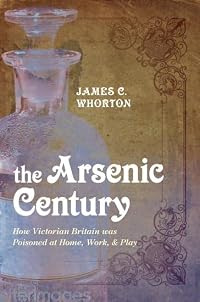
The Arsenic Century: How Victorian Britain was Poisoned at Home, Work, and Play
by James C. Whorton
On This Page
Description
Arsenic is rightly infamous as the poison of choice for Victorian murderers. Yet the great majority of fatalities from arsenic in the nineteenth century came not from intentional poisoning, but from accident. Kept in many homes for the purpose of poisoning rats, the white powder was easily mistaken for sugar or flour and often incorporated into the family dinner. It was also widely present in green dyes, used to tint everything from candles and candies to curtains, wallpaper, and clothing show more (it was arsenic in old lace that was the danger). Whether at home amidst arsenical curtains and wallpapers show lessTags
Recommendations




















Member Recommendations
Member Reviews
An extremely fascinating look at the Victorian period from the perspective of everyone's favourite poison -- arsenic, the murderer's friend, "inheritance powder", odourless and tasteless and therefore very easily mistaken ("mistaken"?) for baking powder or sugar. Whorton takes us through every aspect of life that was touched by arsenic, starting of course with its use for homicidal purposes, before wending his way through food and drink, occupational exposure, everyday household objects, clothing and medications, before ending with a look at arsenic-contaminated beer. (Oh the horror!)
Whorton writes extremely well, with clear logical connections that steer the reader along. The work is sprinkled with judiciously chosen quotes (the show more chapter titles in particular are excellent: "Death that Lies Wait in the Pint-Pot", "A Very Wholesome Poison") and the details are excellent. For example, apparently the mucous membranes in the stomach retain arsenic, so even if an unfortunate victim is vomiting incessantly, the poison is still embedded in their system. The description of an arsenic victim's stomach as "glittering with diamond-like arsenic crystals" is spooky but also kind of cool if you have a taste for the macabre.
Now this book is a really interesting read on its own, but I was also impressed by Whorton's ability to tie arsenic scares and contaminations to modern-day issues, such as the past decade's drive to eliminate trans fats from food, and the ongoing difficulty of getting politicians to apply regulation to force manufacturers to do the right thing and eliminate hazardous materials from their products. He also closes with a comment about all of the new chemical products we bring into our homes every day, some of which have never existed before and whose long-term effects on health are as yet unknown.
The book also includes some illustrations, not too many but again very judiciously chosen (although to be honest I could have done without the picture on page 298). The text tends to speak for itself for the most part.
To sum up, this is highly recommended for anyone interested in the Victorian period, murder mysteries (especially those of the Golden Age), environmental issues or chemistry. show less
Whorton writes extremely well, with clear logical connections that steer the reader along. The work is sprinkled with judiciously chosen quotes (the show more chapter titles in particular are excellent: "Death that Lies Wait in the Pint-Pot", "A Very Wholesome Poison") and the details are excellent. For example, apparently the mucous membranes in the stomach retain arsenic, so even if an unfortunate victim is vomiting incessantly, the poison is still embedded in their system. The description of an arsenic victim's stomach as "glittering with diamond-like arsenic crystals" is spooky but also kind of cool if you have a taste for the macabre.
Now this book is a really interesting read on its own, but I was also impressed by Whorton's ability to tie arsenic scares and contaminations to modern-day issues, such as the past decade's drive to eliminate trans fats from food, and the ongoing difficulty of getting politicians to apply regulation to force manufacturers to do the right thing and eliminate hazardous materials from their products. He also closes with a comment about all of the new chemical products we bring into our homes every day, some of which have never existed before and whose long-term effects on health are as yet unknown.
The book also includes some illustrations, not too many but again very judiciously chosen (although to be honest I could have done without the picture on page 298). The text tends to speak for itself for the most part.
To sum up, this is highly recommended for anyone interested in the Victorian period, murder mysteries (especially those of the Golden Age), environmental issues or chemistry. show less
This book is a morbid but well-researched exploration of the many types of death and injury caused by arsenic poisoning in Victorian Britain. Whorton provides a thorough overview of cases from throughout the era to illustrate the harms of arsenic, which range from intentional murders to accidentical mix ups (such as the candymaker who added arsenic to his candy cut the costs on sugar thinking it was only plaster of Paris), to unknowing contamination (beware the colour green!).
What makes this book truly chilling is that instead of just allowing us to laugh at the folly of the Victorians from a place of smug, modern superiority, Whorton reminds us that today we are tampering with even more unregulated chemicals. At least people sort of show more knew what arsenic was! Who the heck even knows what is going on in our own food, clothing, and furniture. So even though this book is hyper arsenic-specific, I appreciated how the author widens the scope by warning us of the dangers of an unregulated capitalist market where profit is priority. show less
What makes this book truly chilling is that instead of just allowing us to laugh at the folly of the Victorians from a place of smug, modern superiority, Whorton reminds us that today we are tampering with even more unregulated chemicals. At least people sort of show more knew what arsenic was! Who the heck even knows what is going on in our own food, clothing, and furniture. So even though this book is hyper arsenic-specific, I appreciated how the author widens the scope by warning us of the dangers of an unregulated capitalist market where profit is priority. show less
Arsenic was a sensation in Victorian times. Cheap, widely available, and the source of much shock and horror at the terrible things people got up to with it, it prompted scientific breakthrough, took advantage of a nascent insurance industry, and inspired wild fictional flights of fancy. Whether it was women getting rid of consecutive husbands, heirs getting rid of aging parents, or the terrible accidents that happen when a deadly poison looks close enough to sugar to be added to sweets, arsenic caused an uproar, and helped to prompt some of the first regulations on ingredients, poisons, and foodstuffs.
Read the rest on BookGeeks:
http://www.bookgeeks.co.uk/2010/12/11/the-arsenic-century-by-james-c-whorton/
Read the rest on BookGeeks:
http://www.bookgeeks.co.uk/2010/12/11/the-arsenic-century-by-james-c-whorton/
Ratings
Members
- Recently Added By
Author Information

7 Works 206 Members
James C. Whorton is Professor of the History of Medicine in the University of Washington School of Medicine, Seattle, Washington.
Common Knowledge
- Original publication date
- 2010
Classifications
Statistics
- Members
- 118
- Popularity
- 274,771
- Reviews
- 4
- Rating
- (4.18)
- Languages
- English
- Media
- Paper, Ebook
- ISBNs
- 4
- ASINs
- 1