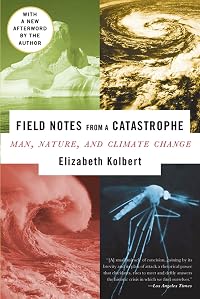
Field Notes from a Catastrophe: Man, Nature, and Climate Change
by Elizabeth Kolbert
On This Page
Description
New Yorker writer Kolbert tackles the controversial subject of global warming. Americans have been warned since the late 1970s that the buildup of carbon dioxide in our atmosphere threatens to melt the polar ice sheets and irreversibly change our climate. With little done since then to alter this dangerous course, now is the moment to salvage our future. By the end of the century, the world will likely be hotter than it's been in the last two million years, and the sweeping consequences of show more this change will determine the future of life on earth for generations to come. Kolbert approaches this monumental problem from every angle. She travels to the Arctic, interviews researchers and environmentalists, explains the science and the studies, draws frightening parallels to lost ancient civilizations, unpacks the politics, and presents the personal tales of those who are being affected most--the people who make their homes near the poles and are watching their worlds disappear.--From publisher description. show lessTags
Recommendations




















Member Reviews
Don't know if I have 2 of these or just entered it twice On the burgeoning shelf of cautionary but occasionally alarmist books warning about the consequences of dramatic climate change, Kolbert's calmly persuasive reporting stands out for its sobering clarity. Expanding on a three-part series for the New Yorker, Kolbert (The Prophet of Love) lets facts rather than polemics tell the story: in essence, it's that Earth is now nearly as warm as it has been at any time in the last 420,000 years and is on the precipice of an unprecedented "climate regime, one with which modern humans have had no prior experience." An inexorable increase in the world's average temperature means that butterflies, which typically restrict themselves to show more well-defined climate zones, are now flitting where they've never been found before; that nearly every major glacier in the world is melting rapidly; and that the prescient Dutch are already preparing to let rising oceans reclaim some of their land. In her most pointed chapter, Kolbert chides the U.S. for refusing to sign on to the Kyoto Accord. In her most upbeat chapter, Kolbert singles out Burlington, Vt., for its impressive energy-saving campaign, which ought to be a model for the rest of the nation ? just as this unbiased overview is a model for writing about an urgent environmental crisis show less
`Field Notes From a Catastrophe' is Elizabeth Kolbert's masterpiece of conciseness and clarity explaining current climate change science and the political obstacles (read the US, Republicans, and Bush Administration in ascending order) to getting serious about attacking the problem. Originally published in 2005, the paperback version has an afterword written in 2006.
Kolbert takes a journalist's approach to explaining the climate change phenomenon (the book began as a series in the New Yorker). She takes the reader to Shishmaref, Alaska an island village rapidly becoming an untenable place to live due to climate-induced sea ice changes, to the North Slope, to the great Greenland ice shield and she brings the story down to a human scale. show more
Kolbert also leads the reader through the science of global warming making understandable seemingly arcane topics like "dangerous anthropogenic interference" (DAI), which is basically the point where something truly major goes haywire. Kolbert brings the joy of learning to the reader, until one ponders the potential consequences of what she lays out for us. Perhaps most disturbing is the evidence she marshals that the climate has already changed. For example, the climate has warmed sufficiently to allow numerous butterfly species to migrate to new previously too cold locations and to cause the extinction of certain frog species.
Scientists do not, of course, understand everything about climate change (indeed, it is in the very nature of science that an endpoint of total knowledge is never achieved). Those political and economic forces (primarily in the United States) that benefit from the status quo latch on to the uncertainties to create doubt among the public and forestall action. Her interviews with Bush administration officials strike an odd note - they stonewall with robotic incantations. While Europe and most of industrialized world has acted, the US has dithered, delayed, and denied.
Kolbert explains why scientists conclude that it is virtually certain that under the current `business as usual' approach, greenhouse gas concentrations will reach a level that causes massive coastal flooding, large scale extinctions, and crop failures leading to starvation (DAI). These outcomes will not be evenly distributed and are likely to fall heaviest on the poorest countries. Scientists do not, however, know what level of greenhouse gas concentration will cause these impacts. The Bush administration uses that uncertainty as a reason to do essentially nothing and Congress too has failed to force any action.
Kolbert's book inspires the reader to search out even more current information (NOAA's Arctic Change web site is one good source). And the news is alarming. This stuff is not just a tree hugger's paranoid delusion: global heating is happening, it is happening now, and it is getting worse faster than anticipated.
Kolbert's book is a work of journalism (and given the rapidly changing reality, journalism is probably the best source of information) that informs on both the science and the politics of climate change without stridently hectoring the reader. Kolbert presents the facts. The reader would have to be a dim bulb indeed not to get the picture.
Absolutely the very highest recommendation. Kolbert's Field Notes From a Catastrophe deserves more than 5 stars show less
Kolbert takes a journalist's approach to explaining the climate change phenomenon (the book began as a series in the New Yorker). She takes the reader to Shishmaref, Alaska an island village rapidly becoming an untenable place to live due to climate-induced sea ice changes, to the North Slope, to the great Greenland ice shield and she brings the story down to a human scale. show more
Kolbert also leads the reader through the science of global warming making understandable seemingly arcane topics like "dangerous anthropogenic interference" (DAI), which is basically the point where something truly major goes haywire. Kolbert brings the joy of learning to the reader, until one ponders the potential consequences of what she lays out for us. Perhaps most disturbing is the evidence she marshals that the climate has already changed. For example, the climate has warmed sufficiently to allow numerous butterfly species to migrate to new previously too cold locations and to cause the extinction of certain frog species.
Scientists do not, of course, understand everything about climate change (indeed, it is in the very nature of science that an endpoint of total knowledge is never achieved). Those political and economic forces (primarily in the United States) that benefit from the status quo latch on to the uncertainties to create doubt among the public and forestall action. Her interviews with Bush administration officials strike an odd note - they stonewall with robotic incantations. While Europe and most of industrialized world has acted, the US has dithered, delayed, and denied.
Kolbert explains why scientists conclude that it is virtually certain that under the current `business as usual' approach, greenhouse gas concentrations will reach a level that causes massive coastal flooding, large scale extinctions, and crop failures leading to starvation (DAI). These outcomes will not be evenly distributed and are likely to fall heaviest on the poorest countries. Scientists do not, however, know what level of greenhouse gas concentration will cause these impacts. The Bush administration uses that uncertainty as a reason to do essentially nothing and Congress too has failed to force any action.
Kolbert's book inspires the reader to search out even more current information (NOAA's Arctic Change web site is one good source). And the news is alarming. This stuff is not just a tree hugger's paranoid delusion: global heating is happening, it is happening now, and it is getting worse faster than anticipated.
Kolbert's book is a work of journalism (and given the rapidly changing reality, journalism is probably the best source of information) that informs on both the science and the politics of climate change without stridently hectoring the reader. Kolbert presents the facts. The reader would have to be a dim bulb indeed not to get the picture.
Absolutely the very highest recommendation. Kolbert's Field Notes From a Catastrophe deserves more than 5 stars show less
Recent (March 2006) addition to the literature addressed to the mythical educated layman on the issue of anthrogenic climate change.
Better than most, a bit more science, much more personal interest (partly i think because the author is female and partly because it began as a series in the NYT). It was an enjoyable and informative read, the best was the relationship of the science to several personal encounters with people, the chapter on Swiss camp. Makes the case for DAI (dangerous anthrogenic interference) kind of slowly, increased in not upsetting people so that they cease reading, interested in making the case scientifically and well structured. Is perhaps better than most in the genre, certainly i'd have no problems recommending show more it.
Chapter 3, Under the Glacier is both the most interesting and the best written chapter. Her personality and observational abilities both make this an excellent place to start reading and a good introduction to the book. If you are looking for a nice read on the topic of global climate change, this is a suitable and interesting book. show less
Better than most, a bit more science, much more personal interest (partly i think because the author is female and partly because it began as a series in the NYT). It was an enjoyable and informative read, the best was the relationship of the science to several personal encounters with people, the chapter on Swiss camp. Makes the case for DAI (dangerous anthrogenic interference) kind of slowly, increased in not upsetting people so that they cease reading, interested in making the case scientifically and well structured. Is perhaps better than most in the genre, certainly i'd have no problems recommending show more it.
Chapter 3, Under the Glacier is both the most interesting and the best written chapter. Her personality and observational abilities both make this an excellent place to start reading and a good introduction to the book. If you are looking for a nice read on the topic of global climate change, this is a suitable and interesting book. show less
Well, what I got from this book was that we're pretty much screwed.
However this is less depressing than you might expect since I just read [book:The World Without Us] and it seems like even if we don't survive at least the rest of the world will, and it'll probably evolve some interesting new species, which would be cool.
Also, this book was a more entertaining read than I thought it might be, because apparently climate scientists are FUN GUYS. Perhaps they feel liberated, knowing that it's pretty much the end of the world as we know it.
However this is less depressing than you might expect since I just read [book:The World Without Us] and it seems like even if we don't survive at least the rest of the world will, and it'll probably evolve some interesting new species, which would be cool.
Also, this book was a more entertaining read than I thought it might be, because apparently climate scientists are FUN GUYS. Perhaps they feel liberated, knowing that it's pretty much the end of the world as we know it.
Published in '06, Kolbert's Field Notes is more valid now than ever. With a president in office that is ignorant of the change's of the Earth due to man's hand, we learn, from real science, the price we are paying for the choices we have made. But there is a positive. There isn't a way we can undo what we have done, but Field Notes offers ways to cut down our emissions. As is said for most things, little changes go a long way.
Field Notes from a Catastrophe is the literary equivalent of taking a photo of a power plant on a snowless winter's day to enhance the heated air rising from the cooling stacks to exaggerate "global warming." Kolbert is a journalist and relies on the emotional aspects of changes in our world to promote her belief. The only thing seemingly out of place in the book, besides the Rolling Stone magazine-style one or two sentence description of her interviewee's physical appearances, is the fossil fuel she consumed to research the stories covered in this book. From trucks, to snowmobiles, to flying, she travels the world and unapologetically writes about cruising the landscape with her hosts.
I still don't fully understand her inclusion of show more the demise of Mesopotamian civilization of Akkadians. They suffered loss of fertile and arable land via droughts, heat and sandstorms over the course of a century. Yet, if we are hurtling towards the same fate through coal burning, gas guzzling and tree falling, what did the Akkadians do to suffer the same downfall?
My copy has been marked with margin comments on nearly every page. One thing that became apparent was an occasional quick toss of a bone to "global warming deniers" and acknowledgement of arguments, possibly to suggest plausibility as being evenhanded, but she just as swiftly follows-up with a caveat by order of a counter-argument. This book was not science based, it was written to persuade those who are concerned but maybe not "on the bandwagon" yet. From a sorrowful Native Alaskan and sinking homes in thawing permafrost, to horrified Scandinavian children subjected to public service announcements threatening doom in a deluge of flood water, to awe of Dr. James Hansen and his computer models which take a month of processing to predict the end of the world, Elizabeth Kolbert pleads a case more and more people are believing less and less in. show less
I still don't fully understand her inclusion of show more the demise of Mesopotamian civilization of Akkadians. They suffered loss of fertile and arable land via droughts, heat and sandstorms over the course of a century. Yet, if we are hurtling towards the same fate through coal burning, gas guzzling and tree falling, what did the Akkadians do to suffer the same downfall?
My copy has been marked with margin comments on nearly every page. One thing that became apparent was an occasional quick toss of a bone to "global warming deniers" and acknowledgement of arguments, possibly to suggest plausibility as being evenhanded, but she just as swiftly follows-up with a caveat by order of a counter-argument. This book was not science based, it was written to persuade those who are concerned but maybe not "on the bandwagon" yet. From a sorrowful Native Alaskan and sinking homes in thawing permafrost, to horrified Scandinavian children subjected to public service announcements threatening doom in a deluge of flood water, to awe of Dr. James Hansen and his computer models which take a month of processing to predict the end of the world, Elizabeth Kolbert pleads a case more and more people are believing less and less in. show less
Fun and interesting book to read. The book is divided in different chapters talking about completely different aspects about climate change from her own experiences at the pole to how capitalists are blocking every action towards solving it. It's not a book were you will learn the hardcore facts about climate change but one that shows you a few aspects in a very readable way. Not a book for someone who wants to learn his/her first facts about climate change but a very "fun" book for people who's lives are being dominated by such subjects.
Members
- Recently Added By
Lists

Climate Change
87 works; 7 members

Recommended Books about Climate Change
30 works; 2 members
Author Information

19+ Works 7,164 Members
Elizabeth Kolbert is a staff writer for The New Yorker. Her series on global warming, The Climate of Man, won the American Association for the Advancement of Science's magazine writing award and a National Academies communications award. She is a two-time National Magazine Award winner. She has written several books including Catastrophe: Man, show more Nature, and Climate Change and The Sixth Extinction: An Unnatural History, which won the 2015 Pulitzer Prize for Nonfiction. (Bowker Author Biography) show less
Some Editions
Awards and Honors
Distinctions
Series
Belongs to Publisher Series
Work Relationships
Common Knowledge
- Original publication date
- 2006
- Dedication
- To my boys
- First words
- There isn't much to do at the Hotel Arctic except watch the icebergs flow by.
- Last words
- (Click to show. Warning: May contain spoilers.)Such a choice to put off change, however, will merely drive us toward it.
Classifications
- Genres
- Science & Nature, Nonfiction, General Nonfiction
- DDC/MDS
- 363.73874 — Society, government, & culture Social problems and social services Public Safety - Police, Crime Investigation Environmental Issues - Pollution, Recycling, Global Warming Pollution Pollutants by source Fumes, gases, smoke Greenhouse gases
- LCC
- QC981.8 .G56 .K655 — Science Physics Physics Meteorology. Climatology Climatology and weather
- BISAC
Statistics
- Members
- 1,067
- Popularity
- 24,024
- Reviews
- 20
- Rating
- (3.94)
- Languages
- Dutch, English, German, Spanish
- Media
- Paper, Audiobook, Ebook
- ISBNs
- 19
- ASINs
- 11