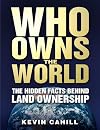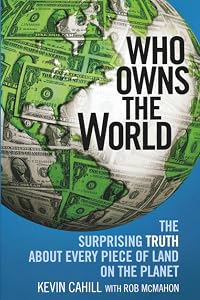
Who Owns the World?
by Kevin Cahill
On This Page
Description
You don't have to be a student of geography or cartography to have an interest in the world around you, especially with globalization making our planet seem smaller than ever. Now you can IM someone in Alaska, purchase coffee beans from Timor-Leste, and visit Dubai. But what do we really know about these lands?WHO OWNS THE WORLD presents the results of the first-ever landownership survey of all 197 states and 66 territories of the world, and reveals facts both startling and eye-opening. show more You'll learn that:
—Only 15% of the world's population lays claim to landownership, and that landownership in too few hands is probably the single greatest cause of poverty.
—Queen Elizabeth II owns 1/6 of the entire land surface on earth (nearly 3 times the size of the U.S.).
—The Lichtenstein royal family is wealthier than the Grimaldis of Monaco.
—80% of the American population is crammed in urban areas.
—The least crowded state is Alaska, with 670 acres per person. The most crowded is New Jersey, with .7 acres per person. —60% of America's population are property owners. That's behind the UK (69% homeownership).
—And much, much more!
With its relevance to contemporary issues and culture, WHO OWNS THE WORLD makes for fascinating reading. Both entertaining and educational, it provides cocktail party conversation for years to come and is guaranteed to change the way you view the U.S. and the world.
. show less
Tags
Recommendations






Member Recommendations
Member Reviews
I’m a geography geek, so I was thrilled to get an ER copy of Who Owns the World—a question I have pondered often in my travels. Chapter one, “Of Wealth and Poverty,” although not very well written, is an interesting and thought-provoking essay on the important relationship between poverty and land ownership. Unfortunately, this chapter was the only worthwhile part of the book. I’d really like those hours back that I spent with this one.
Who really does own the world? I’ll save you the frustration of reading the book and just tell you: according to this book, it is highly probable that wherever you are, the land is somehow in some form, ultimately owned by the state. Not very useful, I know, but there you have it. For show more example, Cahill says that Queen Elizabeth II is the largest single landowner on the planet. The first problem with that is that he uses her name as a synonym for the British monarchy or crown, which it is not. The second—bigger—problem with this is that he includes her property to include every inch of the UK, Australia, Canada, New Zealand and a whole bunch of other countries. Maybe that’s technically true on some level, but it is simplistic and meaningless. It gives zero information on the reality of everyday life for the people connected to that land. Furthermore, in the case of Canada, he doesn’t even mention that Quebec is legally a “distinct society” has its own system of law based on the French system, and he fails to mention Indigenous land claims. He doesn’t come right out and say it, but the implications of his statements are that, if she wanted to, Queen Elizabeth could, say, kick everyone out of the province of Prince Edward Island because she wants to retire there on her own private sheep farm. This is absolute nonsense.
The structure of the book is terrible. First, there is not one single map. Not one. How do you have a geography book without maps? Two, instead of logically dividing the world into its physical landforms, he discusses first “The Land of America,” by which he means only the United States, and utterly ignoring all the other countries that are part of America (the Caribbean, Central America, Canada, South America). This is just one example of how the author is sloppy in his use of language. He may think that America = USA, but many people in this world strongly do not. Along the same lines, he states that Columbus “discovered America.” Why would he choose that term when it has been widely deemed offensive and inaccurate for at least the past 25 years? He could so easily have selected historically correct and neutral words. It’s not just with language that he is imprecise. He does not value precision of fact either. According to Cahill, Canada (which he categorizes not as part of North America, but as a “Land of Queen Elizabeth II”) is a “federation of 13 provinces.” Uh, no it’s not. There are ten provinces and three territories. Similarly, he claims that Australia is “a federation of six states, including Tasmania, the Australian Capital Territory and Jarvis Bay Territory.” That one isn’t even close to correct. It’s not like these details about Canada and Australia are obscure or confusing. I had this info down by the time I was nine years old. And it’s easy to verify. So why would he blunder so? And if he gets this simple information wrong, what else has he messed up? Why would you bother to read a book by an author with no credibility?
Okay, maybe I’m being too nit-picky, and I need to look at the larger picture. Unfortunately, as a whole, the book doesn’t get any better. Many sentences are ambiguous, and Cahill constantly drops facts into paragraphs without explaining the implications of what it means. The organization is a mess—entirely inconsistent. He throws in trivial tidbits intermittently that have nothing to do with landownership, but then doesn’t give basic information in other places. (I really could go on and on and on and on about how poorly organized this book is—if you really need to know, ask me for more details on my profile page.) He uses seemingly important statistics but doesn’t explain what they mean. For example, for most countries, he gives an “ownership factor,” which is always either “N/A” or “1”. I have no idea what that means. He sometimes gives the information collected from a World Bank land-registration system questionnaire, but does not explain the implications of this information, or what the reader should expect to see.
In conclusion, this book is a worthless mess that is sadly a waste of the paper used to print it.
Recommended for: people who like lots and lots of stats, but don’t really care about accuracy; people who think the United States is the centre of the universe; people looking for scrap paper to start their campfire. show less
Who really does own the world? I’ll save you the frustration of reading the book and just tell you: according to this book, it is highly probable that wherever you are, the land is somehow in some form, ultimately owned by the state. Not very useful, I know, but there you have it. For show more example, Cahill says that Queen Elizabeth II is the largest single landowner on the planet. The first problem with that is that he uses her name as a synonym for the British monarchy or crown, which it is not. The second—bigger—problem with this is that he includes her property to include every inch of the UK, Australia, Canada, New Zealand and a whole bunch of other countries. Maybe that’s technically true on some level, but it is simplistic and meaningless. It gives zero information on the reality of everyday life for the people connected to that land. Furthermore, in the case of Canada, he doesn’t even mention that Quebec is legally a “distinct society” has its own system of law based on the French system, and he fails to mention Indigenous land claims. He doesn’t come right out and say it, but the implications of his statements are that, if she wanted to, Queen Elizabeth could, say, kick everyone out of the province of Prince Edward Island because she wants to retire there on her own private sheep farm. This is absolute nonsense.
The structure of the book is terrible. First, there is not one single map. Not one. How do you have a geography book without maps? Two, instead of logically dividing the world into its physical landforms, he discusses first “The Land of America,” by which he means only the United States, and utterly ignoring all the other countries that are part of America (the Caribbean, Central America, Canada, South America). This is just one example of how the author is sloppy in his use of language. He may think that America = USA, but many people in this world strongly do not. Along the same lines, he states that Columbus “discovered America.” Why would he choose that term when it has been widely deemed offensive and inaccurate for at least the past 25 years? He could so easily have selected historically correct and neutral words. It’s not just with language that he is imprecise. He does not value precision of fact either. According to Cahill, Canada (which he categorizes not as part of North America, but as a “Land of Queen Elizabeth II”) is a “federation of 13 provinces.” Uh, no it’s not. There are ten provinces and three territories. Similarly, he claims that Australia is “a federation of six states, including Tasmania, the Australian Capital Territory and Jarvis Bay Territory.” That one isn’t even close to correct. It’s not like these details about Canada and Australia are obscure or confusing. I had this info down by the time I was nine years old. And it’s easy to verify. So why would he blunder so? And if he gets this simple information wrong, what else has he messed up? Why would you bother to read a book by an author with no credibility?
Okay, maybe I’m being too nit-picky, and I need to look at the larger picture. Unfortunately, as a whole, the book doesn’t get any better. Many sentences are ambiguous, and Cahill constantly drops facts into paragraphs without explaining the implications of what it means. The organization is a mess—entirely inconsistent. He throws in trivial tidbits intermittently that have nothing to do with landownership, but then doesn’t give basic information in other places. (I really could go on and on and on and on about how poorly organized this book is—if you really need to know, ask me for more details on my profile page.) He uses seemingly important statistics but doesn’t explain what they mean. For example, for most countries, he gives an “ownership factor,” which is always either “N/A” or “1”. I have no idea what that means. He sometimes gives the information collected from a World Bank land-registration system questionnaire, but does not explain the implications of this information, or what the reader should expect to see.
In conclusion, this book is a worthless mess that is sadly a waste of the paper used to print it.
Recommended for: people who like lots and lots of stats, but don’t really care about accuracy; people who think the United States is the centre of the universe; people looking for scrap paper to start their campfire. show less
 This review was written for LibraryThing Early Reviewers.
My goodness, what an amazing book! Chock full of information from stem to stern, it is an enormously revealing compilation of everything from individuals of great wealth to the vast anonymous and powerless poorest of the poor which make up half of the worlds population.
Of special interest was the various hoops that citizens of various nations have to go through to get their property properly deeded and registered in the proper governmental offices. In northern Europe, it is quite (surprisingly) expensive but quick, efficient and backed by the force of law (enforceable law, that is). In most of Africa, however, it is both mind bogglingly convoluted and outlandishly expensive. In many countries where the average income is less than $500 show more a year, it costs upwards of $16,000 to register private property (at the same rate, getting a deed in the U.S. would cost over 2 Million dollars (!))- and that does not include the multiple and mandatory bribes that would be necessary to move the process along). On top of that, it may take almost a years worth of paper work to finish and record the process. And, even more despairing, in many of those nations, the government's actual control over what happens on the ground ends at the outskirts of the capitol city.
(These are things the proud tea-bagger tax protesters should think about before trying to destroy the American system of Government. Our present system might not work the way that you personally would like it to work (that is, to your own particular advantage), but the alternative is anarchy and the dissolution of civilized (as we have come to think of it) society).
This is a book for stat-heads, geography junkies, closet historians, astrologers/economists, sociologists of any stripe and a should-read for anyone who desires to be literate on the state of the world and the power that wealth affords those in possession of it and the also the power that Power gives over the poor and uneducated. show less
Of special interest was the various hoops that citizens of various nations have to go through to get their property properly deeded and registered in the proper governmental offices. In northern Europe, it is quite (surprisingly) expensive but quick, efficient and backed by the force of law (enforceable law, that is). In most of Africa, however, it is both mind bogglingly convoluted and outlandishly expensive. In many countries where the average income is less than $500 show more a year, it costs upwards of $16,000 to register private property (at the same rate, getting a deed in the U.S. would cost over 2 Million dollars (!))- and that does not include the multiple and mandatory bribes that would be necessary to move the process along). On top of that, it may take almost a years worth of paper work to finish and record the process. And, even more despairing, in many of those nations, the government's actual control over what happens on the ground ends at the outskirts of the capitol city.
(These are things the proud tea-bagger tax protesters should think about before trying to destroy the American system of Government. Our present system might not work the way that you personally would like it to work (that is, to your own particular advantage), but the alternative is anarchy and the dissolution of civilized (as we have come to think of it) society).
This is a book for stat-heads, geography junkies, closet historians, astrologers/economists, sociologists of any stripe and a should-read for anyone who desires to be literate on the state of the world and the power that wealth affords those in possession of it and the also the power that Power gives over the poor and uneducated. show less
This review was written for LibraryThing Early Reviewers.Not exactly what I was expecting. I thought it would be a narrated almanac or a list of facts and the author's interpretations of the stats given about land ownership across the world. What we are given is an irate person who has an agenda he is poorly trying to push. If you skip Part 1 Overview and Analysis the rest of the book is an interesting almanac with lots of information and usually a quick piece of trivia about each country. You also will most likely not notice the little sniping and snarking for what they are.
However if you actually read the first section the author has a grand view of 'what is wrong with the world'. Namely, too much land in the hands of too few. He starts on a tirade about the US Government owning ~%33 of show more the country and takes pot shots at people like Ted Turner for personally owning 1.8 Million acres. Then later he makes a big deal about the Queen of England owning 1/6 of the land surface of the entire planet. He starts by blurring the 'Crown' with the 'Queen' and then claims she owns all of Canada, Australia, New Zealand, Britain and several other smaller countries as well as %60 of Antarctica. While the Queen is one of the richest land owners on the planet, it comes from her personal wealth not 'owning' entire countries.
The author seems to think that the world is in the trouble it is in because too many people do not have land of their own and that something should be done about this. He never gives any suggestions on what should be done or how he thinks this utopia should come about, but that doesn't deter him from whining. Apparently in one country, the ruling king gives every male at the age of 18 a home in the city and one in the country and the author seemed to think this was an excellent idea to be carried out, only expanding it to include women as well. Even though to do this lies in direct contradiction too few controling too much, since who will decide who gets what land and when?
So to sum up, Land is wealth and the poor are poor because they don't have any, and by reallocating the land we will make everyone richer. Of course he ignores the fact that not all land is equal (he estimated that Canada was worth about $5,000 an acre on average for the entire country), and many uses of land for cost effectiveness and efficiency require larger tracts of land. Which would produce more wheat a 500 acre field or 100-5 acre plots with houses and paths for travel? You'd be lucky to graze 2 cows on a 5 acre lot in many of the Western states, but where would you get your water? Overall while the author had a book of facts (which were interesting) he was rather ignorant of the real land scape. While I agree with his assessment for very narrow list of countries in Africa and Asia, his general disdain is rather ignorant in my opinion. show less
However if you actually read the first section the author has a grand view of 'what is wrong with the world'. Namely, too much land in the hands of too few. He starts on a tirade about the US Government owning ~%33 of show more the country and takes pot shots at people like Ted Turner for personally owning 1.8 Million acres. Then later he makes a big deal about the Queen of England owning 1/6 of the land surface of the entire planet. He starts by blurring the 'Crown' with the 'Queen' and then claims she owns all of Canada, Australia, New Zealand, Britain and several other smaller countries as well as %60 of Antarctica. While the Queen is one of the richest land owners on the planet, it comes from her personal wealth not 'owning' entire countries.
The author seems to think that the world is in the trouble it is in because too many people do not have land of their own and that something should be done about this. He never gives any suggestions on what should be done or how he thinks this utopia should come about, but that doesn't deter him from whining. Apparently in one country, the ruling king gives every male at the age of 18 a home in the city and one in the country and the author seemed to think this was an excellent idea to be carried out, only expanding it to include women as well. Even though to do this lies in direct contradiction too few controling too much, since who will decide who gets what land and when?
So to sum up, Land is wealth and the poor are poor because they don't have any, and by reallocating the land we will make everyone richer. Of course he ignores the fact that not all land is equal (he estimated that Canada was worth about $5,000 an acre on average for the entire country), and many uses of land for cost effectiveness and efficiency require larger tracts of land. Which would produce more wheat a 500 acre field or 100-5 acre plots with houses and paths for travel? You'd be lucky to graze 2 cows on a 5 acre lot in many of the Western states, but where would you get your water? Overall while the author had a book of facts (which were interesting) he was rather ignorant of the real land scape. While I agree with his assessment for very narrow list of countries in Africa and Asia, his general disdain is rather ignorant in my opinion. show less
If you begin by randomly flipping through the pages of this 369 page reference work, you'll erroneously come to the conclusion that this is simply another almanac. To be sure, there are certainly almanac elements like total land area per country, population per acre, building vacancy and such, but this is not a typical almanac. It is something grandly more than that. It is the summation of a larger work, which the editor mentions in the first pages, also by Cahill; Who Own the World: The Hidden Facts Behind Landownership. Although it is a summation and direct reference for that work, it still provides detailed history concerning those individuals responsible for some of the largest land transactions in history including the purchase of show more Manhattan Island and the Louisiana Purchase. It doesn't simply rest in the U.S., but brings you around the world and into the ample pockets of the world's most influential, affluent, and perhaps greedy individuals on the planet. If ever you wanted to, "follow the money," this and its companion are what you need to even get a running start at it. show less
This review was written for LibraryThing Early Reviewers.Well, this one is somewhat interesting, but a bit of a mess. It's sort of an almanac, and does contain interesting trivia about many of the countries, but I have to question the veracity of much of the information, particularly the statistics which are really supposed to be the core of the book. The author seems to either be intentional selective about how he defines "ownership" of land, or else he is inexperienced with statistical analysis. Either way, there is clear confirmation bias for his thesis that too much land is in the hands of too small a minority of people. His claims that the Queen of England OWNS the entirety of the UK and all British protectorates stands out in particular. While it may be technically true that the Crown show more owns all the land it rules, the Queen Herself doesn't own it, nor in practice does this equate to a single owner. It's largely an antiquated formality, and would be an interesting curiosity as a side note, but distracts from the reality of modern practice.
Worth flipping through, but don't risk citing it for research. show less
Worth flipping through, but don't risk citing it for research. show less
This review was written for LibraryThing Early Reviewers.The premise for this work is good: of all the world's land surface, who really owns all the various bits of it? Clearly land ownership is not equitably distributed; some own much more than others. This book presents reams of statistics about land ownership in just about every country and territory in the world, and most of these numbers have been well researched and are as good a set of numbers as you are likely to see, given that some countries have almost zero real data collection processes about these matters, and many more are in such a state of inner turmoil that determining who 'owns' what is a frustrating and near-meaningless endeavor.
But this book is marred by a major flaw, that of trying to impose the author's particular show more feelings on how land ownership should be dealt with, rather than investigating the reasons and history of how it is currently set up, and just how the world economies are very dependent on such distribution. In the first chapter, the author continuously points out that there is plenty of land for everybody, several acres for every man, woman, and child on the planet, and that if only such a equal distribution could be achieved, all the worlds troubles would go away. While it is certainly true that many of the world's wars have been over ownership of particular pieces of land, what this author misses are several facts:
1. Large portions of the world's surface, while technically marginally habitable, in reality will not support any type of heavy-density human presence. Areas such as the Australian outback, the huge Artic tundra areas, large tracts of land around and in the Sahara desert, the many heavily mountainous regions of the world should all be subtracted from the available land area that is available for divvying up amongst the world's population. There are very good reasons why so much of the world's population is concentrated in relative small areas of the planet, but this book does not delve into those reasons.
2. Many areas of the world can be farmed, but the most efficient, greatest yield-producing methods for many of these areas cannot be done in small plots, but rather require large tracts that lend themselves to mechanized farming methods, or have so little vegetation that their only viable use is grazing land at many acres per cow.
3. The best pieces of land are relatively small in comparison to all the rest, and like any item in short supply, there is strong competition for such pieces. Once someone has managed to gain control of such areas, they will normally do all they can to maintain that control. As the author presents no concrete plan for just how his 'equitable' distribution of land could be achieved, his harping about just how much of the world is controlled by so few comes across as a very irritating whine.
This same author viewpoint leads him to make some claims, that while they are 'technically' true, are absurd on their face, such as the claim that Queen Elizabeth II personally holds close to a sixth of world's land. Most of this is actually claimed by the British Crown, not the Queen personally, and if the Crown ever tried to actually invoke that claim (such as all of Australia) and kick all the current inhabitants out, there would be instant and massive opposition. Of much more interest was the author's detailing of what the Queen actually holds in her own name (not the Crown's), and this list is quite impressive, truly showing her to actually be one of largest landholders in the world. If all of this book had been like this one area, it would have truly been a very useful and enlightening look at who really owns the world. As it is, the only really useful items here are the statistics he has compiled on all the various countries listing area, population, and general form of land ownership, as this data is not easily findable all collected in one place.
Note also that this is not a book for casual reading; other than the first chapter the balance is composed of data listings for each country (or, for the US, each state) followed by a short half page set of tidbits about the area, some of which, while interesting, have nothing to do with land ownership.
Recommended only for statistical use.
---Reviewed by Patrick Shepherd (hyperpat) show less
But this book is marred by a major flaw, that of trying to impose the author's particular show more feelings on how land ownership should be dealt with, rather than investigating the reasons and history of how it is currently set up, and just how the world economies are very dependent on such distribution. In the first chapter, the author continuously points out that there is plenty of land for everybody, several acres for every man, woman, and child on the planet, and that if only such a equal distribution could be achieved, all the worlds troubles would go away. While it is certainly true that many of the world's wars have been over ownership of particular pieces of land, what this author misses are several facts:
1. Large portions of the world's surface, while technically marginally habitable, in reality will not support any type of heavy-density human presence. Areas such as the Australian outback, the huge Artic tundra areas, large tracts of land around and in the Sahara desert, the many heavily mountainous regions of the world should all be subtracted from the available land area that is available for divvying up amongst the world's population. There are very good reasons why so much of the world's population is concentrated in relative small areas of the planet, but this book does not delve into those reasons.
2. Many areas of the world can be farmed, but the most efficient, greatest yield-producing methods for many of these areas cannot be done in small plots, but rather require large tracts that lend themselves to mechanized farming methods, or have so little vegetation that their only viable use is grazing land at many acres per cow.
3. The best pieces of land are relatively small in comparison to all the rest, and like any item in short supply, there is strong competition for such pieces. Once someone has managed to gain control of such areas, they will normally do all they can to maintain that control. As the author presents no concrete plan for just how his 'equitable' distribution of land could be achieved, his harping about just how much of the world is controlled by so few comes across as a very irritating whine.
This same author viewpoint leads him to make some claims, that while they are 'technically' true, are absurd on their face, such as the claim that Queen Elizabeth II personally holds close to a sixth of world's land. Most of this is actually claimed by the British Crown, not the Queen personally, and if the Crown ever tried to actually invoke that claim (such as all of Australia) and kick all the current inhabitants out, there would be instant and massive opposition. Of much more interest was the author's detailing of what the Queen actually holds in her own name (not the Crown's), and this list is quite impressive, truly showing her to actually be one of largest landholders in the world. If all of this book had been like this one area, it would have truly been a very useful and enlightening look at who really owns the world. As it is, the only really useful items here are the statistics he has compiled on all the various countries listing area, population, and general form of land ownership, as this data is not easily findable all collected in one place.
Note also that this is not a book for casual reading; other than the first chapter the balance is composed of data listings for each country (or, for the US, each state) followed by a short half page set of tidbits about the area, some of which, while interesting, have nothing to do with land ownership.
Recommended only for statistical use.
---Reviewed by Patrick Shepherd (hyperpat) show less
This review was written for LibraryThing Early Reviewers.Who Owns the World is a fascinating book that explores who owns land in every country and territory in the world. A fun book to flip through. It turns out that Queen Elizabeth II owns a sixth of the entire land surface on Earth – but that’s because she technically owns all of Canada and Australia. This book is more than fun facts. Only 15% of the world’s population lays claim to land. Could too much land in the hands of too few people be a leading cause of poverty?
This review was written for LibraryThing Early Reviewers.Members
- Recently Added By
Author Information
5 Works 112 Members
Common Knowledge
- Canonical title
- Who Owns the World?
- Alternate titles
- Who Owns the World?
- Original publication date
- 2010-01
- Dedication
- For Rosalind, Jane, Kay, Stella and Ivo Cahill
- First words
- Poverty and wealth are not, as is often thought, opposites.
- Last words
- (Click to show. Warning: May contain spoilers.)Vanuatu did not respond to the World Bank's land-registration questionnaire.
Classifications
- Genres
- Nonfiction, General Nonfiction, Politics and Government, Economics, Reference, History, Science & Nature, Business
- DDC/MDS
- 333.3 — Society, government, & culture Economics Economics of land and energy Private ownership
- LCC
- HD593 .C34 — Social sciences Industries. Land use. Labor Industries. Land use. Labor Land use
- BISAC
Statistics
- Members
- 79
- Popularity
- 401,199
- Reviews
- 13
- Rating
- (2.93)
- Languages
- English
- Media
- Paper, Ebook
- ISBNs
- 5
- ASINs
- 2