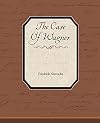
The Case of Wagner
by Friedrich Nietzsche 
On This Page
Description
The book is a critique of Richard Wagner and the announcement of Nietzsche's rupture with the German artist, who had involved himself too much, in Nietzsche's eyes, in the nationalist movement. His music is no longer represented as a possible "philosophical affect," and Wagner is ironically compared to Georges Bizet. However, Nietzsche presents Wagner as only a particular symptom of a broader "disease" that is affecting Europe: that is, nihilism. The book shows Nietzsche as a capable show more music-critic, and provides the setting for some of his further reflections on the nature of art and its relationship to the future health of humanity. show lessTags
Recommendations








































Member Reviews
Nietzsche slams Wagner
In this series of essays Nietzsche excoriates the composer Richard Wagner to the point that it's hard to see how the two men remained friends.
In this series of essays Nietzsche excoriates the composer Richard Wagner to the point that it's hard to see how the two men remained friends.
Ratings
Members
- Recently Added By
Author Information

1,362+ Works 77,821 Members
The son of a Lutheran pastor, Friedrich Wilhelm Nietzsche was born in 1844 in Roecken, Prussia, and studied classical philology at the Universities of Bonn and Leipzig. While at Leipzig he read the works of Schopenhauer, which greatly impressed him. He also became a disciple of the composer Richard Wagner. At the very early age of 25, Nietzsche show more was appointed professor at the University of Basel in Switzerland. In 1870, during the Franco-Prussian War, Nietzsche served in the medical corps of the Prussian army. While treating soldiers he contracted diphtheria and dysentery; he was never physically healthy afterward. Nietzsche's first book, The Birth of Tragedy Out of the Spirit of Music (1872), was a radical reinterpretation of Greek art and culture from a Schopenhaurian and Wagnerian standpoint. By 1874 Nietzsche had to retire from his university post for reasons of health. He was diagnosed at this time with a serious nervous disorder. He lived the next 15 years on his small university pension, dividing his time between Italy and Switzerland and writing constantly. He is best known for the works he produced after 1880, especially The Gay Science (1882), Thus Spake Zarathustra (1883-85), Beyond Good and Evil (1886), On the Genealogy of Morals (1887), The Antichrist (1888), and Twilight of the Idols (1888). In January 1889, Nietzsche suffered a sudden mental collapse; he lived the last 10 years of his life in a condition of insanity. After his death, his sister published many of his papers under the title The Will to Power. Nietzsche was a radical questioner who often wrote polemically with deliberate obscurity, intending to perplex, shock, and offend his readers. He attacked the entire metaphysical tradition in Western philosophy, especially Christianity and Christian morality, which he thought had reached its final and most decadent form in modern scientific humanism, with its ideals of liberalism and democracy. It has become increasingly clear that his writings are among the deepest and most prescient sources we have for acquiring a philosophical understanding of the roots of 20th-century culture. (Bowker Author Biography) show less
Friedrich Nietzsche has a Legacy Library. Legacy libraries are the personal libraries of famous readers, entered by LibraryThing members from the Legacy Libraries group.
Some Editions
Series
Belongs to Publisher Series
insel taschenbuch (0686)
Work Relationships
Common Knowledge
- Canonical title
- The Case of Wagner
- People/Characters
- Wagner, Richard
- Quotations
- Only sick music makes money today.
Classifications
Statistics
- Members
- 83
- Popularity
- 382,057
- Reviews
- 1
- Rating
- (4.31)
- Languages
- 9 — Danish, Dutch, English, French, German, Italian, Portuguese, Romanian, Swedish
- Media
- Paper, Ebook
- ISBNs
- 13
- ASINs
- 4