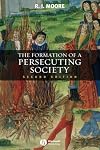
The Formation of a Persecuting Society: Authority and Deviance in Western Europe 950-1250
by R. I. Moore
On This Page
Description
The tenth to the thirteenth centuries in Europe saw the appearance of popular heresy and the establishment of the Inquisition, the expropriation and mass murder of Jews, and the propagation of elaborate measures to segregate lepers from the healthy and curtail their civil rights. These were traditionally seen as distinct and separate developments, and explained in terms of the problems which their victims presented to medieval society. In this stimulating book, first published in 1987 and show more now widely regarded as a a classic in medieval history, R. I. Moore argues that the coincidences in the tr show lessTags
Recommendations












































Member Reviews
(Second edition) This is a fascinating and important work, an extended essay on the persecution of lepers, heretics and Jews by others in medieval Europe. Moore takes issue with the traditional explanation for the increase in the scale and force of that persecution from the eleventh and twelfth century onwards—that it became more strenuous and more oppressive because heretics, Jews and lepers increased in number—and argues that we should seek the cause of persecution not in the persecuted but in the persecutors. Moore argues that in the wake of the Gregorian church reforms and as a result of an increase in socio-economic complexity, with both churchmen and aristocrats making new claims to universal political and cultural authority, show more the image and the rhetoric of the Other (the dangerous, the polluted, the heretic and the Jew and the carrier of disease) became means of legitimating authority. For the first time, western Europe (the book focuses mostly on France and northern Italy) becomes not a society in which some persecution takes place, but a persecuting society—a change which has ramifications for Western society right down to the twentieth century.
As a short book, addressing some very large issues, Moore is making quite a generalising argument at times, but he is careful to acknowledge that and to point out that he seeks to give a partial explanation for persecution, which is dependent always on context and contingency, and not a whole one. There are some points that I'd quibble with in terms of how Moore draws on anthropology (particularly that on African societies; I'm more and more disaffected with how (medieval) European scholars don't seem to realise that slavery is not the same institution in all societies and all time periods) to make his case, but overall this is a persuasive and well-written book. Even if you have not much background in medieval history, I would recommend The Formation of a Persecuting Society if you have an interest in social justice movements because of how Moore teases out the origins of a rhetoric of oppression that's had lengthy consequences. show less
As a short book, addressing some very large issues, Moore is making quite a generalising argument at times, but he is careful to acknowledge that and to point out that he seeks to give a partial explanation for persecution, which is dependent always on context and contingency, and not a whole one. There are some points that I'd quibble with in terms of how Moore draws on anthropology (particularly that on African societies; I'm more and more disaffected with how (medieval) European scholars don't seem to realise that slavery is not the same institution in all societies and all time periods) to make his case, but overall this is a persuasive and well-written book. Even if you have not much background in medieval history, I would recommend The Formation of a Persecuting Society if you have an interest in social justice movements because of how Moore teases out the origins of a rhetoric of oppression that's had lengthy consequences. show less
This is an interesting book which speculates on the reasons behind increased persecution of Jews, heretics, lepers, homosexuals and others in 11th-12th century Europe. The author wants to refute the thesis that such persecuted groups all manifested an actual threats to society at this time. Persecution was not demanded or supported by the general public. Instead it originated among the literate classes who obtained responsibility for practical government in churches and kingdoms in these centuries. To them persecution was a means of protecting their position against challengers and a means for justifying their power to their rulers and the public. On the final pages the author writes that he does not want to replace one simplistic show more explanation with another, so his thesis must be qualified. But it nevertheless poses a question with interesting implications for subsequent periods in European history, especially the Renaissance and the religious wars that came with it. Was intolerance among literate elites a necessary complement to literary advancement? show less
It is the argument of this that however the tremendous extension of the power and influence of the literate is described, the development of persecution in all its forms was part of it, and therefore inseparable from the great and positive achievement with which it is associated. Whether they might have taken place without it is another question, and one which, perhaps thankfully, historians are not called upon to answer.
The above is how Professor Moore concludes this harrowing taxonomy on the persecution and peril inflicted upon heretics, Jews, lepers, homosexuals and prostitutes across Europe during the High iddle Ages. The period chronicles cited indicate a sort of change of attitudes and stiffening of response around the 11th show more century. The narrative ascribed to each of these offenses appeared very similar. Around p. 100 we begin to probe for causality. Moore then broaches whether these events constitute either a nascent form of Durkeheimian deviance or a Webernian consolidation of central power. Without a doubt the dislocation of the populace form the feudal/manorial to the urban really disoriented people. Couple that with the emerging cash economy and all bets were off. The author gauges the limits of available information and won't speculate further. Then citing Foucault he does offer another thesis about the threat posed by Jewish scholarship. This learned community was thus a rival to the new literate (Christian) class which were becoming the stewards of power. This last argument isn't quite convincing. The rich bibliography made this an enjoyable excursion on a winter evening. show less
The above is how Professor Moore concludes this harrowing taxonomy on the persecution and peril inflicted upon heretics, Jews, lepers, homosexuals and prostitutes across Europe during the High iddle Ages. The period chronicles cited indicate a sort of change of attitudes and stiffening of response around the 11th show more century. The narrative ascribed to each of these offenses appeared very similar. Around p. 100 we begin to probe for causality. Moore then broaches whether these events constitute either a nascent form of Durkeheimian deviance or a Webernian consolidation of central power. Without a doubt the dislocation of the populace form the feudal/manorial to the urban really disoriented people. Couple that with the emerging cash economy and all bets were off. The author gauges the limits of available information and won't speculate further. Then citing Foucault he does offer another thesis about the threat posed by Jewish scholarship. This learned community was thus a rival to the new literate (Christian) class which were becoming the stewards of power. This last argument isn't quite convincing. The rich bibliography made this an enjoyable excursion on a winter evening. show less
Two books about the Middle Ages must be read by every literate American, at gunpoint if neccessary.
1. The Pursuit of the Millennium by Norman Cohn
2. and this one
1. The Pursuit of the Millennium by Norman Cohn
2. and this one
In de loop van de elfde en twaalfde eeuw werd Europa wat het sindsdien is geweest - een maatschappij van vervolging. Tegen de volksketterij die in deze periode opkwam, werd de inquisitie in het leven geroepen, met tegenmaatregelen die in geen verhouding stonden tot de werkelijke bedreiging van de ketterij voor de kerk. Wilde verhalen werden verkondigd over de praktijken van de ketters, evenals over de verdorvenheden van andere belangrijke groepen die in deze tijd steeds meer en steeds wreder werden vervolgd: joden en melaatsen in de eerste plaats en, minder bekend, ook homoseksuelen en prostituees. Moore geeft een gedetailleerde beschrijving van elk van deze vervolgde groepen, hoe er in de christelijke maatschappij over hen werd gedacht show more en hoe zij door allerlei dwangmaatregelen uit de gemeenschap werden gestoten. Daarbij brengt hij opvallende overeenkomsten in de behandeling van de diverse minderheden aan het licht. In tegenstelling tot wat algemeen wordt aangenomen, stelt Moore, vond de vervolging haar oorsprong niet in de vijandigheid van het volk, maar in de diepgaande veranderingen die het Europa van de twaalfde eeuw onderging, in sociaal en bestuurlijk opzicht, in het godsdienstig en economisch leven. In deze periode werd een patroon van vervolging gecreëerd dat tot op de dag van vandaag wordt toegepast. (flaptekst) show less
Feb 16, 2018Dutch
Ratings
Members
- Recently Added By
Lists

r/AskHistorians' Recommended Books
1,068 works; 16 members

Bibliography of How the Old World Ended by Jonathan Scott
308 works; 1 member
Author Information

9+ Works 792 Members
R. I. Moore has been Professor of Medieval History at the University of Newcastle upon Tyne since 1993.
Common Knowledge
- Original title
- The formation of a persecuting society
- Original publication date
- 1987
- Important places
- Western Europe; Europe
- Original language
- English
Classifications
- Genres
- History, Nonfiction, Religion & Spirituality, General Nonfiction
- DDC/MDS
- 323.1409 — Society, Government, and Culture Political science Civil Rights & Liberties/ Human Rights Minority Politics
- LCC
- HN375 .M66 — Social sciences Social history and conditions. Social problems. Social reform Social history and conditions. Social problems. By region or country
- BISAC
Statistics
- Members
- 315
- Popularity
- 100,930
- Reviews
- 5
- Rating
- (4.04)
- Languages
- Dutch, English, French, Spanish
- Media
- Paper, Ebook
- ISBNs
- 12
- ASINs
- 3