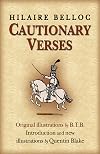
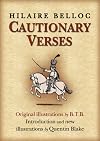
Cautionary Verses
by Hilaire Belloc, Nicolas Bentley (Illustrator)
On This Page
Description
An hilarious classic anthology of moral instruction introduced by Quentin Blake. If you are you prone to telling tales or running away then ignore these poems at your peril or you might suffer the same fate as Matilda, Who told lies and was Burned to Death or Jim, Who ran away from his nurse and was eaten by a Lion! First published over a hundred years ago, Hilaire Belloc's tongue-in-cheek poems of moral instruction for children, with amusing illustrations by B.T.B. and Quentin Blake, are as show more sharp, funny and memorable as ever. show lessTags
Recommendations



















Member Reviews
Received a complimentary copy in a LibraryThing Member Giveaway.
These works live up to their reputation: I'd read of Belloc as sharing the same muse as Gorey. I expect now that Gorey at least honored Belloc's wit and wordplay, or it's an uncanny bit of coincidence they share subjects as well as tone.
This volume combines seven separate works, and the various verses play around with a few common themes, but the fun really comes in the word choice and how Belloc appears to be painting himself into a corner, and suddenly ends with a rhyme perfect in metre and comedic effect.
Recurrent themes for Belloc are foibles of latter day aristocrats, a bestiary ("The Bad Child's Book of Beasts" and "More Beasts for Worse Children"), and cautionary show more tales for obnoxious kids. The morals typically take the form either of an outsize fate, or instructions which clearly reflect an adult's own childishness: pretending good parenting is keeping children seen and not heard. (Now I think of it, the verses on aristocracy make the same point, but between adults.) There's also a good bit of nonsense verse, not brainiac like Carroll but simply wacky.
As others have said, a great deal of it seems eminently quotable, if only I had the talent of recalling lines from works I love. My best effort will be to have it on my shelf to pull out and remind myself of it, as I do Gorey, Carroll, Peake. show less
These works live up to their reputation: I'd read of Belloc as sharing the same muse as Gorey. I expect now that Gorey at least honored Belloc's wit and wordplay, or it's an uncanny bit of coincidence they share subjects as well as tone.
This volume combines seven separate works, and the various verses play around with a few common themes, but the fun really comes in the word choice and how Belloc appears to be painting himself into a corner, and suddenly ends with a rhyme perfect in metre and comedic effect.
Recurrent themes for Belloc are foibles of latter day aristocrats, a bestiary ("The Bad Child's Book of Beasts" and "More Beasts for Worse Children"), and cautionary show more tales for obnoxious kids. The morals typically take the form either of an outsize fate, or instructions which clearly reflect an adult's own childishness: pretending good parenting is keeping children seen and not heard. (Now I think of it, the verses on aristocracy make the same point, but between adults.) There's also a good bit of nonsense verse, not brainiac like Carroll but simply wacky.
As others have said, a great deal of it seems eminently quotable, if only I had the talent of recalling lines from works I love. My best effort will be to have it on my shelf to pull out and remind myself of it, as I do Gorey, Carroll, Peake. show less
This review was written for LibraryThing Member Giveaways.
The trouble with Belloc, at least the Belloc of the Cautionary Verses, is that one can't stop quoting him. To discuss his work with a fan is like starting a Monty Python aficionado off on the dead parrot sketch. The verses really do speak for themselves.
I suppose the most popular are those about children with challenging behaviour who meet appropriate fates, if not worse than death, at least pretty terminal. I tend to prefer Belloc as a social commentator, particularly of the rich. Hildebrand, for example, who is frightened by a motor car. His father reproaches him, citing the Lord Uxbridge-like lack of concern of a forebear as several of his legs are shot off in the Napoleonic Wars. Papa is reassuring, however - "But do not fret about show more it! Come! We'll off to town and purchase some!" Another indulgent father was the Earl of Potamus who stumped up fifteen hundred thousand pounds to cover his son, Lord Hippo's, gambling debts with "....stiffen up, you wreck; boys will be boys - so here's the cheque."
Some aristos did less well, however, like Godolphin Horne who, because he was "Deathly Proud" upset the hangers-on at Court and had his name struck from the "Perfectly Enormous Book called 'Persons Qualified to be Attendant on His Majesty'. "And now Godolphin is the boy that blacks the boots at the Savoy." And then there was Lord Lundy who spoiled a sound political career by blubbing at the slightest thing. He was finally summoned by his grandfather, the Duke who bitterly addressed him thus - "Sir, you have disappointed us! We had intended you to be the next Prime Minister but three: the stocks were sold; the Press was squared: The Middle Class was quite prepared. But as it is! ...my language fails! Go out and govern New South Wales!"
Attitudes towards the medical profession vary - Henry King's middle class parents were on the back foot when the physicians of the utmost fame appeared and "stated, as they took their fees, "There is no cure for this disease. Henry will very soon be dead." Lord Roehampton, however, avoided paying for his specialist care. Told to desist from speaking for a week to cure his strained vocal chord, burst with the effort and, according to the butler, "What is more, I doubt if he Has left enough to pay your fee." The Specialist "ever since, as I am told, Gets it beforehand; and in gold."
Money could be a problem even for the better off. Peter Goole ruined his parents by his inability to save and had his university career blasted by the need to earn his living - "He was compelled to join a firm of Brokers - in the summer term! And even now, at twenty-five, He has to WORK to keep alive! Yes! All day long from 10 till 4! For half the year or even more."
You see what I mean? These poems are to be read and enjoyed, and preferably learned by heart.
My copy has the traditional illustrations by Nicholas Bentley and B.T.B (Basil T. Blackwood) which are hard to better. show less
I suppose the most popular are those about children with challenging behaviour who meet appropriate fates, if not worse than death, at least pretty terminal. I tend to prefer Belloc as a social commentator, particularly of the rich. Hildebrand, for example, who is frightened by a motor car. His father reproaches him, citing the Lord Uxbridge-like lack of concern of a forebear as several of his legs are shot off in the Napoleonic Wars. Papa is reassuring, however - "But do not fret about show more it! Come! We'll off to town and purchase some!" Another indulgent father was the Earl of Potamus who stumped up fifteen hundred thousand pounds to cover his son, Lord Hippo's, gambling debts with "....stiffen up, you wreck; boys will be boys - so here's the cheque."
Some aristos did less well, however, like Godolphin Horne who, because he was "Deathly Proud" upset the hangers-on at Court and had his name struck from the "Perfectly Enormous Book called 'Persons Qualified to be Attendant on His Majesty'. "And now Godolphin is the boy that blacks the boots at the Savoy." And then there was Lord Lundy who spoiled a sound political career by blubbing at the slightest thing. He was finally summoned by his grandfather, the Duke who bitterly addressed him thus - "Sir, you have disappointed us! We had intended you to be the next Prime Minister but three: the stocks were sold; the Press was squared: The Middle Class was quite prepared. But as it is! ...my language fails! Go out and govern New South Wales!"
Attitudes towards the medical profession vary - Henry King's middle class parents were on the back foot when the physicians of the utmost fame appeared and "stated, as they took their fees, "There is no cure for this disease. Henry will very soon be dead." Lord Roehampton, however, avoided paying for his specialist care. Told to desist from speaking for a week to cure his strained vocal chord, burst with the effort and, according to the butler, "What is more, I doubt if he Has left enough to pay your fee." The Specialist "ever since, as I am told, Gets it beforehand; and in gold."
Money could be a problem even for the better off. Peter Goole ruined his parents by his inability to save and had his university career blasted by the need to earn his living - "He was compelled to join a firm of Brokers - in the summer term! And even now, at twenty-five, He has to WORK to keep alive! Yes! All day long from 10 till 4! For half the year or even more."
You see what I mean? These poems are to be read and enjoyed, and preferably learned by heart.
My copy has the traditional illustrations by Nicholas Bentley and B.T.B (Basil T. Blackwood) which are hard to better. show less
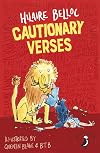
To my shock I realised that I didn’t actually own a copy of this, so when I saw a new edition in the bookshop, it was an easy decision to buy it. Belloc’s collection of poems from the 1930s is full of relevant moral instructions for children and adults alike, and is as caustically funny as ever it was; this edition is blessed with the addition of complemtary new illustrations by Quentin Blake (and Belloc is truly a predecessor of Roald Dahl, making that exquisitely fitting)
This is one of those books I think everyone should have read at some point, if only to learn from the tales contained within. If you’ve read of Rebecca Who Slammed Doors for Fun and Perished Miserably, or Jim Who Ran Away from his Nurse and was show more Eaten by a Lion, or Matilda Who Told Lies and was Burned to Death before, then you don’t need to tell me how much fun there is in these, especially if you’re reading them to a small child. Classic. show less
This is one of those books I think everyone should have read at some point, if only to learn from the tales contained within. If you’ve read of Rebecca Who Slammed Doors for Fun and Perished Miserably, or Jim Who Ran Away from his Nurse and was show more Eaten by a Lion, or Matilda Who Told Lies and was Burned to Death before, then you don’t need to tell me how much fun there is in these, especially if you’re reading them to a small child. Classic. show less
A favourite childhood book. How I relished the many ways these hideous characters managed to meet their untimely ends (or worse!), especially Rebecca who slammed doors...
The classic and instantly memorisable hundred-year-old verses about children who played with mud, told lies and chewed bits of string and came to well-deserved bad ends. Not a politically correct social worker in sight; I wonder the book hasn't been banned.
Amusing tales for children re: obedience to one's parents and proper observance of manners, etc, all told in rhyming verse. I listened to these in audiobook format (whilst cleaning my bedroom, appropriately), and found some of them pretty hilarious.
Parts of this are available separately; e.g., "Jim, Who ran away from his Nurse, and was eaten by a Lion" is a picture book.
Members
- Recently Added By
Lists

Brilliant poetry collections for kids
51 works; 18 members

1,000 Good Books of John Senior
36 works; 6 members

Poetry Corner
187 works; 15 members

Books Read in 2018
4,360 works; 110 members
Author Information

253+ Works 9,047 Members
Hilaire Belloc, 1870 - 1953 Hilaire Belloc was born in France in 1870, educated at Oxford, and naturalized as a British subject in 1902. Although he began as a writer of humorous verse for children, his works include satire, poetry, history, biography, fiction, and many volumes of essays. With his close friend and fellow Catholic, G. K. show more Chesterton, Belloc founded the New Witness, a weekly newspaper opposing capitalism and free thought and supporting a philosophy known as distributism. The pair was so close in thought and association that George Bernard Shaw nicknamed them Chesterbelloc. During his life, Belloc published over 150 books. Today, however, he is best remembered for only a few works, most notably his light verse, such as Cautionary Tales (1907) and A Bad Child's Book of Beasts (1896). Belloc died in 1953 from burns caused when his dressing gown caught fire from the hearth. (Bowker Author Biography) show less

Some Editions
Work Relationships
Contains
Common Knowledge
- Canonical title
- Cautionary Verses
Classifications
Statistics
- Members
- 365
- Popularity
- 88,065
- Reviews
- 8
- Rating
- (4.23)
- Languages
- English
- Media
- Paper, Audiobook, Ebook
- ISBNs
- 18
- ASINs
- 25