On This Page
Description
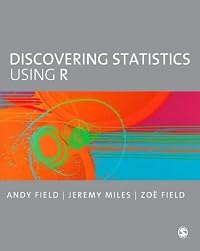
Andy Field draws on his experience of teaching advanced statistics to extend existing SPSS Windows texts to a higher level. He covers ANOVA, MANOVA, logistic regression, comparing means tests and factor analysis.Tags
Recommendations





Member Reviews
Although I would not read this book for fun, it is immensely useful to a postgraduate student in the social sciences who did not take maths A-level. Without it, I would totally at sea with quantitative analysis. It is helpful, comprehensible, and cheering enough that trying to understand chi-square doesn't make you lose the will to live. I've referred to it frequently in the past two years of study and will continue to do so. Thank you, Mr. Field!
I'm deducting a star because it's so heavy. Cycling with this book in your bag is exhausting.
I'm deducting a star because it's so heavy. Cycling with this book in your bag is exhausting.
It’s hard to know where to start with this textbook, primarily because of how strange I found it to be. As a textbook, I think it served its purpose(s) relatively well. In addition to familiarizing the reader with the myriad functions of SPSS and how to best exploit them, the author also does a good job of explaining some of the more abstract theoretical underpinnings of regression models which might be more advanced than what you would find in a standard stats text. I found this supplemental material especially helpful since SPSS is actually pretty intuitive if you’re generally familiar with computer software and how to navigate menus/find things, etc.
On the other hand, there were several aspects of this book that I found extremely show more disconcerting, starting first and foremost with the author’s disturbing and often inappropriate sense of humor. At times, it was like using a textbook written by Beavis and Butthead. He likes to use examples involving sex (the act, not the gender), reproductive functions, flatulence, and other generally asinine topics which I would more likely expect an adolescent male to make use of than a professional statistician. Also, the formatting of the book’s content was very off-putting, with lots of little box inserts which would be more appropriate in a textbook for 7th graders than graduate students: “Cramming Sam’s Tips” and “Jane Superbrain.” The presentation was actually pretty condescending. Explain analysis of variance to me. You don’t need to supplement it with graphics of some dude with devil horns and a ripped t-shirt giving me a “tip” in order to make it interesting or engaging. (Yes, there really is a regular character in the book – I say “character” because it’s a freaking cartoon – with spiky hair, devil horns, and a ripped t-shirt with a skull on the front. I couldn’t make this stuff up if I tried).
At the end of the day, I’d say I got what I needed out of this book, but I doubt I’d recommend it. If Mr. Field could dispense with the cartoons and the sophomoric (often mildly offensive) jokes, and just focus on the statistical theory and software advice, I’d be far more enthusiastic. show less
On the other hand, there were several aspects of this book that I found extremely show more disconcerting, starting first and foremost with the author’s disturbing and often inappropriate sense of humor. At times, it was like using a textbook written by Beavis and Butthead. He likes to use examples involving sex (the act, not the gender), reproductive functions, flatulence, and other generally asinine topics which I would more likely expect an adolescent male to make use of than a professional statistician. Also, the formatting of the book’s content was very off-putting, with lots of little box inserts which would be more appropriate in a textbook for 7th graders than graduate students: “Cramming Sam’s Tips” and “Jane Superbrain.” The presentation was actually pretty condescending. Explain analysis of variance to me. You don’t need to supplement it with graphics of some dude with devil horns and a ripped t-shirt giving me a “tip” in order to make it interesting or engaging. (Yes, there really is a regular character in the book – I say “character” because it’s a freaking cartoon – with spiky hair, devil horns, and a ripped t-shirt with a skull on the front. I couldn’t make this stuff up if I tried).
At the end of the day, I’d say I got what I needed out of this book, but I doubt I’d recommend it. If Mr. Field could dispense with the cartoons and the sophomoric (often mildly offensive) jokes, and just focus on the statistical theory and software advice, I’d be far more enthusiastic. show less
This should be the standard text for every statistics course. Andy Field takes a difficult and constantly misunderstood subject and explains it in a way that not only demystifies but actually entertains.
No really.
Come back, I'm not mad.
No really.
Come back, I'm not mad.
Comprehensive, yes, but for me the attempt at coverage came at the expense of clarity, and therefore utility.
Well written and easy to use. Excellent table of contents which provides guidance to exactly the section you need. Excellent index as well.
This book helps a lot with understanding (or at least trying to understand) SPSS.
The explanations used in the book are quite clear.
The explanations used in the book are quite clear.
Thick but very readable intro that gets into details too.
Members
- Recently Added By
Author Information

9 Works 773 Members
Awards and Honors
Series

Common Knowledge
- Canonical title
- Discovering Statistics Using SPSS
Classifications
Statistics
- Members
- 333
- Popularity
- 95,373
- Reviews
- 10
- Rating
- (4.06)
- Languages
- English, Portuguese
- Media
- Paper, Ebook
- ISBNs
- 15
- ASINs
- 1