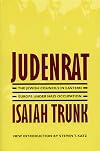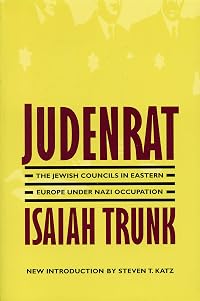
Judenrat : the Jewish councils in Eastern Europe under Nazi occupation
by Isaiah Trunk
On This Page
Description
During World War II, more than five million Jews lived under Nazi rule in Eastern Europe. In occupied Poland, the Baltic countries, Byelorussia, and Ukraine, they were stripped of property and "resettled" in ghettos. The German authorities established in each ghetto a Jewish Council, or Judenrat, to maintain minimal living standards. The Judenrat was required to carry out Nazi directives against other Jews, to supply forced labor, and eventually to cooperate in the Final Solution. Did the show more Jewish leaders of the ghettos, who were also victims, assist their murderers? If cooperation with the Nazi oppressors was morally defensible during the first stage in organizing the ghettos, what about later, when deportations to death camps began? Trunk analyzes situations where the Councils and ghetto police were forced to send their own communities to death. Some Council members chose suicide rather than supply lists to the Nazis; others used delaying tactics. Some handed over the lists. Some joined their families in the gas chamber. In assessing guilt and innocence, Trunk never allows the reader to forget that the impossible choices facing the Jewish leaders were created by the Nazis. show lessTags
Recommendations























Member Reviews
Steven Katz, Director of the Elie Wiesel Center for Judaic Studies at Boston University, has chosen to discuss Isaiah Trunk’s Judenrat: The Jewish Councils in Eastern Europe under Nazi Occupation , on FiveBooks (http://five-books.com) on his list of essential reading on The Holocaust, saying that:
“…After the war there was tremendous debate about the role of the Jewish councils in the ghettos, about how they acted, about the morality of some of them. So this subject is at the very centre of the study of the Holocaust. Isaiah Trunk, who is a survivor, undertook a study of the various Jewish councils that ran the ghettos and investigated the question of collaboration and of cowardice, of heroism, of support for resistance or lack of show more support. The bottom line of Trunk’s evaluation is that their behaviour really made no difference..."
The full interview is available here: http://thebrowser.com/books/interviews/steven-katz show less
“…After the war there was tremendous debate about the role of the Jewish councils in the ghettos, about how they acted, about the morality of some of them. So this subject is at the very centre of the study of the Holocaust. Isaiah Trunk, who is a survivor, undertook a study of the various Jewish councils that ran the ghettos and investigated the question of collaboration and of cowardice, of heroism, of support for resistance or lack of show more support. The bottom line of Trunk’s evaluation is that their behaviour really made no difference..."
The full interview is available here: http://thebrowser.com/books/interviews/steven-katz show less
Ratings
Members
- Recently Added By
Lists

Books recommended in the history category on FiveBooks.com
329 works; 4 members
Author Information
4 Works 171 Members
Isaiah Trunk became a senior research associate and chief archivist a the YIVO Institute for Jewish Research.
Awards and Honors
Awards
Common Knowledge
- Canonical title
- Judenrat : the Jewish councils in Eastern Europe under Nazi occupation
- Original title
- Judenrat : the Jewish councils in Eastern Europe under Nazi occupation
- Original publication date
- 1972
- Important events
- Holocaust
Classifications
- Genres
- Nonfiction, History, General Nonfiction, Religion & Spirituality
- DDC/MDS
- 940.53 — History & geography History of Europe History of Europe 1918- World War II, 1939-1945
- LCC
- KBM2612 .J83 .T78 — Law Jewish law Jewish law. Halakah Mishpat Ivri Constitutional law. Constitutional principles of the Jewish
- BISAC
Statistics
- Members
- 106
- Popularity
- 305,963
- Reviews
- 1
- Rating
- (5.00)
- Languages
- English, Hebrew
- Media
- Paper
- ISBNs
- 3
- ASINs
- 1