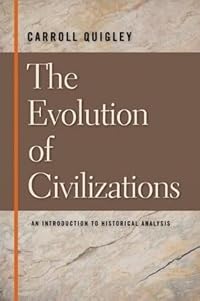
The Evolution of Civilizations
by Carroll Quigley
On This Page
Description
"The Evolution of Civilizations" is a comprehensive and perceptive look at the factors behind the rise and fall of civilisations. Quigley defines a civilisation as "a producing society with an instrument of expansion". A civilisation's decline is not inevitable but occurs when its instrument of expansion is transformed into an institution -- that is, when social arrangements that meet real social needs are transformed into social institutions serving their own purposes regardless of real show more social needs. show lessTags
Recommendations




























Member Reviews
Let me repeat a short part from the Conclusion of the book: "To know is not too demanding: it merely requires memory and time. But to understand is quite a different matter: it requires intellectual ability and training, a self-conscious awareness of what one is doing, experience in techniques of analysis and synthesis, and above all, perspective." I'm not a professional historian but I can see that Quigley had put a very honest intellectual effort in order help bring a perspective to the readers who want to understand the history of civilizations. He puts his framework into test by trying to explain the major phases of many civilizations and he seems to have achieved a consistent set of explanations. Moreover, he does this without show more being dry, the whole book is an exciting read and feels like listening to a good professor who seems to have a deep understanding and knowledge of his subject matter. Nevertheless, there are still many open questions regarding the evolution of civilizations, such as: is it really possible to explain and predict many events by focusing on weapons technology? Why the difference between civilizations between different times, etc?
The book has other drawbacks, especially the explanations about linguistics, but I think they can be tolerated, after all it was written about 50 years ago. We have learned a lot since then but it's a pity that we do not see more people like Quigley; people who can write really good books on big topics without being drown in details, and people who can defend a strong framework for analyzing grand structures throughout long periods of time. show less
The book has other drawbacks, especially the explanations about linguistics, but I think they can be tolerated, after all it was written about 50 years ago. We have learned a lot since then but it's a pity that we do not see more people like Quigley; people who can write really good books on big topics without being drown in details, and people who can defend a strong framework for analyzing grand structures throughout long periods of time. show less
Upon researching the Cold War I came across a recommendation to study Quigley's "Tragedy and Hope" as a means for understanding the mechanism that drove the Cold War. As I was researching that book before starting, it seemed that this book would make for a good introduction to Quigley's method of historical analysis.
Having just finished "The Evolution of Civilizations" it does feel like this to be the case. He uses the core concept of how societies are formed on the wave of an "instrument of expansion". From there, that instrument will create growth until it slows and eventually morphs into an instution. At that point the civilization begins to decay before it eventually falls to invasion. He describes this life cycle of a show more civilization, through seven stages, in depth and I think it is a useful model for examining ones over the course of history. It's all expansion and contraction, mannnn.
At times I was loving his process, especially with specific example subjects like the sport of football and the military structure of a calvary. He cites these in the early chapters and I was hoping for similar imagery throughout. Unfortunately I found much of it to be broad-brushed encapsulations of epochs, fitting ancient civilizations to his model, and attaching them to relatively mundane inventions in this technological age as the plow and Jethro Tull's (the agriculturalist) method of crop rotation. While certainly vital concepts to understand human history, I prefer Jacob Bronowski's imaginative and evocative depiction of innovation in the series "The Ascent of Man."
All that being said, I did enjoy the book a good deal. I'm buying what he's selling in terms of his method of historical analysis and am intrigued enough to want to go on to "Tragedy and Hope" - looking for more specific examples to better understand the 20th century. show less
Having just finished "The Evolution of Civilizations" it does feel like this to be the case. He uses the core concept of how societies are formed on the wave of an "instrument of expansion". From there, that instrument will create growth until it slows and eventually morphs into an instution. At that point the civilization begins to decay before it eventually falls to invasion. He describes this life cycle of a show more civilization, through seven stages, in depth and I think it is a useful model for examining ones over the course of history. It's all expansion and contraction, mannnn.
At times I was loving his process, especially with specific example subjects like the sport of football and the military structure of a calvary. He cites these in the early chapters and I was hoping for similar imagery throughout. Unfortunately I found much of it to be broad-brushed encapsulations of epochs, fitting ancient civilizations to his model, and attaching them to relatively mundane inventions in this technological age as the plow and Jethro Tull's (the agriculturalist) method of crop rotation. While certainly vital concepts to understand human history, I prefer Jacob Bronowski's imaginative and evocative depiction of innovation in the series "The Ascent of Man."
All that being said, I did enjoy the book a good deal. I'm buying what he's selling in terms of his method of historical analysis and am intrigued enough to want to go on to "Tragedy and Hope" - looking for more specific examples to better understand the 20th century. show less
This is an excellent introduction to the nature of civilizations and the reasons why they rise and fall. by analyzing five major civilizations: the Mesopotamian, Canaanite, Minoan, classical, and Western, he provides a breadth to his theories of development, rise and fall. Having recently been immersed in some of the great works of the classical period I found that this study was a useful adjunct to my reading.
4362. The Evolution of Civilizations An Introduction to Historical Analysis, by Carroll Quigley (read 20 Sep 2007) I read this book in two days, but the ideal approach to it would be to use it as a text--in the author's class. But since he died Jan.3, 1977, this is impossible. He puts forth a mass of material and sets out, with a pleasing air of know-it-allness, the answers to puzzling developments in history. That it is a book which should be read can scarcely be doubted, but that I got enough out of it to make my reading fruitful I confess is doubtful.
As huge as the name suggests.
Ratings
Members
- Recently Added By
Author Information

13+ Works 982 Members
Common Knowledge
- Canonical title
- The Evolution of Civilizations
- Original publication date
- 1961
Classifications
Statistics
- Members
- 268
- Popularity
- 120,165
- Reviews
- 5
- Rating
- (4.50)
- Languages
- English
- Media
- Paper
- ISBNs
- 3
- ASINs
- 4