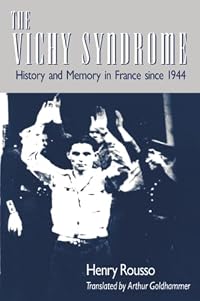
The Vichy Syndrome: History and Memory in France since 1944
by Henry Rousso
On This Page
Description
From the Liberation purges to the Barbie trial, France has struggled with the memory of the Vichy experience: a memory of defeat, occupation, and repression. In this provocative study, Henry Rousso examines how this proud nation--a nation where reality and myth commingle to confound understanding--has dealt with les années noires. Specifically, he studies what the French have chosen to remember--and to conceal.Tags
Recommendations


















Member Reviews
The Vichy Syndrome is a history of a history. The target period is 1940-1944 France, during the Occupation by the Germans. The French reaction during the time ranged from outright active collaboration with the Nazis, to resistance from within France, and membership in the the Free French armed forces mostly under the control of de Gaulle in England. Genuine treason thus abounded during the period. Who the traitors were depended strongly on which year the judgement was being made, but they often included your neighbors and relatives and not just some remote faceless abstractions.
These labels didn't go away with the Liberation, and they remained stubbornly affixed to French names. In particular, the man memorialized as the Hero of Verdun show more became also the man who surrendered France to the Nazis and governed what was left of it for them. Rousso in this book describes how the events that took place in the Occupation were depicted as the years went by - from 1944 to the late 1980s when this book was written. The history of the Occupation mutated. What was accepted as 'correct' depended on what year you were asking in, the age of the person being asked, and their politics. Rousso sets out to capture this and I think succeeds, if only roughly. He describes, too, generally who was doing the rewriting and how the rewrite served their current purposes. That the current story of the Occupation was still a factor in French politics 40 years later he affirms.
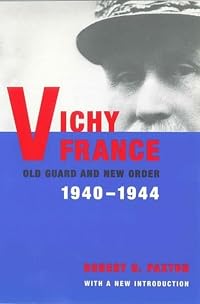
This instance of evolving stories is not at all unique. I think it is what always happens and it has changed how I value a particular narrative of particular events. I now look to see when it was written and how the author personally was situated with respect to the events. Rousso encouraged this with his description of French reception of the American historian Robert Paxton's book 'Vichy France: Old Guard and New Order'. Rousso notices that Paxton had no stake in the then-current French politics and thus had no reason to be embarrassed about particular actions or stands. Outsiders see things differently. show less
These labels didn't go away with the Liberation, and they remained stubbornly affixed to French names. In particular, the man memorialized as the Hero of Verdun show more became also the man who surrendered France to the Nazis and governed what was left of it for them. Rousso in this book describes how the events that took place in the Occupation were depicted as the years went by - from 1944 to the late 1980s when this book was written. The history of the Occupation mutated. What was accepted as 'correct' depended on what year you were asking in, the age of the person being asked, and their politics. Rousso sets out to capture this and I think succeeds, if only roughly. He describes, too, generally who was doing the rewriting and how the rewrite served their current purposes. That the current story of the Occupation was still a factor in French politics 40 years later he affirms.
This instance of evolving stories is not at all unique. I think it is what always happens and it has changed how I value a particular narrative of particular events. I now look to see when it was written and how the author personally was situated with respect to the events. Rousso encouraged this with his description of French reception of the American historian Robert Paxton's book 'Vichy France: Old Guard and New Order'. Rousso notices that Paxton had no stake in the then-current French politics and thus had no reason to be embarrassed about particular actions or stands. Outsiders see things differently. show less
Ratings
Members
- Recently Added By
Lists

Books Cited in Digging Up the Dead by Michael Kammen
183 works; 1 member
Author Information

20+ Works 231 Members
Henry Rousso is director of the Institut d'Histoire du Temps Present.
Some Editions
Common Knowledge
- Canonical title
- The Vichy Syndrome: History and Memory in France since 1944
- Important places
- France
- Important events
- World War II, German Occupation of France (1940 | 1944); French Resistance
Classifications
- Genres
- History, Nonfiction, General Nonfiction
- DDC/MDS
- 944.082 — History & geography History of Europe France and Monaco France Third republic 1870- Fourth Republic 1945-1958
- LCC
- DC397 .R7314 — History of Europe, Asia, Africa and Oceania France – Andorra – Monaco History of France Modern, 1515- 20th century 1940-1946
- BISAC
Statistics
- Members
- 101
- Popularity
- 318,794
- Reviews
- 1
- Rating
- (3.50)
- Languages
- English, French
- Media
- Paper
- ISBNs
- 6