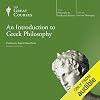
An Introduction to Greek Philosophy
by David Roochnik
The Great Courses: Philosophy and Intellectual History (4477), The Great Courses (4477)
On This Page
Description
More than 2,500 years later, the fundamental questions asked by the ancient Greeks continue to challenge, fascinate, and instruct us. Is reality stable and permanent or is it always changing? Are ethical values like justice and courage relative? What is justice? What is happiness? How shall we best live our lives? In this series of 24 lectures, Professor Roochnik invites you to join this eternal discussion. You'll study the development of Greek philosophy, meet its major thinkers, and show more explore the issues and ideas that concerned them, from the Pre-Socratic concerns with "Being" to the staggering contributions of Plato and Aristotle. Alfred North Whitehead, the great 20th-century British philosopher, said, "The safest general characterization of the European philosophical tradition is that it consists of a series of footnotes to Plato." In the Middle Ages, Aristotle was held in such high esteem that he was simply known as "the philosopher." In this course, you not only learn about Greek philosophy but, to some extent, how to do it. Professor Roochnik emphasizes that Greek philosophy is ultimately not about facts or answers but about the give-and-take of ideas. By joining the conversation, you will come away with a new appreciation for how Greek philosophy still heavily influences our view of life. show lessTags
Recommendations






















Member Reviews
Great review/intro to Greek philosophy. Well-organized and covering a decent amount of ground. Nothing new for anyone who knows the subject, but well told by a good teacher. Audible.
An Enlightened Dialogue
This course exposes the ideas of greek philosophers in a dialectic form. The thinkers are engaged in a dialogue, reacting from the ideas of his predecessors. The author examines the presocratic philosophers, Socrates, Plato and Aristotle in an understandable way and gives his insights about the many problems they posed. When exposing Socrates words, no distinction is made to adress the question about who is speaking (Socrates or Plato). The presupposition is that Socrates speaks. Plato and Aristotle works are presented as the culmination of greek wisdom. The sophist objections and thought are always mentioned. In the course they served as a bridge with modern concepts and thought. The work gives a clear exposition show more of greek philosophy. One will profit listening to it! show less
This course exposes the ideas of greek philosophers in a dialectic form. The thinkers are engaged in a dialogue, reacting from the ideas of his predecessors. The author examines the presocratic philosophers, Socrates, Plato and Aristotle in an understandable way and gives his insights about the many problems they posed. When exposing Socrates words, no distinction is made to adress the question about who is speaking (Socrates or Plato). The presupposition is that Socrates speaks. Plato and Aristotle works are presented as the culmination of greek wisdom. The sophist objections and thought are always mentioned. In the course they served as a bridge with modern concepts and thought. The work gives a clear exposition show more of greek philosophy. One will profit listening to it! show less
Course Lecture Titles
1. A Dialectical Approach to Greek Philosophy
2. From Myth to Philosophy—Hesiod and Thales
3. The Milesians and the Quest for Being
4. The Great Intrusion—Heraclitus
5. Parmenides—The Champion of Being
6. Reconciling Heraclitus and Parmenides
7. The Sophists—Protagoras, the First "Humanist"
8. Socrates
9. An Introduction to Plato's Dialogues
10. Plato versus the Sophists, I
11. Plato versus the Sophists, II
12. Plato's Forms, I
13. Plato's Forms, II
14. Plato versus the Presocratics
15. The Republic—The Political Implications of the Forms
16. Final Reflections on Plato
17. Aristotle—"The" Philosopher
18. Aristotle's Physics—What is Nature?
19. Aristotle's Physics—The Four Causes
20. Why Plants Have show more Souls
21. Aristotle's Hierarchical Cosmos
22. Aristotle's Teleological Politics
23. Aristotle's Teleological Ethics
24. The Philosophical Life show less
1. A Dialectical Approach to Greek Philosophy
2. From Myth to Philosophy—Hesiod and Thales
3. The Milesians and the Quest for Being
4. The Great Intrusion—Heraclitus
5. Parmenides—The Champion of Being
6. Reconciling Heraclitus and Parmenides
7. The Sophists—Protagoras, the First "Humanist"
8. Socrates
9. An Introduction to Plato's Dialogues
10. Plato versus the Sophists, I
11. Plato versus the Sophists, II
12. Plato's Forms, I
13. Plato's Forms, II
14. Plato versus the Presocratics
15. The Republic—The Political Implications of the Forms
16. Final Reflections on Plato
17. Aristotle—"The" Philosopher
18. Aristotle's Physics—What is Nature?
19. Aristotle's Physics—The Four Causes
20. Why Plants Have show more Souls
21. Aristotle's Hierarchical Cosmos
22. Aristotle's Teleological Politics
23. Aristotle's Teleological Ethics
24. The Philosophical Life show less
Ratings
Members
- Recently Added By
Author Information

12+ Works 228 Members
David Roochnik is the Maria Stata Professor of Classical Greek Studies at Boston University, and is the recipient of numerous awards for excellence in teaching. His book's include Retrieving Aristotle in an Age of Crisis (2013), Retrieving the Ancients: An Introduction to Greek Philosophy (Blackwell, 2004), Beautiful City: The Dialectical show more Character of Plato's Republic (2003), Art and Wisdom: Plato's Understanding of Techne (1996), and The Tragedy of Reason: Toward a Platonic Conception of Logos (1991). show less
Series


Common Knowledge
- Canonical title
- An Introduction to Greek Philosophy
Classifications
Statistics
- Members
- 55
- Popularity
- 556,154
- Reviews
- 4
- Rating
- (3.94)
- Languages
- English
- Media
- Paper, Audiobook, Ebook
- ISBNs
- 6
- ASINs
- 2