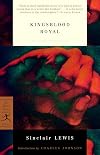
Kingsblood Royal
by Sinclair Lewis
On This Page
Description
A neglected tour de force by the first American to win the Nobel Prize in literature, Kingsblood Royal is a stirring and wickedly funny portrait of a man who resigns from the white race. When Neil Kingsblood a typical middle-American banker with a comfortable life makes the shocking discovery that he has African-American blood, the odyssey that ensues creates an unforgettable portrayal of two Americas, one black, one white. As timely as when it was first published in 1947, one need only open show more today's newspaper to see the same issues passionately being discussed between blacks and whites that we find in Kingsblood Royal, says Charles Johnson. Perhaps only now can we fully appreciate Sinclair Lewis's astonishing achievement. show lessTags
Recommendations


















Member Reviews
A late novel by the 1930 Nobel Laureate, exploring the dangers of genealogical research. Wounded whilst serving as an infantry officer during World War II, Neil Kingsblood returns home to his lilywhite middle-class family and successful banking career in Minnesota. Since he’s unable to play football and tennis any more, his father suggests that he could devote some of his spare time to looking into family history. He does so, and discovers the alarming fact that one of his eighteenth century great-great-great grandfathers, a voyageur on the frontier, was a Black man from Martinique. Neil is 1/32 Black, it seems (and an equal proportion of Chippewa, but that doesn’t seem to matter). In the USA of the 1940s, this is potentially show more explosive information, even in relatively egalitarian Minnesota.
Lewis has fun making the politically-naive Neil think through his new situation and question most of the assumptions his life has been built on. Being a moral kind of person, he wants to do the right thing, but it’s far from clear what that might be. He ventures (for the first time in his life) into the Wrong Side of Town to talk to Black people and find out what life is like for them, and he starts to pay attention to the vicious racist things some of his White friends and neighbours are saying, until he is finally provoked into “coming out” as Black, with predictably disastrous consequences.
This isn’t one of Lewis’s best problem-novels — the plot is creaky and predictable and there are clumsy shortcuts. People spend far too much time telling us stuff Lewis wants us to know by talking at Neil. But that is rather the point of the book — it’s not whether or not Neil decides to make a Prince and the pauper life-swap, it’s all about the research Lewis did into the large and small ways the lives of Black people in the USA in the 1940s were being made unnecessarily difficult without them having any legal means of recourse to prevent it, and about the crazy arguments white racists were making to justify this state of affairs. Lewis is magnificent when he quotes the testimony of his Black characters, and when he allows his white racists to expose the inconsistencies and blatant self-interest in their thinking.
It would be nice to be able to say that this is a book we don’t need to read any more, other than as a historical curiosity. But… show less
Lewis has fun making the politically-naive Neil think through his new situation and question most of the assumptions his life has been built on. Being a moral kind of person, he wants to do the right thing, but it’s far from clear what that might be. He ventures (for the first time in his life) into the Wrong Side of Town to talk to Black people and find out what life is like for them, and he starts to pay attention to the vicious racist things some of his White friends and neighbours are saying, until he is finally provoked into “coming out” as Black, with predictably disastrous consequences.
This isn’t one of Lewis’s best problem-novels — the plot is creaky and predictable and there are clumsy shortcuts. People spend far too much time telling us stuff Lewis wants us to know by talking at Neil. But that is rather the point of the book — it’s not whether or not Neil decides to make a Prince and the pauper life-swap, it’s all about the research Lewis did into the large and small ways the lives of Black people in the USA in the 1940s were being made unnecessarily difficult without them having any legal means of recourse to prevent it, and about the crazy arguments white racists were making to justify this state of affairs. Lewis is magnificent when he quotes the testimony of his Black characters, and when he allows his white racists to expose the inconsistencies and blatant self-interest in their thinking.
It would be nice to be able to say that this is a book we don’t need to read any more, other than as a historical curiosity. But… show less
When people are promoting books about anti-racism, I hope this one starts to get more attention. Even though it is set in the 1940s, it is still highly relevant to today. The story centers around Neil who goes searching for royal ancestry and finds something a bit more commonplace--a dark skinned ancestor. This revelation upends Neil's life as well as that of his family when it becomes public and former friends and colleagues suddenly object to his presence simply because they believe his race has changed. What I like best about this book is even the White "heroes" are shown to have prejudices and missteps, even when they are doing the right thing. Neil's wife Vestal stays be his side even when family and friends encourage her to show more leave...but still harbors fairly racist views. This inherent contradiction felt real to the people I know in life who can have both racist and anti-racist views and beliefs at the same time and have to consciously reject the racist stereotypes fed to us by society and the media. Definitely worth a read. show less
While not entirely successful as a narrative, Kingsblood Royal is fascinating as a timely meditation on race in America. Though many things have changed, some for the better, the sad reality is that many elements of this book read as if they could have been written in the quite recent past. Neil Kingsblood suffers dismissal from his bank job and attitudes ranging from rude to terroristic in his all-white neighborhood after "coming out" as part African American. There is now de jure protection against restrictive neighborhood racial covenants and discrimination in hiring, but we know that in practice many African Americans are not truly protected by these legal safeguards.
Throughout the book Lewis uses high satire to get his point show more across, and many of the actions and thoughts of the characters demonstrate these extremes of satirical depiction. But the awakening that Neil comes to over the course of the book is still quite interesting, despite my doubts about its plausibility. Lewis brings a sensitive racial consciousness to the novel and the character of Neil, but in the end it is more a novel about white privilege and its unraveling than a truly genuine depiction of the African American community in the 1940s. Still, I was quite astonished by the boldness of this book for its time period, daring to speak aloud about the racism that still haunts this country even in the supposedly enlightened north. Lewis's craft elevates what sometimes shaded over into a polemic into a touching and nuanced portrayal of one man's growing self-awareness. show less
Throughout the book Lewis uses high satire to get his point show more across, and many of the actions and thoughts of the characters demonstrate these extremes of satirical depiction. But the awakening that Neil comes to over the course of the book is still quite interesting, despite my doubts about its plausibility. Lewis brings a sensitive racial consciousness to the novel and the character of Neil, but in the end it is more a novel about white privilege and its unraveling than a truly genuine depiction of the African American community in the 1940s. Still, I was quite astonished by the boldness of this book for its time period, daring to speak aloud about the racism that still haunts this country even in the supposedly enlightened north. Lewis's craft elevates what sometimes shaded over into a polemic into a touching and nuanced portrayal of one man's growing self-awareness. show less
I can't recall the last time I read a farce or satire that slapped so hard, right from the start. I enjoyed the book to a certain extent, and rolled my eyes numerous times, but the lampooning here turns it up to eleven. I do think it went on too long and things were laid on very thick. The points would have been made and this would have been quite serviceable at a shorter length. It got a little boring.
This was published in 1947 and I think it is set in 1944 when it opens. Neil Kingsblood works at a bank following a term in the service where he was badly injured fighting in Italy. The fictional town of Grand Republic Michigan where he resides is a war industry town and although I wouldn't say Kingsblood is regarded as a local hero, he show more is referred to with respect as "Captain Kingsblood". He is a handsome man admired for who he is, and he has married above his class (before WW2) in what seems to be a very class conscious environment. His wife and four year old daughter benefit with him from Kingsblood's well-off in-laws and they live in a neighborhood that he would not be able to afford on his bank teller salary. He is not long back from the war and is reasonably ambitious.
Kingsblood does some family history research at the prompting of his father to find the "king's blood" connection to Henry VIII. They could be the legitimate royal family of England maybe! Capt Kingsblood instead discovers when given the name of a several times great supposed ancestor, that he is 1/32 black and at least that amount of Chippewa Indian. Kingsblood has some perhaps typical for the time racial views - all men are equal but some are more equal than others comes to my mind, to riff on 'Animal Farm'. He views blacks as inferior whereas he may have had some more liberal views beforehand. Still, there are all sorts of hierarchies of this white blood is better than that white blood, and here he was thinking he had the good white blood although there is that French bit supposedly, and now he is tainted with black. Indian blood he could live with, but black blood throws him into despair. The historian points out to him that in many states just "one drop" of negro blood renders him black. (I felt at times like I was watching an old silent movie with all the overacting going on)
Well, the story is a satire in the extreme. Just about every form of class and racial prejudice and crazy ideas that you can think of gets a sendup here. The story starts with the high class New Yorkers looking down on the hicks who live in Michigan. They contrast grain elevators with their glorious Empire State. Nothing is spared.
As I said at the beginning I think this goes on too long. The point is gotten across well but I would have slimmed this novel down by a 4th, and the author is really teetering with the absurd finale. Still, this all "works" in a way, because it hits all kinds of truth buttons. The novel is at it's best when it shows the reader how black people live and what they must live with in the supposedly unsegregated North. There are some poignant moments here. 1947 is well before my time so I can't know how it was then, but we have all seen class and racial prejudice, and we see it everyday with a U.S. President who was a white mother and a black father, as well as the class and racial strife across America.
Interesting read, but I wouldn't really recommend it. An odd book. This didn't make me a Sinclair Lewis fan, but I am glad to have sampled him. show less
This was published in 1947 and I think it is set in 1944 when it opens. Neil Kingsblood works at a bank following a term in the service where he was badly injured fighting in Italy. The fictional town of Grand Republic Michigan where he resides is a war industry town and although I wouldn't say Kingsblood is regarded as a local hero, he show more is referred to with respect as "Captain Kingsblood". He is a handsome man admired for who he is, and he has married above his class (before WW2) in what seems to be a very class conscious environment. His wife and four year old daughter benefit with him from Kingsblood's well-off in-laws and they live in a neighborhood that he would not be able to afford on his bank teller salary. He is not long back from the war and is reasonably ambitious.
Kingsblood does some family history research at the prompting of his father to find the "king's blood" connection to Henry VIII. They could be the legitimate royal family of England maybe! Capt Kingsblood instead discovers when given the name of a several times great supposed ancestor, that he is 1/32 black and at least that amount of Chippewa Indian. Kingsblood has some perhaps typical for the time racial views - all men are equal but some are more equal than others comes to my mind, to riff on 'Animal Farm'. He views blacks as inferior whereas he may have had some more liberal views beforehand. Still, there are all sorts of hierarchies of this white blood is better than that white blood, and here he was thinking he had the good white blood although there is that French bit supposedly, and now he is tainted with black. Indian blood he could live with, but black blood throws him into despair. The historian points out to him that in many states just "one drop" of negro blood renders him black. (I felt at times like I was watching an old silent movie with all the overacting going on)
Well, the story is a satire in the extreme. Just about every form of class and racial prejudice and crazy ideas that you can think of gets a sendup here. The story starts with the high class New Yorkers looking down on the hicks who live in Michigan. They contrast grain elevators with their glorious Empire State. Nothing is spared.
As I said at the beginning I think this goes on too long. The point is gotten across well but I would have slimmed this novel down by a 4th, and the author is really teetering with the absurd finale. Still, this all "works" in a way, because it hits all kinds of truth buttons. The novel is at it's best when it shows the reader how black people live and what they must live with in the supposedly unsegregated North. There are some poignant moments here. 1947 is well before my time so I can't know how it was then, but we have all seen class and racial prejudice, and we see it everyday with a U.S. President who was a white mother and a black father, as well as the class and racial strife across America.
Interesting read, but I wouldn't really recommend it. An odd book. This didn't make me a Sinclair Lewis fan, but I am glad to have sampled him. show less
Neil Kingsblood is a banker in a small city in Minnesota. He lives a Dick and Jane life in the suburbs with his wife, Vestal, and his 5-year old daughter, Elizabeth, known as Biddy. Neil's father gets him interested in some old family lore about how they might be related to royalty and convinces Neil that he should do some geneological research. What Neil learns is that he had a great, great, great grandfather who was a negro and who married an Chippewa Indian. Thus, Neil, had a drop of "tainted" negro blood, making him "tainted" as well.
What to do? Should he tell Vestal? His father? His boss and co-workers? It doesn't help that Neil lives in a horrifically racist society. More racist by ignorance than direct intention. So, first of show more all, he decides to befriend some negroes and try to learn a bit more about them. It turns out, that negroes are mostly normal people, just like the rest of us. This revelation doesn't help Neil all that much. He still needs to know coping mechanisms for dealing with the racism of others. He still worries about his marriage and his "tainted" child. After all, if no one knows about his tainted blood, what's the harm?
But, he can't help himself. He admits to one person and another about his taint. Naturally, no individual person is prejudiced, but, you know, "other" people will begin to complain, and that will be bad for business, or lower property values, or whatever.
It's weird to read this stuff thinking that we've come a long way in the last 70 years, then realize that we just elected a President who is totally ignorant about the basics of government, ethics, the Constitution, Christianity, you name it. But, he knows how to play on people's race fears. For the first time since 1948, it became "safe" for the Klu Klux Klan to publicly endorse a Presidential Candidate. Yeah, we're so over racism in the U.S. ["Oh, but it's not me, but we do have to worry about our business model, and ...."] show less
What to do? Should he tell Vestal? His father? His boss and co-workers? It doesn't help that Neil lives in a horrifically racist society. More racist by ignorance than direct intention. So, first of show more all, he decides to befriend some negroes and try to learn a bit more about them. It turns out, that negroes are mostly normal people, just like the rest of us. This revelation doesn't help Neil all that much. He still needs to know coping mechanisms for dealing with the racism of others. He still worries about his marriage and his "tainted" child. After all, if no one knows about his tainted blood, what's the harm?
But, he can't help himself. He admits to one person and another about his taint. Naturally, no individual person is prejudiced, but, you know, "other" people will begin to complain, and that will be bad for business, or lower property values, or whatever.
It's weird to read this stuff thinking that we've come a long way in the last 70 years, then realize that we just elected a President who is totally ignorant about the basics of government, ethics, the Constitution, Christianity, you name it. But, he knows how to play on people's race fears. For the first time since 1948, it became "safe" for the Klu Klux Klan to publicly endorse a Presidential Candidate. Yeah, we're so over racism in the U.S. ["Oh, but it's not me, but we do have to worry about our business model, and ...."] show less
This book...is both amusing and infuriating. Amusing because of Lewis's humorously ironic storytelling, and infuriating because of the injustices suffered by some of the characters in the book. Of course that's a given, with it being about racism.
A really interesting look into the times and issues.
A really interesting look into the times and issues.
I had an English teacher in high school who spoke highly of this book in the late 60's, explaining that it was far ahead of its time in understanding race relations and anticipating their deterioration. I read it years afterward and agreed with her entirely. Lewis, who understood and portrayed the shallow materialism of American culture, also had insights into racial problems, which are sharply dramatized in Kingsblood Royal. There is fine use of irony throughout, starting from the title.
Members
- Recently Added By
Lists

Favorite Sinclair Lewis Novels
10 works; 3 members

Publisher's Weekly Bestsellers - Part II - 1940 - 1979
355 works; 5 members
Author Information

127+ Works 23,012 Members
Harry Sinclair Lewis was born on February 7, 1885 in Minnesota. He was an American novelist, short-story writer, and playwright. In 1930, he became the first writer from the United States to receive the Nobel Prize in Literature. A lonely child, Lewis immersed himself in reading and diary writing. While studying at Yale University and living in show more writer Upton Sinclair's communal house, he wrote for Yale Literary Magazine and helped to build the Panama Canal. After graduating from Yale in 1908, Lewis began writing fiction, publishing 22 novels by the end of his career. His early works, while often praised by literary critics, did not reach popularity but with Main Street (1920), Babbitt (1922), Arrowsmith (1925), Elmer Gantry (1927), and Dodsworth (1929), Sinclair Lewis achieved fame as a writer. His style of choice was satire; he explored American small-town life, conformity, hypocrisy, and materialism. Sinclair Lewis was married and divorced twice. As his career wound down, he spent his later life in Europe and died in Rome on January 10, 1951. (Bowker Author Biography) show less
Awards and Honors
Series
Belongs to Publisher Series
Work Relationships
Is contained in
Contains
Common Knowledge
- Canonical title
- Kingsblood Royal
- Original publication date
- 1947
- People/Characters
- Neil Kingsblood; Vestal Kingsblood; Elizabeth Kingsblood (Biddy)
- Important places
- Minnesota, USA
- Important events
- Great Depression
- Dedication
- To S.S.S., who first heard this story.
- First words
- Mr. Blingham, and may he fry in his own cooking oil, was assistant treasurer of the Flaver-Saver Company.
- Last words
- (Click to show. Warning: May contain spoilers.)"We're moving," said Vestal.
Classifications
Statistics
- Members
- 624
- Popularity
- 46,735
- Reviews
- 12
- Rating
- (3.45)
- Languages
- 8 — Czech, English, German, Hungarian, Norwegian (Bokmål), Portuguese (Portugal), Russian, Swedish
- Media
- Paper, Ebook
- ISBNs
- 9
- ASINs
- 28