Back of the Bus
by Aaron Reynolds
On This Page
Description
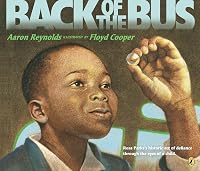
From the back of the bus, an African American child watches the arrest of Rosa Parks.Tags
Recommendations
Member Reviews
"Back of the Bus" tells the story of Rosa Parks refusing to move to the back of the bus, but from the perspective of a young boy who is confused about what is going on. I really liked the perspective this story took. I have heard and read about the story of Rosa Parks many times, but never from the perspective of a young boy. In a part of the story, he says "Somebody's talkin' back, but I can't hear the words" and another part he asks his mother if they are doing something wrong. It makes the reader feel as if they were there as a young child trying to grasp the seriousness of what it is happening. Also, I really enjoyed the language of the story; the author used similes to help the reader paint a picture in their mind of the feelings show more and ideas in the story. For example, the boy describes Rosa Parks as she remains in her seat by saying "her eyes all fierce like a lightnin' storm." This imagery helps to capture how strong and powerful Rosa looked and felt sitting in her seat. Overall, I think the theme is segregation, yet hope for change of that segregation. At the end of the story, the boy holds up his marble that has been hiding in his pocket and allows it to shine in the light, which resembles the way Rosa Parks is shining of strength and no longer hides her feelings from the back of the bus. show less
This book is a beautiful depiction of Rosa Parks' act of defiance in 1955. From the eyes of a young African American boy sitting in the back of the bus, Aaron Reynolds tells the story of just what happened that day and gives a unique view on such a crucial event in the Civil Rights Movement. This is a wonderful example of historical fiction and a great book for children to read through and discuss with an adult, as it gives them a way to relate to this piece of history, whatever their race.
Uses: I would use this in a Civil Rights unit to give my students a way to personally relate to what we are learning.
Medium: it doesn't say, but it looks like pastels
Uses: I would use this in a Civil Rights unit to give my students a way to personally relate to what we are learning.
Medium: it doesn't say, but it looks like pastels
I thought that this was a great book for children! The author dresses the characters in the clothing that would be worn in 1955 in order to make sure the readers are aware of the time period. I think that this is told from a perspective that children would understand. Also, the author uses words and vocabulary that children would use. For example, on page 22 when Mrs. Parks gets arrested Reynolds refers to handcuffs as "them metal things." This book is full of descriptive water colored painting that can relate to the words in the book. The message that was portrayed was very clear in the book. Even though the little boys mother told him, tomorrow they will forget about this, he knew that this was the start of history. The child knew show more that the future was bright and that better things would be happening thanks to the strength of African American heros such as Rosa Parks. show less
Standing up for your rights can resolve more problems than hiding in the background. This book had a very powerful message, whether the main character realized it or not. I liked this story for several reasons. Structurally, the writing had a nice flow, almost as if reading a poem. The language used was relevant to the time period, as well as sounding like it was spoken from a child. When the boy referred to the “big ol’ bus, or compared the people on the bus to crammed lima beans, a certain voice was set. The voice was innocent, and imaginative. I also liked the common recurring reference of a “strong chin.” This reference appeared several times throughout the book, and each time was as significant as the last. The boy learned show more a lesson at the end of the story about his rights, but took that lesson and connected it back to his marble. Children who read can make their own inferences about the lesson being taught, without being formally told. show less
Most children know who Rosa Parks is and her inspirational story. Back of the Bus is told from the perspective of a young boy who was sitting at the back of the bus with his mother the day Rosa Parks gets arrested for refusing to give up her seat. The boy notices Rosa Parks's expression and describes it at "fierce". He also describes her as having "lightnin' -storm eyes" and having on her "strong chin". At the end of the story the boy's mother holds him telling him everything will be alright and that everything will be forgotten tomorrow but the boy knows that is not true. I love how the boy compares his mother to Rosa Parks, describing their similar qualities. He describes his mother as "having a strong chin" as well. He also uses show more phrases to describe emotions. The boy has a marble which is used as a metaphor. He is playing with but hides it once he realizes something is wrong. At the end of the story he takes the marble back out and holds it up to the sun and says "it's smilin', I think, 'cuz it ain't gotta hide no more." show less
From the minute I opened this book, before reading a single word I noticed the magnificent, extraordinary illustrations jumping right into the setting of 1955 during the civil rights movement. The story is written so perfectly for children as it teaches students about a significant event in history, but they do it through the eyes of a child. Instead of just telling the story of Rosa Parks, they put another perspective in, a by-stander to the whole situation who may or may not have been there, but that is up for the reader to decide. This allows for children to picture themselves there at that moment in time when Rosa Parks would not give up her seat.
Back of the Bus Is the story of Rosa Parks told from the perspective of a child. The boy and his mom ride on the back of the bus every day. On December 1, 1955 they load the back of the bus like they do everyday. The boy plays with his marble and the movement from the bus rolls it forward to the front. Ms. Rosa picks it up and smiles at him and rolls it back, it seems like a normal day until the bus fills up with people. Then the commotion starts, Ms. Rosa's eyes are "fierce like she belongs up there." The police eventually come and arrest Ms. Parks for not giving her seat up to a white rider. Rosa started a movement to change the rights for African American's and her act of bravery even influenced the young boy. The boy says "don't show more know why, but instead of feelin' all shaky, I feel a little strong." My family loved this book we discussed standing up for what is right even if you get in trouble. My daughter said that she wanted to be a "fierce" women like Rosa Parks. show less
Members
- Recently Added By
Lists

Picture Books About Civil Rights
51 works; 4 members
Author Information

40 Works 9,192 Members
Awards and Honors
Awards
Distinctions
Common Knowledge
- Original publication date
- 2010-01-07
- People/Characters
- Rosa Parks
- Important places
- Alabama, USA
Classifications
Statistics
- Members
- 339
- Popularity
- 93,491
- Reviews
- 76
- Rating
- (4.19)
- Languages
- English
- Media
- Paper, Ebook
- ISBNs
- 9
- ASINs
- 1