The Literary Conference
by César Aira
On This Page
Description
Cesar is a translator who's fallen on very hard times due to the global economic downturn; he is also an author, and a mad scientist hell-bent on world domination. On a visit to the beach he intuitively solves an ancient riddle, finds a pirate's treasure, and becomes a very wealthy man. Even so, Cesar's bid for world domination comes first and so he attends a literary conference to be near the man whose clone he hopes will lead an army to victory: the world-renowned Mexican author, Carlos show more Fuentes. A comic science fiction fantasy. show lessTags
Recommendations
































Member Reviews
"Under my interior magnifying glass, or inside it, each thought takes on the figure of a clone in its rhetorical anamorphosis: an overdetermined identity." - pg. 20
"The lights were very low, we were practically in the dark. Or rather, the beams and pulses of the colored lights allowed us to see what was going on but not reconstruct it in our minds. This is the astute discovery such night spots have made. Their lighting arrangements reproduce subjectivity thereby nullifying it, a process further assisted by the alcohol and the noise." - pg. 46
In a literary floor routine worthy of an Olympic medal Aira contemplates the nature of subjectivity, the relationship between the reader and the author, the value and flow of intellectual ideas as show more Lyotard-ian self-replicating viruses, the limits of perception, even the nature of reality itself wrapped inside a brilliant and entertaining package of allusions to Frankenstein, giant B-Movie monsters, and secret pirate's treasure. HE DOES THIS IN 68 PAGES.
In a very self-conscious departure from Aira's usual third person POV, and in the only way he ever could write in first person, this novel revels in the subjective trappings of its perspective, doubling back on it, justifying it, getting completely tangled like an entire film made between Hugh Grant's stuttering from one idea to another.
"At least I had the good sense not to mix my drinks, but rum is deceptive, always so smooth, so calming, like a perennial cause with no effect, until the effect shows itself, and then you realize the effect had been there from the beginning, even before there began to be a cause." - pg. 42
Themes in this novel scale and like fractals in the natural world and it all feels like magic to me as a reader. How did Aira pull off such virtuosity in such bold concision?
His interests, playfulness, and intelligence have quickly won me over. I'll be reading a lot more. show less
"The lights were very low, we were practically in the dark. Or rather, the beams and pulses of the colored lights allowed us to see what was going on but not reconstruct it in our minds. This is the astute discovery such night spots have made. Their lighting arrangements reproduce subjectivity thereby nullifying it, a process further assisted by the alcohol and the noise." - pg. 46
In a literary floor routine worthy of an Olympic medal Aira contemplates the nature of subjectivity, the relationship between the reader and the author, the value and flow of intellectual ideas as show more Lyotard-ian self-replicating viruses, the limits of perception, even the nature of reality itself wrapped inside a brilliant and entertaining package of allusions to Frankenstein, giant B-Movie monsters, and secret pirate's treasure. HE DOES THIS IN 68 PAGES.
In a very self-conscious departure from Aira's usual third person POV, and in the only way he ever could write in first person, this novel revels in the subjective trappings of its perspective, doubling back on it, justifying it, getting completely tangled like an entire film made between Hugh Grant's stuttering from one idea to another.
"At least I had the good sense not to mix my drinks, but rum is deceptive, always so smooth, so calming, like a perennial cause with no effect, until the effect shows itself, and then you realize the effect had been there from the beginning, even before there began to be a cause." - pg. 42
Themes in this novel scale and like fractals in the natural world and it all feels like magic to me as a reader. How did Aira pull off such virtuosity in such bold concision?
His interests, playfulness, and intelligence have quickly won me over. I'll be reading a lot more. show less
"Under my interior magnifying glass, or inside it, each thought takes on the figure of a clone in its rhetorical anamorphosis: an overdetermined identity." - pg. 20
"The lights were very low, we were practically in the dark. Or rather, the beams and pulses of the colored lights allowed us to see what was going on but not reconstruct it in our minds. This is the astute discovery such night spots have made. Their lighting arrangements reproduce subjectivity thereby nullifying it, a process further assisted by the alcohol and the noise." - pg. 46
In a literary floor routine worthy of an Olympic medal Aira contemplates the nature of subjectivity, the relationship between the reader and the author, the value and flow of intellectual ideas as show more Lyotard-ian self-replicating viruses, the limits of perception, even the nature of reality itself wrapped inside a brilliant and entertaining package of allusions to Frankenstein, giant B-Movie monsters, and secret pirate's treasure. HE DOES THIS IN 68 PAGES.
In a very self-conscious departure from Aira's usual third person POV, and in the only way he ever could write in first person, this novel revels in the subjective trappings of its perspective, doubling back on it, justifying it, getting completely tangled like an entire film made between Hugh Grant's stuttering from one idea to another.
"At least I had the good sense not to mix my drinks, but rum is deceptive, always so smooth, so calming, like a perennial cause with no effect, until the effect shows itself, and then you realize the effect had been there from the beginning, even before there began to be a cause." - pg. 42
Themes in this novel scale and like fractals in the natural world and it all feels like magic to me as a reader. How did Aira pull off such virtuosity in such bold concision?
His interests, playfulness, and intelligence have quickly won me over. I'll be reading a lot more. show less
"The lights were very low, we were practically in the dark. Or rather, the beams and pulses of the colored lights allowed us to see what was going on but not reconstruct it in our minds. This is the astute discovery such night spots have made. Their lighting arrangements reproduce subjectivity thereby nullifying it, a process further assisted by the alcohol and the noise." - pg. 46
In a literary floor routine worthy of an Olympic medal Aira contemplates the nature of subjectivity, the relationship between the reader and the author, the value and flow of intellectual ideas as show more Lyotard-ian self-replicating viruses, the limits of perception, even the nature of reality itself wrapped inside a brilliant and entertaining package of allusions to Frankenstein, giant B-Movie monsters, and secret pirate's treasure. HE DOES THIS IN 68 PAGES.
In a very self-conscious departure from Aira's usual third person POV, and in the only way he ever could write in first person, this novel revels in the subjective trappings of its perspective, doubling back on it, justifying it, getting completely tangled like an entire film made between Hugh Grant's stuttering from one idea to another.
"At least I had the good sense not to mix my drinks, but rum is deceptive, always so smooth, so calming, like a perennial cause with no effect, until the effect shows itself, and then you realize the effect had been there from the beginning, even before there began to be a cause." - pg. 42
Themes in this novel scale and like fractals in the natural world and it all feels like magic to me as a reader. How did Aira pull off such virtuosity in such bold concision?
His interests, playfulness, and intelligence have quickly won me over. I'll be reading a lot more. show less
The more I read his work, the more I don’t know what to make of him. There’s talent, to be sure. But I’m not sure what it’s a talent for. The story revolves around César, a translator who’s got troubles because of the economy. His goal is simple: world domination. One day he happens to be at the beach where he quickly solves an ancient riddle, finds a pirate’s treasure, thus becoming wealthy. But world domination is his goal and so he attends a literary conference to be near Carlos Fuentes. Why Fuentes? Simple: a clone of Fuentes will lead his army to victory. All this in under 100 pages.
The main character in this book sets up a metaphor of himself as a Mad Scientist. But this metaphor is actually more apt for Cesar Aira himself, as his books always seem like experiments in the best sense of the word. But not the type of experimental writing (a la Joyce or Stein) that is more interested in pure language play (not that Aira isn’t interested in language, but it is only one part of his experiment)... In most experimental writing you at least have a sense of the experiment being somewhat finished, predetermined, or at least a manifestation of an aesthetic leaning that the author is trying to work out, the endpoint being the ultimate artistic vision. But here the writing style is more conventional. But it is precisely show more those conventions (of narrative, of language...) which are the alchemical ingredients in Cesar Aira’s mad scientist lab. These experiments have no predetermined ends, not even a hypothesis before the scientific process commences, they are simply ‘mad’--ideas and literary devices are used, or rather, bent, to accomplish no specific purpose but to see what the end result would be.
That is why to appreciate Cesar Aira, one must be him/herself a little obsessed, a little mad, or at least open to playfulness and adventure, and a little bit interested in ‘what would happen if...’. His books may not all be good, but they’re always fascinating. Every once in a while his experiment succeeds beyond even his own wildest expectations, like in [b:An Episode in the Life of a Landscape Painter|152809|An Episode in the Life of a Landscape Painter|César Aira|http://photo.goodreads.com/books/1327932983s/152809.jpg|147499]. But most of the time, he will fail, but fail so amazingly that you cannot help but love reading it...
This novel in particular presents ‘Cesar Aira’ as a writer/translator/scientist, and in most cases I wouldn’t assume an autobiographical component to a book just because the name of the protagonist is the same as the name of the author (Cesar Aira appears in [b:How I Became a Nun|152808|How I Became a Nun|César Aira|http://photo.goodreads.com/books/1328032897s/152808.jpg|147498] too). But in this case, I feel justified in at least reading into it a bit more. Not only is the mad scientist metaphor so apt for his playfulness, but also parts of this read as if he were looking back and musing on his own process.
If you’ve ever been frustrated with his wacko plots, imagine what he feels about them! As I read Aira (the character in the book) talking about a performance of a play that he wrote many years ago, I imagined the real Aira’s voice talking (about his books):
More writers should include a review of their own work in their novels... it makes my job easier ;) show less
That is why to appreciate Cesar Aira, one must be him/herself a little obsessed, a little mad, or at least open to playfulness and adventure, and a little bit interested in ‘what would happen if...’. His books may not all be good, but they’re always fascinating. Every once in a while his experiment succeeds beyond even his own wildest expectations, like in [b:An Episode in the Life of a Landscape Painter|152809|An Episode in the Life of a Landscape Painter|César Aira|http://photo.goodreads.com/books/1327932983s/152809.jpg|147499]. But most of the time, he will fail, but fail so amazingly that you cannot help but love reading it...
This novel in particular presents ‘Cesar Aira’ as a writer/translator/scientist, and in most cases I wouldn’t assume an autobiographical component to a book just because the name of the protagonist is the same as the name of the author (Cesar Aira appears in [b:How I Became a Nun|152808|How I Became a Nun|César Aira|http://photo.goodreads.com/books/1328032897s/152808.jpg|147498] too). But in this case, I feel justified in at least reading into it a bit more. Not only is the mad scientist metaphor so apt for his playfulness, but also parts of this read as if he were looking back and musing on his own process.
If you’ve ever been frustrated with his wacko plots, imagine what he feels about them! As I read Aira (the character in the book) talking about a performance of a play that he wrote many years ago, I imagined the real Aira’s voice talking (about his books):
Gone were the many doubts that I had written it, for there were my recurrent themes, my little tricks... the idea had been to create something equivalent to those figures that was both realistic and impossible, like Escher’s Belvedere, figures that look viable in a drawing but could not be built because they are but an illusion of perspective...I was able to sustain it in this play only through the strength of ambiguities...but my mania--to be constantly adding things, episodes, characters, paragraphs, to be constantly veering off course, branching out--is fatal. It must be due to insecurity, fear that the basics are not enough, so I have to keep adding more and more adornment until I achieve a kind of surrealist rococo, which exasperates me more than it does anybody else. It was like a nightmare (the mother of all nightmares) to watch the living defects of what I had written materialize in front of me...it was grotesque, repulsive; I was mortified... Difficult as it is to believe, people liked that crap. (p55-60)
More writers should include a review of their own work in their novels... it makes my job easier ;) show less
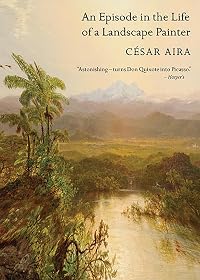
Do you like innovate, avant-garde fiction polished superfine? Introducing César Aira from Argentina, author of dozens of quirky, quizzical, lyrical novellas and novels, many translated into English, his best known An Episode in the Life of a Landscape Painter, a surreal yarn of a nineteenth century German artist's travels in Latin America and Ghosts, a tale about a haunted luxury apartment complex in the city of Buenos Aires.
Why haven’t I heard of César Aira before? Perhaps because he takes delight in being somewhat obscure. As he stated in an interview, nearly half of his ninety titles are pamphlets or booklets, many less than twenty pages. Since by his reckoning every story is a book, he prefers small, independent publishers show more willing to print a limited run. Therefore, he surmises, if someone really wants to read his books, they will find them.
I'm delighted I did just that! The Literary Conference is my first César Aira and it will certainly not be my last.
I was under the impression The Literary Conference would be about, well, a literary conference, featuring famous Latin American authors discussing the aesthetics of literature. I found to my astonishment, what begins as international adventure shifts to a comic version of mad scientist taking over the world via cloning and then again to B-movie, a science fiction monster flick, all the while offering meditations on the nature of art and creativity - contained in a mere eighty-five pages.
The narrator, a playwright with the name César, travels to Venezuela, to the coastal town of Macuto wherein he solves the centuries-long enigma of the Macuto Line and its sunken treasure. Just the right vibration from his fingers on the old hemp line and ta-da! - treasure miraculously falls at his feet. My sense is this piece of authorial legerdemain serves to remind us we are, after all, being told a tale and if the storyteller wants riches at the feet of César (perhaps César Aira himself?), then that’s what will bloody well happen.
Moreover, the Macuto Line could be taken as metaphor: the author engaging his imagination as the rope to guide himself down to the lower depths of his own psyche in order to mine a treasure chest of images and words he can bring to the surface and thus compose the very novella we are reading.
We arrive at the actual conference itself, not exactly a round table discussion, more an extension of César’s internal dialogue. One of the first observations made is how the tale he is relaying must be kept clear since poetic fog horrifies him. However, he acknowledges a fable provides the foundational logic for his story and that fable requires the underlying logic of yet again another fable. And the story we are reading provides the logic for a second story. Does all this Russian dolls story within a story remind you of anything? It does for me: One Thousand and One Nights of Scheherazade, among César Aira’s favorite modes of storytelling.
César goes on to relate how there was once a mad scientist who allowed the clones he created to roam the streets of his neighborhood. Ultimately the mad scientist needed CONTROL and the best way to maintain such control was to clone a superior man. And what will be the nature of such a superior man? Ah, according to the mad scientist, an individual having achieved greatness in the realm of high culture, things like philosophy, literature, history and being steeped in the classics.
César then reveals the truth: the mad scientist in question is none other than himself. And who does César judge the superior man fit for cloning? Why, of course, that giant of world literature – Mexico’s Carlos Fuentes. Permit me a side note: a number of years ago American men and women were asked what individual should be cloned to improve the quality of life within the United States. The results were divided: half the Americans polled voted for Albert Einstein and the other half for Michael Jordan. Perhaps a combination of both would be ideal - theoretical physicists who could tear up a basketball court.
Whacky weird, bugged out bizarre and Kool-Aid kooky from here on out. Thus I will shift from the narrator's singular story to a number of his reflections sweetly seasoning this literary conference confection. Firstly, how “language has shaped our expectations so extensively that real reality has become the most detached and incomprehensible one of all.” Indeed, our view of ourselves and others, our notions of life and death and everything in between is a combination of fact and fiction. And because we coat our world with the thick syrup of language, I suspect the split is along the lines of 2% fact, 98% fiction.
“My Great Work is secret, clandestine, and encompasses my life in its entirety, even its most insignificant folds and those that seem the most banal. Until now I have concealed my purpose under the accommodating guise of literature.” Hmmm, is the narrator (César Aira himself?) suggesting there is an underlying riddle to be solved along the lines of Hugh Vereker’s literary puzzle in Henry James’ The Figure in the Carpet? What a tantalizing prospect! No wonder a number of literary critics have linked Aira with his fellow countryman, Jorge Luis Borges.
“I was considering, with amazement, the quantity of things that were happening to me while nothing was happening. I noticed this as my pen was moving: there were thousands of tiny incidents, all full of meaning. I’ve had to pick and choose carefully, otherwise the list would be endless.” Thank goodness César can choose wisely; otherwise The Literary Conference might include enough peregrinations, colloquies and bagatelles to fill hundreds of pages.
“Only through minimalism is it possible to achieve the asymmetry that for me is the flower of art; complications inevitably form heavy symmetries, which are vulgar and overwrought.” At eighty-five pages, The Literary Conference undoubtedly qualifies as minimal in terms of length. And César Aira’s style is the opposite of heavy, vulgar and overwrought; rather, the author has created a little book chock full of ideas and philosophy that’s sheer fun, all within a breezy storyline too preposterous to be read without a smile. show less
Why haven’t I heard of César Aira before? Perhaps because he takes delight in being somewhat obscure. As he stated in an interview, nearly half of his ninety titles are pamphlets or booklets, many less than twenty pages. Since by his reckoning every story is a book, he prefers small, independent publishers show more willing to print a limited run. Therefore, he surmises, if someone really wants to read his books, they will find them.
I'm delighted I did just that! The Literary Conference is my first César Aira and it will certainly not be my last.
I was under the impression The Literary Conference would be about, well, a literary conference, featuring famous Latin American authors discussing the aesthetics of literature. I found to my astonishment, what begins as international adventure shifts to a comic version of mad scientist taking over the world via cloning and then again to B-movie, a science fiction monster flick, all the while offering meditations on the nature of art and creativity - contained in a mere eighty-five pages.
The narrator, a playwright with the name César, travels to Venezuela, to the coastal town of Macuto wherein he solves the centuries-long enigma of the Macuto Line and its sunken treasure. Just the right vibration from his fingers on the old hemp line and ta-da! - treasure miraculously falls at his feet. My sense is this piece of authorial legerdemain serves to remind us we are, after all, being told a tale and if the storyteller wants riches at the feet of César (perhaps César Aira himself?), then that’s what will bloody well happen.
Moreover, the Macuto Line could be taken as metaphor: the author engaging his imagination as the rope to guide himself down to the lower depths of his own psyche in order to mine a treasure chest of images and words he can bring to the surface and thus compose the very novella we are reading.
We arrive at the actual conference itself, not exactly a round table discussion, more an extension of César’s internal dialogue. One of the first observations made is how the tale he is relaying must be kept clear since poetic fog horrifies him. However, he acknowledges a fable provides the foundational logic for his story and that fable requires the underlying logic of yet again another fable. And the story we are reading provides the logic for a second story. Does all this Russian dolls story within a story remind you of anything? It does for me: One Thousand and One Nights of Scheherazade, among César Aira’s favorite modes of storytelling.
César goes on to relate how there was once a mad scientist who allowed the clones he created to roam the streets of his neighborhood. Ultimately the mad scientist needed CONTROL and the best way to maintain such control was to clone a superior man. And what will be the nature of such a superior man? Ah, according to the mad scientist, an individual having achieved greatness in the realm of high culture, things like philosophy, literature, history and being steeped in the classics.
César then reveals the truth: the mad scientist in question is none other than himself. And who does César judge the superior man fit for cloning? Why, of course, that giant of world literature – Mexico’s Carlos Fuentes. Permit me a side note: a number of years ago American men and women were asked what individual should be cloned to improve the quality of life within the United States. The results were divided: half the Americans polled voted for Albert Einstein and the other half for Michael Jordan. Perhaps a combination of both would be ideal - theoretical physicists who could tear up a basketball court.
Whacky weird, bugged out bizarre and Kool-Aid kooky from here on out. Thus I will shift from the narrator's singular story to a number of his reflections sweetly seasoning this literary conference confection. Firstly, how “language has shaped our expectations so extensively that real reality has become the most detached and incomprehensible one of all.” Indeed, our view of ourselves and others, our notions of life and death and everything in between is a combination of fact and fiction. And because we coat our world with the thick syrup of language, I suspect the split is along the lines of 2% fact, 98% fiction.
“My Great Work is secret, clandestine, and encompasses my life in its entirety, even its most insignificant folds and those that seem the most banal. Until now I have concealed my purpose under the accommodating guise of literature.” Hmmm, is the narrator (César Aira himself?) suggesting there is an underlying riddle to be solved along the lines of Hugh Vereker’s literary puzzle in Henry James’ The Figure in the Carpet? What a tantalizing prospect! No wonder a number of literary critics have linked Aira with his fellow countryman, Jorge Luis Borges.
“I was considering, with amazement, the quantity of things that were happening to me while nothing was happening. I noticed this as my pen was moving: there were thousands of tiny incidents, all full of meaning. I’ve had to pick and choose carefully, otherwise the list would be endless.” Thank goodness César can choose wisely; otherwise The Literary Conference might include enough peregrinations, colloquies and bagatelles to fill hundreds of pages.
“Only through minimalism is it possible to achieve the asymmetry that for me is the flower of art; complications inevitably form heavy symmetries, which are vulgar and overwrought.” At eighty-five pages, The Literary Conference undoubtedly qualifies as minimal in terms of length. And César Aira’s style is the opposite of heavy, vulgar and overwrought; rather, the author has created a little book chock full of ideas and philosophy that’s sheer fun, all within a breezy storyline too preposterous to be read without a smile. show less
The main thing that I love about the Aira novels, and his writing style, is his ability to very subtly mix reality and fiction. Lines and translations. Those are, I think, Aira’s starting points in this little work. Maybe he is following these lines and translations through the character, César, whom the author has made into a mad scientist. What do the lines and translations symbolize or what is the author trying to show us? I feel like he is just having a fun time writing and seeing where things go.
This is not an easy novel to read. On the other hand, the prose is straightforward and uncomplicated. Aira does not sound obnoxious. He has this matter-of-fact delivery that is so engaging when contrasted with the absurd chaos his tales show more run to. Recommended for strong readers. show less
This is not an easy novel to read. On the other hand, the prose is straightforward and uncomplicated. Aira does not sound obnoxious. He has this matter-of-fact delivery that is so engaging when contrasted with the absurd chaos his tales show more run to. Recommended for strong readers. show less
Another spectacular book by César Aira. If he isn't the best living writer, who is? And how would you make the case?
This time I'll try to zero in on just one quality of his imagination that sets him apart from most other authors. This book begins with a short chapter describing how the author, a certain César, famous writer and "mad scientist," discovers the secret of the "Macuto Line," a mysterious braided cord on the coast of Venezuela. The Macuto Line, César says, was one of the world's wonders. It had been constructed by pirates to hide their treasure, but no one had succeeded in figuring out how to retrieve the treasure, which was somehow buried, at the end of the line, under water. César protests that he is not a universal show more genius, that there is no such thing as universal genius. But he has a particular combination of talents and weaknesses that are both ordinary and utterly unique. Aira spends a couple of pages describing his theory of unique but unexceptional talents. He proposes a thought experiment: think of any three books you've read. There may be hundreds of other people in the world who have read those same books. Now add a book, and only a few people will have read those same four books. Add one or two more, and you will be the only one in the world who has read that particular combination of books. You aren't a genius for having done so, but you have skills and qualities of attention no one else has. Using this individual combination, César does something simple to the braided Macuto Line, and the treasure chest bursts out of its underwater cave and falls at his feet.
Now here's what's different about Aira: any other author would have made that an emblem, a theme, a leitmotif, a central subject. But "The Literary Conference" never returns to the subject, never draws any conclusions from it, never proposes it as a master trope or a key to César's character. It doesn't even function as an introduction to the logic or narrative of the book, but at the same time it isn't an absurdist episode that is meant to be read allegorically as a sign of the illogic of life (or some such thing). the Macuto Line is simply the reason the narrator is rich, and even that doesn't matter much for the novel. There is something extremely peculiar about Aira's way of imagining fiction. The Macuto Line, and other things that happen in this book, are nominally surrealist or magic realist, but only in a superficial sense because they don't reveal any unconscious ideas (as in surrealism) or hidden natural sublime poetry (as in magic realism). And the abstract meditations that introduce things like the Macuto Line are nominally examples of philosophic fiction, but only superficially because Aira has no philosophic arguments to make, only stories to tell. It's not that Aira doesn't care about literature and history, but that his imagination is apparently entirely impossible to control. (In that he resembles Thomas Bernhard, whose vitriol can have a similar deforming effect on his narratives.)
Aira is absolutely wonderful. I wish all 60 of his books could be translated. show less
This time I'll try to zero in on just one quality of his imagination that sets him apart from most other authors. This book begins with a short chapter describing how the author, a certain César, famous writer and "mad scientist," discovers the secret of the "Macuto Line," a mysterious braided cord on the coast of Venezuela. The Macuto Line, César says, was one of the world's wonders. It had been constructed by pirates to hide their treasure, but no one had succeeded in figuring out how to retrieve the treasure, which was somehow buried, at the end of the line, under water. César protests that he is not a universal show more genius, that there is no such thing as universal genius. But he has a particular combination of talents and weaknesses that are both ordinary and utterly unique. Aira spends a couple of pages describing his theory of unique but unexceptional talents. He proposes a thought experiment: think of any three books you've read. There may be hundreds of other people in the world who have read those same books. Now add a book, and only a few people will have read those same four books. Add one or two more, and you will be the only one in the world who has read that particular combination of books. You aren't a genius for having done so, but you have skills and qualities of attention no one else has. Using this individual combination, César does something simple to the braided Macuto Line, and the treasure chest bursts out of its underwater cave and falls at his feet.
Now here's what's different about Aira: any other author would have made that an emblem, a theme, a leitmotif, a central subject. But "The Literary Conference" never returns to the subject, never draws any conclusions from it, never proposes it as a master trope or a key to César's character. It doesn't even function as an introduction to the logic or narrative of the book, but at the same time it isn't an absurdist episode that is meant to be read allegorically as a sign of the illogic of life (or some such thing). the Macuto Line is simply the reason the narrator is rich, and even that doesn't matter much for the novel. There is something extremely peculiar about Aira's way of imagining fiction. The Macuto Line, and other things that happen in this book, are nominally surrealist or magic realist, but only in a superficial sense because they don't reveal any unconscious ideas (as in surrealism) or hidden natural sublime poetry (as in magic realism). And the abstract meditations that introduce things like the Macuto Line are nominally examples of philosophic fiction, but only superficially because Aira has no philosophic arguments to make, only stories to tell. It's not that Aira doesn't care about literature and history, but that his imagination is apparently entirely impossible to control. (In that he resembles Thomas Bernhard, whose vitriol can have a similar deforming effect on his narratives.)
Aira is absolutely wonderful. I wish all 60 of his books could be translated. show less
Members
- Recently Added By
Lists

Not the NYT list of top 100 21st century books
100 works; 6 members
Author Information

171+ Works 5,028 Members
Some Editions
Awards and Honors
Series
Belongs to Publisher Series
Work Relationships
Common Knowledge
- Canonical title
- The Literary Conference
- Original title
- El congreso de literatura
- Original publication date
- 1997
- Original language
- Spanish
Classifications
- Genres
- Fiction and Literature, General Fiction
- DDC/MDS
- 863.64 — Literature & rhetoric Spanish Literature Spanish fiction 20th Century 1945-2000
- LCC
- PQ7798.1 .I7 .C66513 — Language and Literature French, Italian, Spanish and Portuguese literatures Spanish literature Provincial, local, colonial, etc. Spanish America
- BISAC
Statistics
- Members
- 339
- Popularity
- 93,684
- Reviews
- 17
- Rating
- (3.66)
- Languages
- 6 — Dutch, English, French, German, Portuguese, Spanish
- Media
- Paper, Ebook
- ISBNs
- 17
- ASINs
- 5