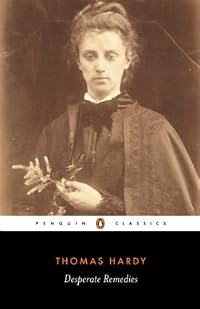
Desperate Remedies
by Thomas Hardy
On This Page
Description
Desperate Remedies is Hardy's first book, which he published anonymously. It foreshadows many of Hardy's favorite themes including the predominant role played by nature in all of his work. It tells the story of a lady's maid who marries a charismatic and manipulative steward only to discover her true love was free to marry. And that her husbands first wife still lives..
Tags
Recommendations





















Member Reviews
In poco meno di un mese ho letto il romanzo d’esordio di Thomas Hardy; il suo primo romanzo per lui e il primo suo romanzo per me. Una fantastica scoperta.
Non avendo mai letto prima quest’autore, non sapevo cosa mi sarei trovata davanti una volta cominciata la lettura; questa, come tante altre, è stata una di quelle letture “al buio”.
Lette le prime pagine non avrei mai pensato che avrei potuto leggere quel che poi ho letto: una storia di intrecci familiari ricca di colpi di scena inaspettati, suspense, quasi da romanzo poliziesco… e un omicidio. Questo è stato il penultimo colpo di scena che mi ha lasciato a bocca aperta. Perché sì, all’inizio, la prima impressione che ho avuto è stata: è come Jane Austen, ma scritto show more da un uomo. Forse perché infondo Hardy ha saputo parlare e scrivere delle donne alla stessa maniera superba e impeccabilmente profonda e realistica con cui la Austen scrive degli uomini. Forse per le vicende, per i due uomini contendenti, uno “buono” e uno “cattivo”; e di quello buono ci si innamora subito come in Jane Austen, vero? No.
Edward Springrove non è stato per me quell’uomo che ho amato con un colpo di fulmine; mi piaceva, inizialmente, ma non lo amavo… non ancora. Era, nelle prime pagine, un uomo passivo alla propria vita, quasi invisibile e vuoto, senza carattere. Mi è bastata una pagina, mi è bastata una frase per farmi cambiare completamente idea su di lui. Perché si è trasformato, repentinamente, mostrando il vero uomo sepolto in sé stesso, mostrando decisione e prontezza, diventando attivo, coraggioso e dannatamente affascinante. Ha preso posizione, ha preso l’iniziativa e si è buttato nel vuoto per l’amore più puro e tenero che un uomo possa provare. Da quel momento in poi l’ho amato.
Per quanto riguarda l’altro uomo, Manston, invece i miei sentimenti nei suoi confronti mi erano perfettamente chiari dal primo momento: odio puro. E senza un motivo apparente, all’inizio, ma sono bastate poche pochissime righe per farmi capire il perché non lo sopportassi affatto. Ogni suo fallimento è stata immancabile fonte di gioia per me, così come ogni colpo di scena che lo riguardava.
Al centro di tutto c’è lei, Cytherea Graye. La protagonista, è lei che non riesco ancora ad inquadrare. Ragazza umile e buona… ecco, troppo buona, una bontà che, in certi passi, mi ha veramente irritata. Ma è questo che voleva Hardy per lei ed è perfettamente riuscito nel suo intento. È una protagonista perfetta, per questo romanzo, protagonista buona e gentile, paziente e sempre pronta a perdonare, come quando nell’ultimo capitolo prima dell’Epilogo ha perdonato Miss Aldclyffe, un perdono che, francamente, non mi sarei mai aspettata, ma che le calzava a pennello.
Thomas Hardy è dunque stato in grado di costruire un romanzo degno di nota, gotico e giallo a un tempo, rispettando perfettamente i canoni dell’epoca, scrivendo come solo un vero poeta e un vero scrittore possono scrivere; lui era entrambe le cose e la prosa del romanzo rispecchia perfettamente questa sua qualità.
Un libro che ho amato moltissimo, che mi ha tenuto sveglia la notte, che mi ha tenuto lo sguardo incollato alle sue pagine fino alla fine.
Come si suol dire: “A mali estremi, estremi rimedi.” show less
Non avendo mai letto prima quest’autore, non sapevo cosa mi sarei trovata davanti una volta cominciata la lettura; questa, come tante altre, è stata una di quelle letture “al buio”.
Lette le prime pagine non avrei mai pensato che avrei potuto leggere quel che poi ho letto: una storia di intrecci familiari ricca di colpi di scena inaspettati, suspense, quasi da romanzo poliziesco… e un omicidio. Questo è stato il penultimo colpo di scena che mi ha lasciato a bocca aperta. Perché sì, all’inizio, la prima impressione che ho avuto è stata: è come Jane Austen, ma scritto show more da un uomo. Forse perché infondo Hardy ha saputo parlare e scrivere delle donne alla stessa maniera superba e impeccabilmente profonda e realistica con cui la Austen scrive degli uomini. Forse per le vicende, per i due uomini contendenti, uno “buono” e uno “cattivo”; e di quello buono ci si innamora subito come in Jane Austen, vero? No.
Edward Springrove non è stato per me quell’uomo che ho amato con un colpo di fulmine; mi piaceva, inizialmente, ma non lo amavo… non ancora. Era, nelle prime pagine, un uomo passivo alla propria vita, quasi invisibile e vuoto, senza carattere. Mi è bastata una pagina, mi è bastata una frase per farmi cambiare completamente idea su di lui. Perché si è trasformato, repentinamente, mostrando il vero uomo sepolto in sé stesso, mostrando decisione e prontezza, diventando attivo, coraggioso e dannatamente affascinante. Ha preso posizione, ha preso l’iniziativa e si è buttato nel vuoto per l’amore più puro e tenero che un uomo possa provare. Da quel momento in poi l’ho amato.
Per quanto riguarda l’altro uomo, Manston, invece i miei sentimenti nei suoi confronti mi erano perfettamente chiari dal primo momento: odio puro. E senza un motivo apparente, all’inizio, ma sono bastate poche pochissime righe per farmi capire il perché non lo sopportassi affatto. Ogni suo fallimento è stata immancabile fonte di gioia per me, così come ogni colpo di scena che lo riguardava.
Al centro di tutto c’è lei, Cytherea Graye. La protagonista, è lei che non riesco ancora ad inquadrare. Ragazza umile e buona… ecco, troppo buona, una bontà che, in certi passi, mi ha veramente irritata. Ma è questo che voleva Hardy per lei ed è perfettamente riuscito nel suo intento. È una protagonista perfetta, per questo romanzo, protagonista buona e gentile, paziente e sempre pronta a perdonare, come quando nell’ultimo capitolo prima dell’Epilogo ha perdonato Miss Aldclyffe, un perdono che, francamente, non mi sarei mai aspettata, ma che le calzava a pennello.
Thomas Hardy è dunque stato in grado di costruire un romanzo degno di nota, gotico e giallo a un tempo, rispettando perfettamente i canoni dell’epoca, scrivendo come solo un vero poeta e un vero scrittore possono scrivere; lui era entrambe le cose e la prosa del romanzo rispecchia perfettamente questa sua qualità.
Un libro che ho amato moltissimo, che mi ha tenuto sveglia la notte, che mi ha tenuto lo sguardo incollato alle sue pagine fino alla fine.
Come si suol dire: “A mali estremi, estremi rimedi.” show less
A complex mystery novel, so popular in the second half of the Nineteenth Century. It is a labyrinthine intrigue that is gradually revealed, but only fully so, in its last chapters. I appreciate the novel's division of chapters through periods of time (weeks maybe, but often into segments of hours). This is a handy device through which a reader is always aware of chronology.
The novel is chock full of coincidences which prop up the continuity of the novel without which the narrative would fold. (For example, someone misreads his Bradshaw timetable, and at another the rural postman gets pissed as part of a dastardly ruse by the villain). All this is saved by a wonderful contrived story told by a young master at the start of his novel show more writing career.
Reading "Desperate Remedies" (and indeed, some them are desperate) is time well and satisfyingly spent. show less
The novel is chock full of coincidences which prop up the continuity of the novel without which the narrative would fold. (For example, someone misreads his Bradshaw timetable, and at another the rural postman gets pissed as part of a dastardly ruse by the villain). All this is saved by a wonderful contrived story told by a young master at the start of his novel show more writing career.
Reading "Desperate Remedies" (and indeed, some them are desperate) is time well and satisfyingly spent. show less
Read as part of the local "Hardy Readers" book group, that is reading many of Hardy's published works, in order.
This is the first book in the series.
It starts with Cytherea and her brother Owen. Their family back history is given short shrift - the father falls in love, has a relationship, she leaves (the implication being to have his child), and he then marries another woman and has two children - Owen, and Cytherea, who was named after his first love.
Both parents die, leaving little money and Owen barely trained to earn a living, and Cytherea trained to do even less. A short term contract leads Owen to another job and Cytherea in love with Edward. When the need to get another job becomes pressing, Cytherea gets a job as a lady's maid, show more which she gets through words of mouth. She is separated from Owen who has to get elsewhere to complete his training and earn money. It soon becomes apparent that she is not suitable to be a lady's maid, but the woman she is now employed by (Miss Aldclyffe) is her father's first love. She is kept on as a companion, and a new maid is hired.
Miss Aldclyffe is a capricious character - seemingly prone to whims and changes in direction. After the death of her father, she hires a steward (Aeneas Manston) over some men who are eminently more qualified to do the job, including Edward, Cytherea's love. The implication being that Mantson is her son. Despite being married, Manston falls in love with Cytherea. After the death of his wife in an accidental fire, Manston blackmails Aldclyffe into helping him get Edward married off to his cousin so that the way to Cytherea is clear. Unable to seduce Cytherea, he resorts to blackmail and emotional pressure into making her marry him, even though she doesnt love him.
However, almost immediately after the marriage, doubt is shed over the death of Manston's first wife, and then things start to unravel for Manston.
Review/Commentary[return][return]As to the story itself, I liked it - mystery, true love, blackmail, intrigue, murder - really, what's not to like?[return][return]As far as I'm concerned, the thing I didnt like was the execution. He did lose me during volume 2, as something I dislike about Hardy's work is his reliance on/habit of "implication". Time and again things are implied (I want to read Tess again to see if it's just as annoying there as I remember too), with things rarely being made explicit or concrete. Manston 's wife does write to Aldclyffe to essentially blackmail her, and I think that's the most concrete statement about Manston's parentage in the whole book almost right to the end.[return][return]I have to admit that things did pick up in Volume 3, and did turn my review of the book around - it was not going to be a good review! If only the whole book had been this good! [return][return]Hardy was either not comfortable with or did not enjoy writing dialogue. Whole passages/pages are spent without a word of dialogue being put down on the page. [return][return]The book is split into sub chapters, some of which covering a matter of minutes or hours, some covering months. Each sub chapter had a heading detailing the time period it covered. I was trying to decide whether I liked this format or not, but decided that the pace suffered in switching from the minute to the epic scale and back within chapters.
As I mentioned earlier, Aldclyffe is capricious and moody. Some of her behaviour is explainable - e.g. her desire to bring Manston to the estate results in her excluding people more qualified for the job but some of it isnt. Her behaviour when she realises who Cytherea is is slightly disturbing, over the top, and uncomfortable - a scene that Hardy himself was not happy with (according to the notes) with the implication that it might be construed as a Lesbian scene, and not a scene I think he corrected particularly well. Her desire (and what she's prepared to resort to) to get Cytherea to marry Manston is not altogether clear until the very last pages of the book. She disappears for most of the second half of the book only to appear again in the last few chapters.
Cytherea is a strange character as well. In some ways she's strong - she rejects Manston for a long time, and evaluates the situation before she finally accepts. However, she's also quite "weak" - some might call it naive.
Edward was always going to be "the hero" and "the one true love" and is a quietly strong man, stuck in a moment waiting for his love.[return][return]Owen is much like his sister, weak and naive, and a little undeveloped. show less
This is the first book in the series.
It starts with Cytherea and her brother Owen. Their family back history is given short shrift - the father falls in love, has a relationship, she leaves (the implication being to have his child), and he then marries another woman and has two children - Owen, and Cytherea, who was named after his first love.
Both parents die, leaving little money and Owen barely trained to earn a living, and Cytherea trained to do even less. A short term contract leads Owen to another job and Cytherea in love with Edward. When the need to get another job becomes pressing, Cytherea gets a job as a lady's maid, show more which she gets through words of mouth. She is separated from Owen who has to get elsewhere to complete his training and earn money. It soon becomes apparent that she is not suitable to be a lady's maid, but the woman she is now employed by (Miss Aldclyffe) is her father's first love. She is kept on as a companion, and a new maid is hired.
Miss Aldclyffe is a capricious character - seemingly prone to whims and changes in direction. After the death of her father, she hires a steward (Aeneas Manston) over some men who are eminently more qualified to do the job, including Edward, Cytherea's love. The implication being that Mantson is her son. Despite being married, Manston falls in love with Cytherea. After the death of his wife in an accidental fire, Manston blackmails Aldclyffe into helping him get Edward married off to his cousin so that the way to Cytherea is clear. Unable to seduce Cytherea, he resorts to blackmail and emotional pressure into making her marry him, even though she doesnt love him.
However, almost immediately after the marriage, doubt is shed over the death of Manston's first wife, and then things start to unravel for Manston.
Review/Commentary[return][return]As to the story itself, I liked it - mystery, true love, blackmail, intrigue, murder - really, what's not to like?[return][return]As far as I'm concerned, the thing I didnt like was the execution. He did lose me during volume 2, as something I dislike about Hardy's work is his reliance on/habit of "implication". Time and again things are implied (I want to read Tess again to see if it's just as annoying there as I remember too), with things rarely being made explicit or concrete. Manston 's wife does write to Aldclyffe to essentially blackmail her, and I think that's the most concrete statement about Manston's parentage in the whole book almost right to the end.[return][return]I have to admit that things did pick up in Volume 3, and did turn my review of the book around - it was not going to be a good review! If only the whole book had been this good! [return][return]Hardy was either not comfortable with or did not enjoy writing dialogue. Whole passages/pages are spent without a word of dialogue being put down on the page. [return][return]The book is split into sub chapters, some of which covering a matter of minutes or hours, some covering months. Each sub chapter had a heading detailing the time period it covered. I was trying to decide whether I liked this format or not, but decided that the pace suffered in switching from the minute to the epic scale and back within chapters.
As I mentioned earlier, Aldclyffe is capricious and moody. Some of her behaviour is explainable - e.g. her desire to bring Manston to the estate results in her excluding people more qualified for the job but some of it isnt. Her behaviour when she realises who Cytherea is is slightly disturbing, over the top, and uncomfortable - a scene that Hardy himself was not happy with (according to the notes) with the implication that it might be construed as a Lesbian scene, and not a scene I think he corrected particularly well. Her desire (and what she's prepared to resort to) to get Cytherea to marry Manston is not altogether clear until the very last pages of the book. She disappears for most of the second half of the book only to appear again in the last few chapters.
Cytherea is a strange character as well. In some ways she's strong - she rejects Manston for a long time, and evaluates the situation before she finally accepts. However, she's also quite "weak" - some might call it naive.
Edward was always going to be "the hero" and "the one true love" and is a quietly strong man, stuck in a moment waiting for his love.[return][return]Owen is much like his sister, weak and naive, and a little undeveloped. show less
This starts out slow and you're almost yawning, but by the end you're figuratively sitting on the edge of your seat. A brother and sister are left orphans when their architect father tumbles from the tower work he's supervising. The brother, not yet completed his architect apprenticeship, can't yet support his sister. Cytherea advertises first as a governess, and finally as a lady's maid, to try to support herself (this is mid-nineteenth century England). The crabby rich woman who hires her, hates her as a maid, but Cytherea softens her heart with her sweetness and grace, and allows herself to be talked into remaining as her companion. There are a lot of secrets going on with this rich lady, though, and the author is a master of twists show more and turns of plot. I could hardly wait to learn all the answers to my questions about Manston, and Cytherea's tocaya. A thriller mystery that does not disappoint. show less
3.5 stars, rounded down. Still a very well written novel.
Desperate Remedies was Thomas Hardy’s first published novel, and while failing to live up to his later works, it foreshadows the brilliant author he would come to be. In a Thomas Hardy channels Wilkie Collins fashion, this novel is a bit of a mystery novel, and lacks the depth of idea development that makes Hardy one of my favorite authors. By three-quarters of the way through, I had guessed at most of the riddles that had been set for us and had a clear idea of exactly where the plot was going.
You might think this would have made the reading less enjoyable, but I find Hardy’s remarkable character development and descriptions are fascinating, even in a lesser work. He can show more describe an activity, in this novel it was cider pressing, with such amazing detail, that you can picture vividly the men at work and thrill with understanding the mechanics of a skill that is literally now lost in time.
Thrust into poverty at the death of her father, a young girl, Cytherea, is forced to seek employment as a lady’s maid, and takes up that station with a woman who turns out to be the love of her father’s life who slipped through his fingers under strange circumstances. Cytherea is an exceptionally lovely girl, and she becomes the object of desire for two men; but her love-life proves to be anything but a simple and straight-forward affair.
There is a great deal of backroom plotting and inexplicable interference in Cytherea’s life by her lady employer, Mrs. Aldclyffe, some false information to overcome and some errors in judgment that make one cringe. The story is neatly tied at the end, no pesky strands left unresolved. From another author, this book might have garnered an extra star. In this case, the author is Thomas Hardy, and the comparison cannot help but be made with his masterpieces, in which case this book falls a tad short.
I am on a quest to read all of Hardy’s works, and I am pleased to have read this one. It was a pleasant way to ease myself back into a reading mode, something I had left behind me, out of necessity, for the last few months. show less
Desperate Remedies was Thomas Hardy’s first published novel, and while failing to live up to his later works, it foreshadows the brilliant author he would come to be. In a Thomas Hardy channels Wilkie Collins fashion, this novel is a bit of a mystery novel, and lacks the depth of idea development that makes Hardy one of my favorite authors. By three-quarters of the way through, I had guessed at most of the riddles that had been set for us and had a clear idea of exactly where the plot was going.
You might think this would have made the reading less enjoyable, but I find Hardy’s remarkable character development and descriptions are fascinating, even in a lesser work. He can show more describe an activity, in this novel it was cider pressing, with such amazing detail, that you can picture vividly the men at work and thrill with understanding the mechanics of a skill that is literally now lost in time.
Thrust into poverty at the death of her father, a young girl, Cytherea, is forced to seek employment as a lady’s maid, and takes up that station with a woman who turns out to be the love of her father’s life who slipped through his fingers under strange circumstances. Cytherea is an exceptionally lovely girl, and she becomes the object of desire for two men; but her love-life proves to be anything but a simple and straight-forward affair.
There is a great deal of backroom plotting and inexplicable interference in Cytherea’s life by her lady employer, Mrs. Aldclyffe, some false information to overcome and some errors in judgment that make one cringe. The story is neatly tied at the end, no pesky strands left unresolved. From another author, this book might have garnered an extra star. In this case, the author is Thomas Hardy, and the comparison cannot help but be made with his masterpieces, in which case this book falls a tad short.
I am on a quest to read all of Hardy’s works, and I am pleased to have read this one. It was a pleasant way to ease myself back into a reading mode, something I had left behind me, out of necessity, for the last few months. show less
This is Hardy's first published novel and it displays a number of themes that became staples of his prose works: an affair of the heart thwarted by circumstance, the effects of low social mobility, coincidence influencing the course of protagonists' lives. It does not bring social commentary to the fore-front, however. Instead the reader is propelled through the story by an urge to solve mysteries, one of which is not entirely cleared up until the final pages.
It is interesting to contrast the heroine, her family and lover with other characters in the book; the former are bland and vague, somewhat stereo-typical in comparison to the more minor, rural charcters who come to life instantly through Hardy's intimate knowledge of the local show more dialect. The scenes where they appear are used in large part to convey local gossip without having to have a major protagonist awkwardly have to express the information or learn it in a manner otherwise unrelated to the plot.
Desperate Remedies sits neither in the top rank of Hardy's novels, nor in the bottom; it has the great merit of not having been interfered with by editors but it lacks the anger that seethes through the major Tragedies and the ironic wit displayed by the endings of The Woodlanders or A Laodician but it is certainly worth the time of any Hardy fan. show less
It is interesting to contrast the heroine, her family and lover with other characters in the book; the former are bland and vague, somewhat stereo-typical in comparison to the more minor, rural charcters who come to life instantly through Hardy's intimate knowledge of the local show more dialect. The scenes where they appear are used in large part to convey local gossip without having to have a major protagonist awkwardly have to express the information or learn it in a manner otherwise unrelated to the plot.
Desperate Remedies sits neither in the top rank of Hardy's novels, nor in the bottom; it has the great merit of not having been interfered with by editors but it lacks the anger that seethes through the major Tragedies and the ironic wit displayed by the endings of The Woodlanders or A Laodician but it is certainly worth the time of any Hardy fan. show less
Although this read more like a Gothic Romance than the typical Hardy it was still a very enjoyable read with a mostly happy ending for the romantic couple. As with many of the Gothic Romance novels, there was a great deal of coincidence to make the plots work out and,of course, the dark secrets finally revealed. I did expect Miss Aldwych to have a much darker secret in her bizarre treatment of both Cytherea and Manston but all was revealed and the happy ending achieved. Plus, I have now read all of Hardy's prose. I have been advised to try his drama The Dynasts but I may wait a bit to return to Hardy, I t has been a very good experience but I have other authors I would like to dig into.
Members
- Recently Added By
Author Information

476+ Works 85,026 Members
Thomas Hardy was born on June 2, 1840, in Higher Bockhampton, England. The eldest child of Thomas and Jemima, Hardy studied Latin, French, and architecture in school. He also became an avid reader. Upon graduation, Hardy traveled to London to work as an architect's assistant under the guidance of Arthur Bloomfield. He also began writing poetry. show more How I Built Myself a House, Hardy's first professional article, was published in 1865. Two years later, while still working in the architecture field, Hardy wrote the unpublished novel The Poor Man and the Lady. During the next five years, Hardy penned Desperate Remedies, Under the Greenwood Tree, and A Pair of Blue Eyes. In 1873, Hardy decided it was time to relinquish his architecture career and concentrate on writing full-time. In September 1874, his first book as a full-time author, Far from the Madding Crowd, appeared serially. After publishing more than two dozen novels, one of the last being Tess of the d'Urbervilles, Hardy returned to writing poetry--his first love. Hardy's volumes of poetry include Poems of the Past and Present, The Dynasts: Part One, Two, and Three, Time's Laughingstocks, and The Famous Tragedy of the Queen of Cornwall. From 1833 until his death, Hardy lived in Dorchester, England. His house, Max Gate, was designed by Hardy, who also supervised its construction. Hardy died on January 11, 1928. His ashes are buried in Poet's Corner at Westminster Abbey. (Bowker Author Biography) show less
Some Editions
Series
Belongs to Publisher Series
Work Relationships
Common Knowledge
- Canonical title
- Desperate Remedies
- Original title
- Desperate Remedies
- Original publication date
- 1871
- People/Characters
- Cytherea Graye; Owen Graye; Aeneas Manston; Miss Aldclyffe; Edward Springrove
- Important places
- Wessex, England, UK (fictional); Knapwater House, Wessex, England, UK (fictional)
- First words
- In the long and intricately inwrought chain of circumstance which renders worthy of record some experiences of Cytherea Graye, Edward Springrove, and others, the first event directly influencing the issue was a Christmas visi... (show all)t.
Classifications
Statistics
- Members
- 642
- Popularity
- 44,965
- Reviews
- 23
- Rating
- (3.60)
- Languages
- English, French, Italian, Spanish
- Media
- Paper, Audiobook, Ebook
- ISBNs
- 97
- ASINs
- 24