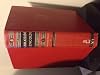
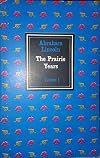
Abraham Lincoln: The Prairie Years (1 of 2)
by Carl Sandburg 
Abraham Lincoln : The Prairie Years (Collections and Selections — 1 of 2), Abraham Lincoln (Collections and Selections — 1 of 6)
On This Page
Description
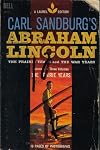
Vol. 1 of a 2 vol. set. The author planned composing this book for nearly thirty years. He desired to make a particular portrait of Lincoln, that being a sketch of the country lawyer and prairie politician who was intimate with the settlers of the Knox County neighborhood where the author grew up. Sandburg heard the conversations of men and women who had eaten with Lincoln, given him a bed overnight, heard his jokes and lingo, remembered his silences and his mobile face. Illustrated.Tags
Recommendations























Member Reviews
Sandburg’s portrait of Abraham Lincoln is detailed, expressive, poignant, and at many times, repetitive and rambling. In the Prairie Years Sandburg, despite filling the book with long and meandering passages, has an overall lyrical language which is to be expected from a writer who is a talented poet first and foremost. He introduces our nation’s sixteenth president as being a captivating and complicated human being long before Lincoln entered the White House. Sandburg starts Lincoln's story by portraying him as a quiet and sensitive child whose dreams were very important to him; catching the symbolisms of life at an early age. Later, as an adult, Lincoln would see his dreams and symbolisms as a connection to his future. As a show more teenager, learning became Lincoln’s obsession. He was said to always have a book in his hand; that he was constantly reading. I have an image of him studying big law books while plowing his father’s fields. All that book reading didn't mean Lincoln was a soft sissy, though. Lincoln was the Superman of his day. As Sandburg frequently points out, because Abe was so tall and strong with “bulldog courage,” people were constantly challenging him to foot races, wrestling matches, and fist fights: anything to prove their strength against him. Sandburg seems proud to report most times these challengers lost.
In the midst of industry's wheels just starting to turn, slavery was seen as a profitable business. At the same time, at the age of twenty-three, Lincoln’s political wheels were just starting to turn as well. He wasn’t interested in drinking or fishing. He wanted to continue to learn the law. He became a postmaster so he could have access to newspaper. In the first installment of Sandburg’s biography, we learn Lincoln grew into a complicated man with many sides. Lincoln the storyteller, always telling jokes and stories. Lincoln the neighbor, ready to help a friend, stranger, or animal in need. Lincoln the silent and sad, afraid to carry a pocketknife for fear of harming himself. Sandburg quotes Lincoln as once saying, “I stay away because I am conscious I should not know how to behave myself” (p 22). show less
In the midst of industry's wheels just starting to turn, slavery was seen as a profitable business. At the same time, at the age of twenty-three, Lincoln’s political wheels were just starting to turn as well. He wasn’t interested in drinking or fishing. He wanted to continue to learn the law. He became a postmaster so he could have access to newspaper. In the first installment of Sandburg’s biography, we learn Lincoln grew into a complicated man with many sides. Lincoln the storyteller, always telling jokes and stories. Lincoln the neighbor, ready to help a friend, stranger, or animal in need. Lincoln the silent and sad, afraid to carry a pocketknife for fear of harming himself. Sandburg quotes Lincoln as once saying, “I stay away because I am conscious I should not know how to behave myself” (p 22). show less
1060 Abraham Lincoln: The Prairie Years Volume One, by Carl Sandburg (read 11 Jul 1970) This is the first of six volumes by Sandburg on Lincoln. It takes Lincoln up to about 1850. It is good, but I miss the footnotes and the trappings of a real biography. So I won't go on--now--to volume II. Sandburg is no lawyer--I should read a book on Lincoln the lawyer. But the picture evoked of the early West in Lincoln's time is a strange and poignant one. One wonders how Lincoln could be the great man he was: what elements in him caused it? Even a poet:
"My childhood's home I see again
And sadden with the view;
And still, as memory crowds my brain,
There's pleasure in it too.
O Memory! thou midway world
Twixt earth and paradise,
Where things decayed show more and loved ones lost
In dreamy shadows rise." show less
"My childhood's home I see again
And sadden with the view;
And still, as memory crowds my brain,
There's pleasure in it too.
O Memory! thou midway world
Twixt earth and paradise,
Where things decayed show more and loved ones lost
In dreamy shadows rise." show less
Written with an uquestioned love of Lincoln, but much of it is fiction.
Donated by Professor Donald J. Berthrong
Jul 2, 2025Chinese, traditional
Ratings
Members
- Recently Added By
Author Information

233+ Works 13,013 Members
The son of Swedish immigrants, Sandburg was born in Galesburg, Illinois. At age 13 he left school to roam the Midwest; he remained on the road for six years, working as a day laborer. Sandburg served in the Spanish-American War and then, from 1898 to 1902, attended Lombard College in Galesburg. After college, he went to Milwaukee, where he worked show more as a journalist; he also married Lillian Steichen there in 1908. During World War I, he served as a foreign correspondent in Stockholm; after the war he returned to Chicago and continued to write about America, especially the common people. Sandburg's first poems to gain wide recognition appeared in Poetry magazine in 1914. Two years later he published his Chicago Poems (1916), and Cornhuskers appeared in 1918. Meanwhile, Sandburg set out to become an authority on Abraham Lincoln (see Vol. 3). His exhaustive biography of the president, which took many years to complete, appeared as Abraham Lincoln: The Prairie Years (2 vols., 1926) and Abraham Lincoln: The War Years (4 vols., 1939), which won a Pulitzer Prize. Sandburg's poetry is untraditional in form. Drawing on Whitman as well as the imagists, its rhymeless and unmetered cadences reflect Midwestern speech, and its diction ranges from strong rhetoric to easygoing slang. Although he often wrote about the uncouth, the muscular, and the primitive, there was a pity and loving kindness that was a primary motive for his poetry. At Sandburg's death, Mark Van Doren, Archibald MacLeish, and President Lyndon Johnson delivered eulogies. In his tribute, President Johnson said that "Carl Sandburg was more than the voice of America, more than the poet of its strength and genius. He was America. . . . He gave us the truest and most enduring vision of our own greatness." The N.Y. Times described Sandburg as "poet, newspaper man, historian, wandering minstrel, collector of folk songs, spinner of tales for children, [whose] place in American letters is not easily categorized. But it is a niche that he has made uniquely his own." Sandburg was the labor laureate of the United States. Sandburg received the Pulitzer Prize for poetry in 1951 for his Complete Poems (1950). Among his many other awards were the gold medal for history and biography (1952) from the American Academy of Arts and Letters; the Poetry Society of America's gold medal (1953) for distinguished achievement; and the Boston Arts Festival Award (1955) in recognition of "continuous meritorious contribution to the art of American poetry." In 1959 he traveled under the auspices of the Department of State to the U.S. Trade Fair in Moscow, and to Stockholm, Paris, and London. In 1960 he received a citation from the U.S. Chamber of Commerce as a great living American for the "significant and lasting contribution which he has made to American literature." (Bowker Author Biography) show less
Carl Sandburg has a Legacy Library. Legacy libraries are the personal libraries of famous readers, entered by LibraryThing members from the Legacy Libraries group.
Series

Abraham Lincoln : The Prairie Years
1 works (Collections and Selections — 1 of 2)

Abraham Lincoln
3 works (Collections and Selections — 1 of 6)
Belongs to Publisher Series
Work Relationships
Is contained in
Common Knowledge
- Canonical title
- Abraham Lincoln: The Prairie Years (1 of 2) (1 of 2)
- Original publication date
- 1925
- People/Characters
- Abraham Lincoln
- Important places
- Kentucky, USA; Illinois, USA
- First words
- Preface: As a growing boy in an Illinois prairie town I saw marching me who had fought under Grant and Sherman; I listened to stories of old-timers who had known Abraham Lincoln.
- Last words
- (Click to show. Warning: May contain spoilers.)And there were voices, "Good-bye, Abe."
- Disambiguation notice
- This is the 1st volume of the 2-volume edition of The Prairie Years which is also the 1st volume of the 6-volume The Prairie Years and the War Years set. There is also a single volume edition of The Prairie ... (show all)Years that is the 1st volume of the 3-volume The Prairie Years and the War Years set.
Classifications
Statistics
- Members
- 128
- Popularity
- 254,908
- Reviews
- 4
- Rating
- (3.67)
- Languages
- English
- Media
- Paper
- ISBNs
- 2
- ASINs
- 17