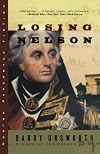
Losing Nelson
by Barry Unsworth
On This Page
Description
In the basement of a large Victorian house in London, Charles Cleasby painstakingly re-enacts the great sea battles of his hero, Horatio Nelson. He is also writing a faithful biography of the great man, as a true English hero for an age without idols, a 'bright angel' to Charles' dark shadow.Tags
Recommendations












Member Reviews
Think of that quarter-deck. At the forward end, looking across the waist to the forecastle, there was only an open rail. That is where your Horatio stood. Think of him there, dressed impeccably, full uniform, cocked hat, silk stockings, buckled shoes, Immaculate. Unoccupied, fully aware of his danger, carnage all around him. Like a rock, Charles, like a rock. That is the way, that is the way forward, Horatio is your lifeline, stay with him, he will get you out and about. Join the Nelson Club, there must be one - in London there is a club for everything under the sun. I'll get my secretary to find the address.
As a child Charles Cleasby became interested in Lord Nelson, encouraged by having a schoolteacher who was a Nelson buff, but his show more interest faded during his teens. When he had a nervous breakdown at university and refused to leave his room at all, his psychiatrist suggested that he take up his hobby again, as a way of rekindling his interest in life, but unfortunately his hobby developed into an all-consuming interest, and Charles started to see himself as Nelson's other half.
He never went back to university or got a job, and at the age of fifty he is a virtual recluse living in the house he inherited from his father, and his only social life is attending the twice weekly meetings of the Nelson Club in Bloomsbury. He keeps a large collection of Nelson memorabilia in his basement, where he also re-enacts all of Nelson's battles on their anniversaries, even if that means getting up before dawn to start the battle on schedule, moving his model ships across the glass table in the basement at the exact time they did so in the real battle.
When he employs a secretary to come in twice a week to help him with the biography of Nelson that he is writing, he is perturbed by her wilfulness in seeing Nelson as a vain man, interested in money and honours, who cares nothing for the lives of his men, rather than as the patriotic hero revered by Charles as a bright angel. What makes things worse is that he has just reached a very difficult point of the book, when he has to decide how to approach the events in Naples in June 1799 which may not show Nelson in a good light at all. I seem to remember reading something else in which the exact meaning of the word embark is vital. show less
As a child Charles Cleasby became interested in Lord Nelson, encouraged by having a schoolteacher who was a Nelson buff, but his show more interest faded during his teens. When he had a nervous breakdown at university and refused to leave his room at all, his psychiatrist suggested that he take up his hobby again, as a way of rekindling his interest in life, but unfortunately his hobby developed into an all-consuming interest, and Charles started to see himself as Nelson's other half.
He never went back to university or got a job, and at the age of fifty he is a virtual recluse living in the house he inherited from his father, and his only social life is attending the twice weekly meetings of the Nelson Club in Bloomsbury. He keeps a large collection of Nelson memorabilia in his basement, where he also re-enacts all of Nelson's battles on their anniversaries, even if that means getting up before dawn to start the battle on schedule, moving his model ships across the glass table in the basement at the exact time they did so in the real battle.
When he employs a secretary to come in twice a week to help him with the biography of Nelson that he is writing, he is perturbed by her wilfulness in seeing Nelson as a vain man, interested in money and honours, who cares nothing for the lives of his men, rather than as the patriotic hero revered by Charles as a bright angel. What makes things worse is that he has just reached a very difficult point of the book, when he has to decide how to approach the events in Naples in June 1799 which may not show Nelson in a good light at all. I seem to remember reading something else in which the exact meaning of the word embark is vital. show less
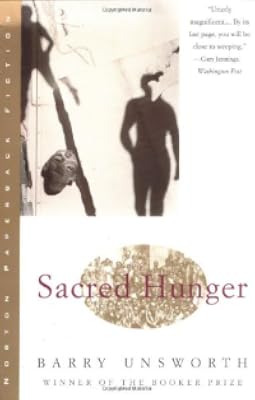
Unsworth has been an author whose name catches my eye ever since I read his Booker winner [b:Sacred Hunger|239592|Sacred Hunger (Sacred Hunger #1)|Barry Unsworth|https://i.gr-assets.com/images/S/compressed.photo.goodreads.com/books/1423442893l/239592._SY75_.jpg|2781088], and more particularly the excellent [b:Morality Play|883995|Morality Play|Barry Unsworth|https://i.gr-assets.com/images/S/compressed.photo.goodreads.com/books/1348373716l/883995._SY75_.jpg|2295319]. This book also demonstrates his interest in history and the depth of his research.
The narrator Charles Cleasby is an obsessive loner, given license to pursue his interests by a generous inheritance from his now dead father. Since childhood, he has been interested in Nelson, show more and has also developed an unhealthy reliance on the heroic aspects of his story. In the course of writing a book, he employs a typist Miss Lily, who starts to question both Nelson's heroism and the nature of Cleasby's obsession. This creates a crisis of confidence, and at the centre of this is his increasingly desperate attempts to exonerate Nelson over his betrayal of the Sicilian republican rebels in 1799, a story which Unsworth rather cleverly uses to undermine the underlying concept of heroism.Cleasby gradually slides into a paranoid fantasy, and the ending is genuinely shocking. show less
The narrator Charles Cleasby is an obsessive loner, given license to pursue his interests by a generous inheritance from his now dead father. Since childhood, he has been interested in Nelson, show more and has also developed an unhealthy reliance on the heroic aspects of his story. In the course of writing a book, he employs a typist Miss Lily, who starts to question both Nelson's heroism and the nature of Cleasby's obsession. This creates a crisis of confidence, and at the centre of this is his increasingly desperate attempts to exonerate Nelson over his betrayal of the Sicilian republican rebels in 1799, a story which Unsworth rather cleverly uses to undermine the underlying concept of heroism.
The lead character spent the book losing his admiration for Nelson, but this book lost me. Nelson is a fascinating, controversial character, but this book just seemed pointless. The lead character was deeply irritating and the opportunity to properly explore the history wasted.
I saw this at the library just after I put it on my wish list, and took that as a sign. I checked it out and read it, and enjoyed it.
The conceit is that a contemporary Englishman, Charles Cleasby, is writing a biography of Nelson, and we see him as he struggles with the fact that Nelson was not perfect. This is a problem, because he has set Nelson up as a paragon, a special person, one of those people who move and change history, and while ordinary rules of conduct don't apply to such people (see: insubordination, Lady Hamilton), they also don't get involved with massacring innocents and murdering innocent men (see: Parthenopaean Republic, Caracciolo). The book follows his efforts to come to terms with what really happened.
Without a show more doubt, the best part of this book are the passages from Nelson's "biography." Cleasby is trying to convey the emotional resonance of Nelson, and these passages bring vivid immediacy to incidents from Nelson's life. They are beautifully written, and show a deep familiarity with the period, the characters in the historical drama, and how everything fits together.
The weakness is that Cleasby himself is not very interesting, his daily life is not very compelling, and the story of his life, told as flashbacks explicitly parallel to Nelson, just isn't much. I also thought that the ending was disappointing. I'm trying to avoid spoilers, but it felt very cliched. I think that a historical novel about Nelson himself, instead, would have been riveting. (But perhaps the author didn't want to cover the entire life, just those few scenes?)
At any rate, this was definitely above average, and I'd recommend it. show less
The conceit is that a contemporary Englishman, Charles Cleasby, is writing a biography of Nelson, and we see him as he struggles with the fact that Nelson was not perfect. This is a problem, because he has set Nelson up as a paragon, a special person, one of those people who move and change history, and while ordinary rules of conduct don't apply to such people (see: insubordination, Lady Hamilton), they also don't get involved with massacring innocents and murdering innocent men (see: Parthenopaean Republic, Caracciolo). The book follows his efforts to come to terms with what really happened.
Without a show more doubt, the best part of this book are the passages from Nelson's "biography." Cleasby is trying to convey the emotional resonance of Nelson, and these passages bring vivid immediacy to incidents from Nelson's life. They are beautifully written, and show a deep familiarity with the period, the characters in the historical drama, and how everything fits together.
The weakness is that Cleasby himself is not very interesting, his daily life is not very compelling, and the story of his life, told as flashbacks explicitly parallel to Nelson, just isn't much. I also thought that the ending was disappointing. I'm trying to avoid spoilers, but it felt very cliched. I think that a historical novel about Nelson himself, instead, would have been riveting. (But perhaps the author didn't want to cover the entire life, just those few scenes?)
At any rate, this was definitely above average, and I'd recommend it. show less
Stunningly imaginative, gripping.
At one level a decent biography of Nelson, the great British naval hero [sorry Copenhagen, we love you but we we love him too!].
But this is a novel, a tale of obsession. The central character identifies himself utterly with Nelson, with appalling consequences.
At one level a decent biography of Nelson, the great British naval hero [sorry Copenhagen, we love you but we we love him too!].
But this is a novel, a tale of obsession. The central character identifies himself utterly with Nelson, with appalling consequences.
I found this book to be pretty snoozeworthy most of the way though. The story is told from Charles Cleasby's point of view, a crazy man with elements of OCD and paranoia and other stuff thrown in. He's severely obsessed with Lord Horatio Nelson and is in the process of writing Lord Nelson's biography. But in his hero worship, Charles cannot accept that Lord Nelson may have done anything dishonorable and is particularly devoted to clearing Lord Nelson of any wrongdoing in the events surrounding the Parthenopaean Republic of Naples in June 1799. Most of this book is taken up by Charles alternately dictating Lord Nelson's biography and being OCD. Three hundred pages later something different happens. And then the last two paragraphs left show more me slack-jawed. Mostly boring, I wouldn't recommend this, but if you happen to be particularly interested in Horatio Nelson or find that you've started reading this book for some other reason, don't skip the end. While it didn't, in my eyes, make the rest of the book worthwhile, the ending definitely puts a more interesting spin on it. show less
Ratings
Members
- Recently Added By
Author Information

20+ Works 6,837 Members
Barry Unsworth was born in Wingate, England on August 10, 1930. He received an undergraduate degree in English from the University of Manchester in 1951. He started out writing short stories, but soon switched to novels. His first novel, The Partnership, was published in 1966. He wrote 17 novels during his lifetime including Stone Virgin, Losing show more Nelson, The Songs of the Kings, Land of Marvels, and The Quality of Mercy. Sacred Hunger won a Booker Prize in 1992. Morality Play and Pascali's Island were both made into feature films. He died from lung cancer on June 5, 2012 at the age of 81. (Bowker Author Biography) show less
Awards and Honors
Common Knowledge
- Canonical title*
- Slag om Nelson
- Original title
- Losing Nelson
- Original publication date
- 1999
- People/Characters
- Horatio Nelson, 1st Viscount Nelson; Emma, Lady Hamilton
*Some information comes from Common Knowledge in other languages. Click "Edit" for more information.
Classifications
Statistics
- Members
- 428
- Popularity
- 72,463
- Reviews
- 6
- Rating
- (3.46)
- Languages
- 6 — Dutch, English, French, German, Serbian, Swedish
- Media
- Paper, Audiobook, Ebook
- ISBNs
- 15
- ASINs
- 3