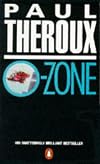
O-Zone
by Paul Theroux
On This Page
Description
On New Year's Eve, eight wealthy New Yorkers fly in their private rotors for a holiday picnic in the forbidden O-Zone, contaminated by nuclear waste. A chance encounter with a band of aliens there will change their lives.Tags
Recommendations


















Member Reviews
When this novel first appeared in 1987, many people in the science fiction community roundly ridiculed it. Here was an author believing that, as a respected Novelist, they had some sort of moral authority over mere peddlers of science fiction and could explore themes of dystopian futures, the perils of nuclear waste, deserted toxic Zones beyond the fortified cities where a privileged caste of Owners live and play whilst the badlands beyond are inhabited by mutant aliens, all served up with lashings of futurespeak and new names for familiar things.
Because this novel has all these things. A group of friends make an excursion by "rotor" into the "O-Zone", visiting deserted cities and thrilling to the threat caused by the "aliens" who are show more probably diseased, most likely mutant, and liable to eat the protagonists' brains (assuming they can find any). Theroux invented new slang for his future, and apparently rediscovered the exclamation mark! His characters all mouth platitudes, except for the sixteen year-old son of two of the friends, who appears to be some sort of genius but gives vent to his opinions about everyone and everything in a Tourette's-like stream of Theroux's invented slang, when he isn't pronouncing his superiority to everyone else. He is apparently some sort of advanced student, majoring in particle physics, though all his discoveries are in made-up words that don't even qualify as technobabble.
Theroux obviously thinks he's being very clever. But his theme is not original, and his vocabulary a source of ridicule. Even science fiction's worst offenders when it comes to future slang don't have their characters spout it in an unceasing stream of drivel. (Later, Theroux introduces a cadre of wannabe space settlers who look forward to colonising Mars or living in an orbital station, He ridicules these people, and has them carry round pulp science fiction novels of a sort that disappeared in the 1950s. This seems to be Theroux satirising science fiction, not realising that what he depicts only shows his ignorance.)
I suspect most of the readers in the science fiction community never made it past the first part of the book, because things get very much worse as the novel progresses. The cities are full of militias who revel in extra-judicial killings of "aliens" (which word apparently is used in the American political sense, as "anyone who is not like us"). Meanwhile, society shows all the signs of decadence in its fashions and mores. We are shown some of the lives of our characters; corporate mendacity is the order of the day, and a holiday in Africa gives an opportunity for characters to indulge in some racial stereotyping. On returning from holiday, one of the characters takes the sixteen year-old back into the O-Zone, ostensibly to carry out some sort of survey, but in truth because the character has become infatuated with a fifteen year-old girl he observed on a surveillance video on the first trip.
Things go awry when the boy is kidnapped by "aliens". He slowly discovers Real Life, though his invective slows to a mere stream and he continues to see himself as some sort of intellectual and moral superior to the "aliens", though he sometimes acknowledges that they do seem to have lives that are not as he expects. Meanwhile, the other character who ventured into the Zone with him has kidnapped the "alien" girl. He proceeds to do nothing other than to subject her to intense grooming, which she nonetheless welcomes. This grooming and the subsequent sex is portrayed as all part of the story; the man expects it as a right and the girl accepts it. Nowhere does Theroux suggest that this is further evidence of the decadence of the city dwellers. Surely this was as illegal in 1987 as it is now.
If this is satire, it doesn't work. All the things that might be considered mockery of the people or the stories of the future falls flat. The society is described in terms that Aldous Huxley used in the 1930s. The militias are shown in the full exercise of their ignorance and hatred, with the support of the legal authorities; perhaps America has moved on since the 1980s, because I feel that readers coming across this book now will just see this as foresight; there is nothing to suggest otherwise. And the grooming and sexual abuse render the book unacceptable now, as it should have been 35 years ago. I cannot recommend this novel to anyone. show less
Because this novel has all these things. A group of friends make an excursion by "rotor" into the "O-Zone", visiting deserted cities and thrilling to the threat caused by the "aliens" who are show more probably diseased, most likely mutant, and liable to eat the protagonists' brains (assuming they can find any). Theroux invented new slang for his future, and apparently rediscovered the exclamation mark! His characters all mouth platitudes, except for the sixteen year-old son of two of the friends, who appears to be some sort of genius but gives vent to his opinions about everyone and everything in a Tourette's-like stream of Theroux's invented slang, when he isn't pronouncing his superiority to everyone else. He is apparently some sort of advanced student, majoring in particle physics, though all his discoveries are in made-up words that don't even qualify as technobabble.
Theroux obviously thinks he's being very clever. But his theme is not original, and his vocabulary a source of ridicule. Even science fiction's worst offenders when it comes to future slang don't have their characters spout it in an unceasing stream of drivel. (Later, Theroux introduces a cadre of wannabe space settlers who look forward to colonising Mars or living in an orbital station, He ridicules these people, and has them carry round pulp science fiction novels of a sort that disappeared in the 1950s. This seems to be Theroux satirising science fiction, not realising that what he depicts only shows his ignorance.)
I suspect most of the readers in the science fiction community never made it past the first part of the book, because things get very much worse as the novel progresses. The cities are full of militias who revel in extra-judicial killings of "aliens" (which word apparently is used in the American political sense, as "anyone who is not like us"). Meanwhile, society shows all the signs of decadence in its fashions and mores. We are shown some of the lives of our characters; corporate mendacity is the order of the day, and a holiday in Africa gives an opportunity for characters to indulge in some racial stereotyping. On returning from holiday, one of the characters takes the sixteen year-old back into the O-Zone, ostensibly to carry out some sort of survey, but in truth because the character has become infatuated with a fifteen year-old girl he observed on a surveillance video on the first trip.
Things go awry when the boy is kidnapped by "aliens". He slowly discovers Real Life, though his invective slows to a mere stream and he continues to see himself as some sort of intellectual and moral superior to the "aliens", though he sometimes acknowledges that they do seem to have lives that are not as he expects. Meanwhile, the other character who ventured into the Zone with him has kidnapped the "alien" girl. He proceeds to do nothing other than to subject her to intense grooming, which she nonetheless welcomes. This grooming and the subsequent sex is portrayed as all part of the story; the man expects it as a right and the girl accepts it. Nowhere does Theroux suggest that this is further evidence of the decadence of the city dwellers. Surely this was as illegal in 1987 as it is now.
If this is satire, it doesn't work. All the things that might be considered mockery of the people or the stories of the future falls flat. The society is described in terms that Aldous Huxley used in the 1930s. The militias are shown in the full exercise of their ignorance and hatred, with the support of the legal authorities; perhaps America has moved on since the 1980s, because I feel that readers coming across this book now will just see this as foresight; there is nothing to suggest otherwise. And the grooming and sexual abuse render the book unacceptable now, as it should have been 35 years ago. I cannot recommend this novel to anyone. show less
Re-reading this - it gets four stars from me, though I'm not sure why. It's actually a better book than a lot of people give it credit for. Paul Theroux - I am pretty sure I would dislike him as a person if we ever me - but that doesn't stop him being a damned good writer a lot of the time (not all the time, it must be admitted) goes into the future with this book. There are little paradoxes and internal contradictions which verge on the cute some of the time, but work at others.
What's especially interesting about a book written in the mid-1980s is the prophetic nature of so much of it. The release of radioactive material creating a desert out of a previously inhabited area sounds horribly familiar to anyone living downwind of Fukushima show more or Chernobyl. But more than that - the polarization of American society into Owners and tax-payers (with ID) and "aliens", who are divided into groups, which are assigned demeaning names: Skells, Roaches, Worms, etc., has already started to come to pass. So has the immense fear that seems to grip developed nations (US, Europe, Japan) as we go through the endless security checks and rituals that are meant to make us safe against "Them".
Overall, the depiction of this nightmare world, which our world of 2011 is rapidly approaching, helps to make up for the deficiencies in characterization, and occasional lapses of style - but then, Theroux is one of those writers who is all the better for the human failings which show though in his work. show less
What's especially interesting about a book written in the mid-1980s is the prophetic nature of so much of it. The release of radioactive material creating a desert out of a previously inhabited area sounds horribly familiar to anyone living downwind of Fukushima show more or Chernobyl. But more than that - the polarization of American society into Owners and tax-payers (with ID) and "aliens", who are divided into groups, which are assigned demeaning names: Skells, Roaches, Worms, etc., has already started to come to pass. So has the immense fear that seems to grip developed nations (US, Europe, Japan) as we go through the endless security checks and rituals that are meant to make us safe against "Them".
Overall, the depiction of this nightmare world, which our world of 2011 is rapidly approaching, helps to make up for the deficiencies in characterization, and occasional lapses of style - but then, Theroux is one of those writers who is all the better for the human failings which show though in his work. show less
My favorite Theroux novel. A dark novel, it's fairly unpredictable unlike some of his others. Has an interesting undertone that makes you keep thinking that just about anything could happen on the next page...
Awesome story with a some of ingredients I love, I.e. post-apocalyptic and anti-elite.
Rich people take a trip to the Ozarks, where leaked nuclear waste has made a closed zone, thought to be uninhabited. It's inhabited, all right, with people that military groups of elite have dumped out of the armed cities. Contact with the"aliens" in the zone changes these freakish elite forever.
Rich people take a trip to the Ozarks, where leaked nuclear waste has made a closed zone, thought to be uninhabited. It's inhabited, all right, with people that military groups of elite have dumped out of the armed cities. Contact with the"aliens" in the zone changes these freakish elite forever.
Ratings
Members
- Recently Added By
Published Reviews
This is a popcorn apocalypse, easy to swallow in large amounts, providing little nourishment, animated by sentimentality rather than sentiment. ''O-Zone'' finally espouses all the virtues of Norman Rockwell: we learn that we ought to love better, that courage can save us, that imaginary fears are worse than real ones, that we all need to be needed, need people to love. Apoplectic rather than show more apocalyptic, ''O-Zone'' tells us what we already know. But it does not tell us this well, or interestingly, or vividly. Mr. Theroux makes none of this new - and his menacing future rattles at us like a badly made plastic skull. show less
added by John_Vaughan
Author Information

113+ Works 32,261 Members
Paul Edward Theroux was born on April 10, 1941 in Medford, Massachusetts and is an acclaimed travel writer. After attending the University of Massachusetts Amherst he joined the Peace Corps and taught in Malawi from 1963 to 1965. He also taught in Uganda at Makerere University and in Singapore at the University of Singapore. Although Theroux has show more also written travel books in general and about various modes of transport, his name is synonymous with the literature of train travel. Theroux's 1975 best-seller, The Great Railway Bazaar, takes the reader through Asia, while his second book about train travel, The Old Patagonian Express (1979), describes his trip from Boston to the tip of South America. His third contribution to the railway travel genre, Riding the Iron Rooster: By Train Through China, won the Thomas Cook Prize for best literary travel book in 1989. His literary output also includes novels, books for children, short stories, articles, and poetry. His novels include Picture Palace (1978), which won the Whitbread Award and The Mosquito Coast (1981), which won the James Tait Black Memorial Prize. Theroux is a fellow of both the British Royal Society of Literature and the Royal Geographic Society. His title Lower River made The New York Times Best Seller List for 2012. Currently his 2015 book, Deep South , is a bestseller. (Bowker Author Biography) Paul Theroux is the distinguished author of numerous award-winning books, including "The Mosquito Coast," "Kowloon Tong," & "Half Moon Street." (Publisher Provided) show less
Common Knowledge
- Original publication date
- 1986
- People/Characters
- Hardy Allbright; Moura Allbright; Fisher Allbright; Hooper Allbright; Barry Eubanks; Rinka Eubanks (show all 10); Willis Murdick; Holly Murdick; Bligh; Mr. Blue
- Important places
- New York, New York, USA
- First words
- The first thing these people always asked, whenever they went out, was where were "they"?
- Quotations
- If you've got nerve gas you don't need clothes!
I'm not a witch, not a whore, not a mother, not a little girl and I despise the word, 'wife.' I'm a woman!
Giving information to a stupid person only made the person stupider and more annoying.
It's usually a mistake to find what you are looking for. - Last words
- (Click to show. Warning: May contain spoilers.)He brought her gently back to the ground, and she thought: In a moment I will know everything.
- Blurbers
- Cheever, Susan
Classifications
Statistics
- Members
- 622
- Popularity
- 46,587
- Reviews
- 4
- Rating
- (3.20)
- Languages
- 6 — English, French, German, Italian, Spanish, Swedish
- Media
- Paper
- ISBNs
- 12
- ASINs
- 18