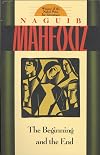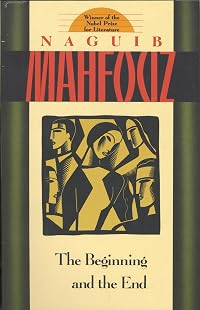
The Beginning and the End
by Naguib Mahfouz, Najīb Maḥfūẓ
On This Page
Description
First published in 1956, this is a powerful portrayal of a middle-class Egyptian family confronted by material, moral, and spiritual problems during World War II.Tags
Recommendations









Member Reviews
Life is futile, happiness is fleeting, and only by sacrificing your own goals and being content with the idea that your sacrifice is contributing to an idealised bigger picture can bring you any semblance of peace. Oh Mahfouz!
It has been a while since I've read his Cairo trilogy but I'm fairly sure it was not as depressing as this. This one is thoughtful for sure, reflective of the slowly changing social structures of the time, and provides different perspectives of how people view and approach a world on the cusp of change. I feel that it would benefit from a sequel due to the ending and selfishly, I really want to find out what becomes of the family.
It has been a while since I've read his Cairo trilogy but I'm fairly sure it was not as depressing as this. This one is thoughtful for sure, reflective of the slowly changing social structures of the time, and provides different perspectives of how people view and approach a world on the cusp of change. I feel that it would benefit from a sequel due to the ending and selfishly, I really want to find out what becomes of the family.
The more Mahfouz I read, the more confounded I become. He has written some works I find absolutely remarkable (such as Children of Gebelaawi) and others that were nearly a waste of time (such as The Harafish. I cannot recall another author whose work I have read who I find so uneven. It doesn’t help that the English translations often are not well done. This particular book was translated by Ramses Awad and, in my estimation, badly needs a new translation. The plot is simple: the father dies and the mother together with her three sons and one daughter are left to carry on as World War Two erupts. Although the story only incidentally involves contemporaneous developments, a knowledge of Egyptian politics in the 1930s (though not show more necessary) enriches the reading. Each of the children is almost impossibly different from the others and each contributes to the family’s descent into poverty and isolation in his or her own way. Awad did, however, contribute an interesting introduction discussing Mahfouz’s development as a writer and I think he describes this work quite well: “a masterpiece of human compassion. So striking is its humanitarianism and sensitivity to human suffering that its tragic vision of life transcends the Egyptian locale and assumes universal significance…. More often than not, critics focus their attention on the social, political, and documentary aspects of Mahfouz’s work, reducing him to a mere producer of sociopolitical commentary. They very regrettably ignore his powerfully tragic vision of life.” (My emphasis.) A book well worth your time. show less
This was a tough read. It begins with the death of the father of an apparently well off family. That is page 1. After his death they struggle to get his pension and make ends meet. But the real thrust is how the characters of the three brothers and one sister are revealed in difficult times and that is what makes it increasingly grim and tough to read. I want to say I did not see the end coming but I began to have feelings of deep dread over Hassenein's anger and contempt for his family and their situation. It was horrible but I did begin to expect it. I have two other books by this author, I'm not totally sure if I will be reading them now.
Story of a Cairo family in the 1930s suddenly plunged into a life of poverty after the unexpected death of their father. Who among this family of mother, three sons and one daughter survives this reversal of fortune and who succumbs, and the effect societal expectations and mores on their fates, makes this a psychological page-turner.
كس أم البشاعة والمعاناة والعبث، حسبي الله ونعم الوكيل..
Ratings
Members
- Recently Added By
Lists

Canon de la narrativa universal del s. XX (cicutadry)
499 works; 3 members
Author Information

330+ Works 19,101 Members
Naguib Mahfouz was born in Cairo, Egypt on December 11, 1911. He received a degree in philosophy from the University of Cairo. He took on several civil service and government department jobs to supplement his income while writing, but retired from that career in 1971. During his lifetime, he wrote more than 30 novels including The Games of Fate, show more The Cairo Trilogy, Children of Gebelawi, The Thief and the Dogs, Autumn Quail, Small Talk on the Nile, and Miramar. He received numerous awards including the Egyptian State Prize, the Presidential Medal from the American University in Cairo, and the Nobel Prize for Literature in 1988. He died as a result of a head injury on August 30, 2006 at the age of 94. (Bowker Author Biography) show less
3+ Works 326 Members
Awards and Honors
Notable Lists
Series
Belongs to Publisher Series
El confident (3)
Common Knowledge
- Canonical title*
- Principio y fin
- Original title
- Bidāyah wa-nihāyah
- Original publication date
- 1949 (original Arabic) (original Arabic); 1985 (English: Awad) (English: Awad)
- Original language*
- Inglés
*Some information comes from Common Knowledge in other languages. Click "Edit" for more information.
Classifications
- Genres
- Fiction and Literature, General Fiction
- DDC/MDS
- 892.736 — Literature & rhetoric Literatures of other languages Afro-Asiatic literatures Arabic (Egypt, Lebanon, Palestine, Saudi Arabia, Sudan) Arabic fiction 1945–2000
- LCC
- PJ7846 .A46 .B513 — Language and Literature Oriental languages and literatures Oriental philology and literature Arabic Arabic literature Individual authors or works
- BISAC
Statistics
- Members
- 324
- Popularity
- 98,126
- Reviews
- 5
- Rating
- (3.93)
- Languages
- 7 — Arabic, Catalan, Dutch, English, German, Italian, Spanish
- Media
- Paper, Ebook
- ISBNs
- 17
- ASINs
- 5