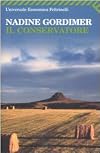
The Conservationist
by Nadine Gordimer
On This Page
Description
Mehring, a wealthy, dominating South African industrialist moves to preserve his way of life, his power, and his possessions in the face of massive injustice and suffering, changing times, and death.Tags
Recommendations









Member Reviews
Fascinating and incisive portrait of an unpleasant person and unnatural landscape. What a tense and uneasy feeling she produces through seemingly lyrical descriptions. I understand this approach is not for everyone, but I also understand why it won prizes.
a rather slow and uneventful novel, the conservationist is able to capture the languid farm life of white south african "farmers" during the apartheid. the protagonist is a chauvinist with enough money to buy 400 acres that he tries to find a life of solitude and enlightenment in. a number of black laborers live on his property to work the land, and it's through their rich (however painful) communal life that you see just how little mehring has going for him—he is constantly sexually harassing or assaulting girls and has an affair with a married woman who can't stand him. mehring is rich enough to possess all the worldly things that are his supposed birthright, as denoted by his whiteness, yet he is severed socially from the rest of show more the world and the farm he clings to for any sense of meaning would function no differently whether he were alive or dead. show less
There were several reasons I was eager to read this book. The first was simply the fact that many people seem to hate it. That made me curious. Partly, it's because I have a bizarre competitive streak that manifests in the strangest ways; partly because I wanted the challenge. I’m a very smart man but the only way I’ll ever get any smarter is through things that challenge me in new ways. So when lots of people say that this book made them feel dumb, well – I had to see what it was all about.
I was also curious to see how my reactions compare to everyone else’s. I’m not a normal reader. I don’t need to like a book in order to appreciate it. I don’t need to enjoy the act of reading in order to find a book rewarding. A perfect show more example of this are The Gormenghast Novels by Mervyn Peake. I’ve read this series half a dozen times – and I can't say that I've ever really enjoyed it. I can’t even tell you whether or not I like the novels – sometimes I do, sometimes I hate them; sometimes I find the text hugely frustrating, and sometimes I sail through it with ease. But no matter what, I know that these are works of unmitigated genius and there is always something in them that I find extremely rewarding. Usually, my satisfaction with them increases those times that I find them most difficult.
If The Conservationist is as challenging as everyone says, then I was curious to see what I could get out of it.
I was also drawn by the fact that everyone seems to hate the main character. When I was in college and still trying to be an actor, all my acting, drama, and playwriting teachers preached the importance of finding the sympathetic aspects of a character. Even if you’re playing a bad guy, you need to find the parts of them that make them relatable. I got so sick of that, though! It started to sound to me like a ridiculous cliché. Why can’t a character be truly unsympathetic? Why can’t you play someone in a way that's completely unrelatable? Wouldn’t it be fascinating to spend time with a character that’s genuinely alien and off-putting?
So of course I was curious to meet the main character of this book!
Unfortunately, I now understand exactly why all my theatre teachers were right. As an actor, the process of creating an unlikable, unsympathetic character may be a fascinating challenge – but as an audience member, it sucks to have to watch. Mehring is thoroughly despicable!
Then again... that’s sort of the point, isn’t it? The purpose of this character isn’t to be a character – it’s to represent the privileged white class of apartheid South Africa. He’s supposed to be completely cut-off from the land and its people. Witnessing his unbelievably inept attempts to change is supposed to frustrate us. The disconnect we feel from Mehring and his worldview is the same cultural disconnect that lay at the heart of apartheid. Almost by definition, even the best intentions of the white upper class had no bearing on the reality of black South Africans and no hope of ever making things better.
I think one of the main problems with this book is that it can’t age well. It’s too deeply rooted in the specific circumstances of its own time to be able to transcend into timelessness.
One of the criticisms I frequently hear applied to the Man Booker Prize is that the selection committee doesn’t care whether or not a book is any good – they only care if it’s challenging and controversial. The Conservationist proves this criticism true. That’s not to say that challenging and controversial aren’t virtues in a work – they very much can be, under the right circumstances. This also isn’t to imply that Nadine Gordimer isn’t a good writer – she’s obviously a fantastically intelligent and skilled wordsmith! Then again, being a good wordsmith isn’t the same as being a good storyteller...
I didn’t like this book at all. Even worse, though – I didn’t find any reward in reading it. It reads to me – a man living in the post-apartheid early 21st century – as nothing more than an intellectual exercise with no real point. show less
I was also curious to see how my reactions compare to everyone else’s. I’m not a normal reader. I don’t need to like a book in order to appreciate it. I don’t need to enjoy the act of reading in order to find a book rewarding. A perfect show more example of this are The Gormenghast Novels by Mervyn Peake. I’ve read this series half a dozen times – and I can't say that I've ever really enjoyed it. I can’t even tell you whether or not I like the novels – sometimes I do, sometimes I hate them; sometimes I find the text hugely frustrating, and sometimes I sail through it with ease. But no matter what, I know that these are works of unmitigated genius and there is always something in them that I find extremely rewarding. Usually, my satisfaction with them increases those times that I find them most difficult.
If The Conservationist is as challenging as everyone says, then I was curious to see what I could get out of it.
I was also drawn by the fact that everyone seems to hate the main character. When I was in college and still trying to be an actor, all my acting, drama, and playwriting teachers preached the importance of finding the sympathetic aspects of a character. Even if you’re playing a bad guy, you need to find the parts of them that make them relatable. I got so sick of that, though! It started to sound to me like a ridiculous cliché. Why can’t a character be truly unsympathetic? Why can’t you play someone in a way that's completely unrelatable? Wouldn’t it be fascinating to spend time with a character that’s genuinely alien and off-putting?
So of course I was curious to meet the main character of this book!
Unfortunately, I now understand exactly why all my theatre teachers were right. As an actor, the process of creating an unlikable, unsympathetic character may be a fascinating challenge – but as an audience member, it sucks to have to watch. Mehring is thoroughly despicable!
Then again... that’s sort of the point, isn’t it? The purpose of this character isn’t to be a character – it’s to represent the privileged white class of apartheid South Africa. He’s supposed to be completely cut-off from the land and its people. Witnessing his unbelievably inept attempts to change is supposed to frustrate us. The disconnect we feel from Mehring and his worldview is the same cultural disconnect that lay at the heart of apartheid. Almost by definition, even the best intentions of the white upper class had no bearing on the reality of black South Africans and no hope of ever making things better.
I think one of the main problems with this book is that it can’t age well. It’s too deeply rooted in the specific circumstances of its own time to be able to transcend into timelessness.
One of the criticisms I frequently hear applied to the Man Booker Prize is that the selection committee doesn’t care whether or not a book is any good – they only care if it’s challenging and controversial. The Conservationist proves this criticism true. That’s not to say that challenging and controversial aren’t virtues in a work – they very much can be, under the right circumstances. This also isn’t to imply that Nadine Gordimer isn’t a good writer – she’s obviously a fantastically intelligent and skilled wordsmith! Then again, being a good wordsmith isn’t the same as being a good storyteller...
I didn’t like this book at all. Even worse, though – I didn’t find any reward in reading it. It reads to me – a man living in the post-apartheid early 21st century – as nothing more than an intellectual exercise with no real point. show less
Good, but short of great. The writing is as expected excellent and captures the feel of the times in South Africa very well. We follow along as our central character, Mehring, loves his getaway farm more and more and his friends and lovers less and less, all watched by the impoverished non-whites that were there before him, and will be after. The end I found a little soft. Mehring is an odd central character, not an active racist but firmly embedded in the apartheid culture, I'm not sure what Gordimer wanted us to feel about him at all, and in fact maybe his purpose was to reflect the times. The title seems to refer not to Mehring's conservation of nature on his farm, which at most he dabbles in, but more in that his acceptance of show more apartheid and apathy/mockery towards any effort to change it end up conserving and promulgating it. show less
Ez a könyv, ahogy én látom, a bizonytalanságról szól. Gordimer megtalálta azt a szövegszintet, ami minden elemével ezt érzékelteti: ezek a széttördelt, egymásba csúszó történetek átragasztják az olvasóra azt az idegenséget, ami a főszereplő talán legjellemzőbb tulajdonsága. Mehring úgy jár-kel afrikanderek, zuluk és indiaiak között, hogy mindegyiktől mintha távolságot akarna tartani. Nem akar rossz ember lenni – de igazából jó se. Csak lenni akar egy olyan országban, ahol önmagunk meghatározásának első lépcsőfoka etnikai hovatartozásunk meghatározása. Ahogy Gordimer bepillantást enged feketék és fehérek és ázsiaiak privát pillanataiba, egyúttal az is világossá válik, show more milyennek látják ezek a csoportok önmagukat, és milyennek látják a többieket – és hogy ezek az elképzelések mennyire távol állnak egymástól. Nem csoda, ha Mehring igyekezete bűzlik a kudarc ígéretétől – még saját fiát sem ismeri eléggé, holott önértékelésének sarkalatos pontja éppen az ő vágyott elismerése. Nehéz, idegen szöveg, nem volt felhőtlen öröm olvasni – talán a legemberibbnek benne még a dél-afrikai táj, a veld leírása tűnik –, de ez a nehézkesség tudatos koncepció. Meg kell vele birkózni, és akkor az ember (talán) egy pillanatra megérti egy érthetetlen ország fájdalmas konfliktusait. show less
The Conservationist is an in-depth character study of Mehring, a South African businessman-cum-farmer. His success in industry provided the means to buy a 400-acre farm, which serves primarily as a tax write-off. In his quest for material success, Mehring has lost his wife and a mistress. His teenage son attends school some distance away, and has become increasingly independent -- estranged, perhaps -- from his father. Mehring mistakenly views interaction with the black laborers on his farm as a meaningful relationship. In reality, the South African class structure ensures their relationship remains distant.
I found Mehring to be a fairly despicable and pathetic character, which I believe was Gordimer's intent. He is a philanderer, at show more one point fondling a young lady he'd never met for the better part of a long-haul flight. Yech. And while at times he seems to appreciate the natural beauty of his farm, he has no one to share it with him. His time spent at the farm is empty, a way to pass the weekend or to hide from social obligations.
This was a difficult book to read because the main character was so unlikeable, and it revolved much more around character than plot. However, Gordimer writes some pretty amazing, descriptive prose that brought the South African scenery to life. Despite my rather lukewarm reaction to this particular novel, I will definitely be reading more of her work. show less
I found Mehring to be a fairly despicable and pathetic character, which I believe was Gordimer's intent. He is a philanderer, at show more one point fondling a young lady he'd never met for the better part of a long-haul flight. Yech. And while at times he seems to appreciate the natural beauty of his farm, he has no one to share it with him. His time spent at the farm is empty, a way to pass the weekend or to hide from social obligations.
This was a difficult book to read because the main character was so unlikeable, and it revolved much more around character than plot. However, Gordimer writes some pretty amazing, descriptive prose that brought the South African scenery to life. Despite my rather lukewarm reaction to this particular novel, I will definitely be reading more of her work. show less
I'm reading all the Booker prize winners this year, and blogging about it at www.methodtohermadness.com
All the Booker books that I have read so far have been well written, of course, but Nobel prizewinner Nadine Gordimer’s The Conservationist (1974) is the first that has made me stop and re-read a beautifully written passage. Take as a brief example this simile that I had to read twice: “…the sound of radio music winds like audible smoke in the clean fine morning: it’s Sunday.” Or the sensory richness of a long passage where our hero Mehring spends New Year’s Eve alone in a field, watching the lightning and fireworks, listening to insects, and smelling his absent son in a borrowed sleeping bag.
Mehring is a wealthy white man show more in South Africa who bought a farm, apparently on a whim, as a place to bring a lover, and now seems to feel alive only there. He becomes more and more withdrawn from his own social group, without ever fitting in with the colored (black or Indian) folks, either. His wife, lover, and son have all left him, but he stubbornly comes out every weekend to supervise his farm, earning him the title epithet.
The drama begins with a body found on Mehring’s land: most likely a black from the “location,” another term for township: a shantytown for blacks, rife with crime and bereft of the most basic amenities. The police find it inconvenient to transport the body, and simply bury it in the vlei (marsh) where it lies. To me, this unidentified victim comes to represent all the blacks of South Africa, how cumbersome and disposable they are to the whites. The locations have become holding pens for the indigenous, like Native American reservations, but more crowded. The whites see them as eyesores, cesspools. Mehring thinks he is a fair man doing the right thing, but we can tell that his more liberal lover and son both reproach him.
**spoiler alert**
Then he takes abominable advantage of a young woman on an airplane, and loses any respect I might have had for him. Symbolically, the country seems to do the same. A flood on a Biblical scale unearths the forgotten body, which must be returned to the earth, properly, in a coffin, and seems to become its new and rightful owner. Also during the flood, Mehring is feared dead, so his hired hands must manage the farm without him – which they do quite well. Finally, Mehring becomes the patsy in a scheme with a seemingly simple lower-class girl, whose race is unclear.
The tables are turned. But is justice served? Several times, Mehring remembers bits of conversation with his liberal lover, who ends up leaving the country – whether in flight or exile is unclear. She seems to think the whole system must be overhauled, whole new countries like Namibia established, while the Conservationist continues to repair, to shore up, to tinker, to distribute gifts and pennies without really changing anything. Will one captain of industry’s receipt of his comeuppance change anything either? It’s not clear.
**end spoiler alert**
I could keep writing: for example, the story is riddled with images of circles, in the form of eggs, rings, and peace signs. And I’m sure someone has written intelligently about this. It’s a deep and delicate novel worth reading, and reading again. show less
All the Booker books that I have read so far have been well written, of course, but Nobel prizewinner Nadine Gordimer’s The Conservationist (1974) is the first that has made me stop and re-read a beautifully written passage. Take as a brief example this simile that I had to read twice: “…the sound of radio music winds like audible smoke in the clean fine morning: it’s Sunday.” Or the sensory richness of a long passage where our hero Mehring spends New Year’s Eve alone in a field, watching the lightning and fireworks, listening to insects, and smelling his absent son in a borrowed sleeping bag.
Mehring is a wealthy white man show more in South Africa who bought a farm, apparently on a whim, as a place to bring a lover, and now seems to feel alive only there. He becomes more and more withdrawn from his own social group, without ever fitting in with the colored (black or Indian) folks, either. His wife, lover, and son have all left him, but he stubbornly comes out every weekend to supervise his farm, earning him the title epithet.
The drama begins with a body found on Mehring’s land: most likely a black from the “location,” another term for township: a shantytown for blacks, rife with crime and bereft of the most basic amenities. The police find it inconvenient to transport the body, and simply bury it in the vlei (marsh) where it lies. To me, this unidentified victim comes to represent all the blacks of South Africa, how cumbersome and disposable they are to the whites. The locations have become holding pens for the indigenous, like Native American reservations, but more crowded. The whites see them as eyesores, cesspools. Mehring thinks he is a fair man doing the right thing, but we can tell that his more liberal lover and son both reproach him.
**spoiler alert**
Then he takes abominable advantage of a young woman on an airplane, and loses any respect I might have had for him. Symbolically, the country seems to do the same. A flood on a Biblical scale unearths the forgotten body, which must be returned to the earth, properly, in a coffin, and seems to become its new and rightful owner. Also during the flood, Mehring is feared dead, so his hired hands must manage the farm without him – which they do quite well. Finally, Mehring becomes the patsy in a scheme with a seemingly simple lower-class girl, whose race is unclear.
The tables are turned. But is justice served? Several times, Mehring remembers bits of conversation with his liberal lover, who ends up leaving the country – whether in flight or exile is unclear. She seems to think the whole system must be overhauled, whole new countries like Namibia established, while the Conservationist continues to repair, to shore up, to tinker, to distribute gifts and pennies without really changing anything. Will one captain of industry’s receipt of his comeuppance change anything either? It’s not clear.
**end spoiler alert**
I could keep writing: for example, the story is riddled with images of circles, in the form of eggs, rings, and peace signs. And I’m sure someone has written intelligently about this. It’s a deep and delicate novel worth reading, and reading again. show less
Members
- Recently Added By
Lists

Booker Prize
491 works; 62 members

Female Author
1,235 works; 65 members

50 Tough Books for Extreme Readers
71 works; 40 members

Most difficult novels
68 works; 27 members
Canon de la narrativa universal del siglo XX
254 works; 6 members

Nobel Price Winners
222 works; 20 members

Elena Ferrante's 40 favourite books by female authors
40 works; 10 members

Man Booker Prize Longlist 1974
5 works; 1 member

Allie's Favourite 150 Books
145 works; 3 members

Booker Prize Shortlist: Titles Not Yet Read
161 works; 4 members

Books Set In Africa
81 works; 4 members
My favourite books
96 works; 3 members

Swinging Seventies
255 works; 18 members

Books Read in 2019
4,052 works; 110 members

Around the World in 80 Books
79 works; 4 members
Author Information

118+ Works 12,475 Members
Nadine Gordimer was born in Gauteng, South Africa on November 20, 1923. She attended the University of Witwatersrand, Johannesburg, South Africa for one year. She is a novelist and short-story writer whose major theme is exile and alienation. Her first short story collection, The Soft Voice of the Serpent, was published in 1952 and her first show more novel, The Lying Days, was published in 1953. Her other short story collections include Jump, Why Haven't You Written: Selected Stories 1950-1972, and Loot. Her other novels include A World of Strangers, A Guest of Honour, Burger's Daughter, July's People, A Sport of Nature, My Son's Story, None to Accompany Me, The Pickup, and Get a Life. She has received numerous awards including the Booker Prize for The Conservationist in 1974, the Nobel Prize for Literature in 1991, and the French Legion of Honour in 2007. She died on July 13, 2014 at the age of 90. (Bowker Author Biography) Nadine Gordimer was awarded the Nobel Prize in Literature in 1991. (Publisher Provided) show less
Awards and Honors
Awards
Series
Belongs to Publisher Series
Work Relationships
Is contained in
Common Knowledge
- Canonical title
- The Conservationist
- Original publication date
- 1974
- People/Characters
- Mehring; Jacobus; De Beer; Terry Mehring; Solomon; Dawood (show all 7); Izak
- Important places
- South Africa
- Epigraph
- I must have been almost crazy
to start out alone like that on my bicycle
pedalling into the tropics carrying
a medicine for which no one had found
the disease and hoping
I would make it in time
I passed thro... (show all)ugh a paper village under glass
where the explorers first found
silence and taught it to speak
where old men where sitting in front
of their houses killing sand without mercy
brothers I shouted to them
tell me who moved the river
where can I find a good place to drown
Richard Shelton,
'The Tattooed Desert'
I pray for corn, that may people may come to this village of yours and make a noise, and glorify you.
...I ask also for children, that this village may have a large population, and that your name may never come to an end.
...once at night he was told to awake and go down to the river and he would find an antelope caught in a Euphorbia tree; and to go and take it.
'So,' said he, 'I awoke. When I had set out, my brother, Umankamane, followed me. He threw a stone and struck an aloe. I was frightened, and ran back to him and chided him, saying, why did you frighten me when I was abo... (show all)ut to lay hold on my antelope?'
...That was the end of it, and he was not again told to be anything to go and fetch the antelope. They went home, there being nothing there.
The Amatongo, they who are beneath. Some natives say, so called, because they have been buried beneath the earth. But we cannot avoid believing that we have an intimation of an old faith in a Hades or Tartarus which has ... (show all)become lost and is no longer understood.
Thus it is with black men: they did not come into being when it was said, 'There are no Amantongo.' They came into being when it was already sayd, 'There are Amantongo.' But we do not know why the man which first came i... (show all)nto being said, 'There are Amantongo.'
...since the white men came and the missionaries, we have heart it said that there is a God.
So we came out possessed of what sufficed us, we thinking that we possessed all tings, that we were wise, that there was nothing we did not know...We saw that, in fact, we black men came out without a single thing: we came... (show all) out naked; we left everything behind, because we came out first. But as for white men...we saw that we came out in a hurry: but they waited for all things, that they might not leave any behind.
...the heaven was hard and it did not rain. The people persecuted him exceedingly. When he was persecuted I saw him and pitied him for I saw men come even by night and smite his doorway with clubs, and take him out of hi... (show all)s house...And on another year, when they saw that the heaven wished to destroy the corn, they hated him exceedingly...I heard it said that it rained excessively that it might cover the dead body of Umkqaekana with earth. I heard it said they poisoned him and did not stab him. I heard it said that those people were troubled, for their gardens were carried away by a flood. - First words
- Pale freckled eggs.
- Last words
- (Click to show. Warning: May contain spoilers.)He took possession of this earth, theirs; one of them.
- Original language
- English
- Canonical DDC/MDS
- 828.9936
Classifications
- Genres
- General Fiction, Fiction and Literature
- DDC/MDS
- 828.9936 — Literature & rhetoric English & Old English literatures English miscellaneous writings English miscellaneous writings 1900- Non-American English language literature outside Britain (option) New Zealand, Australia, India, South Africa South Africa
- LCC
- PR9369.3 .G6 .C65 — Language and Literature English English Literature English literature: Provincial, local, etc.
- BISAC
Statistics
- Members
- 899
- Popularity
- 29,890
- Reviews
- 28
- Rating
- (3.30)
- Languages
- 13 — Danish, Dutch, English, French, German, Greek, Hungarian, Italian, Korean, Norwegian (Bokmål), Portuguese, Spanish, Swedish
- Media
- Paper, Audiobook, Ebook
- ISBNs
- 49
- ASINs
- 8